
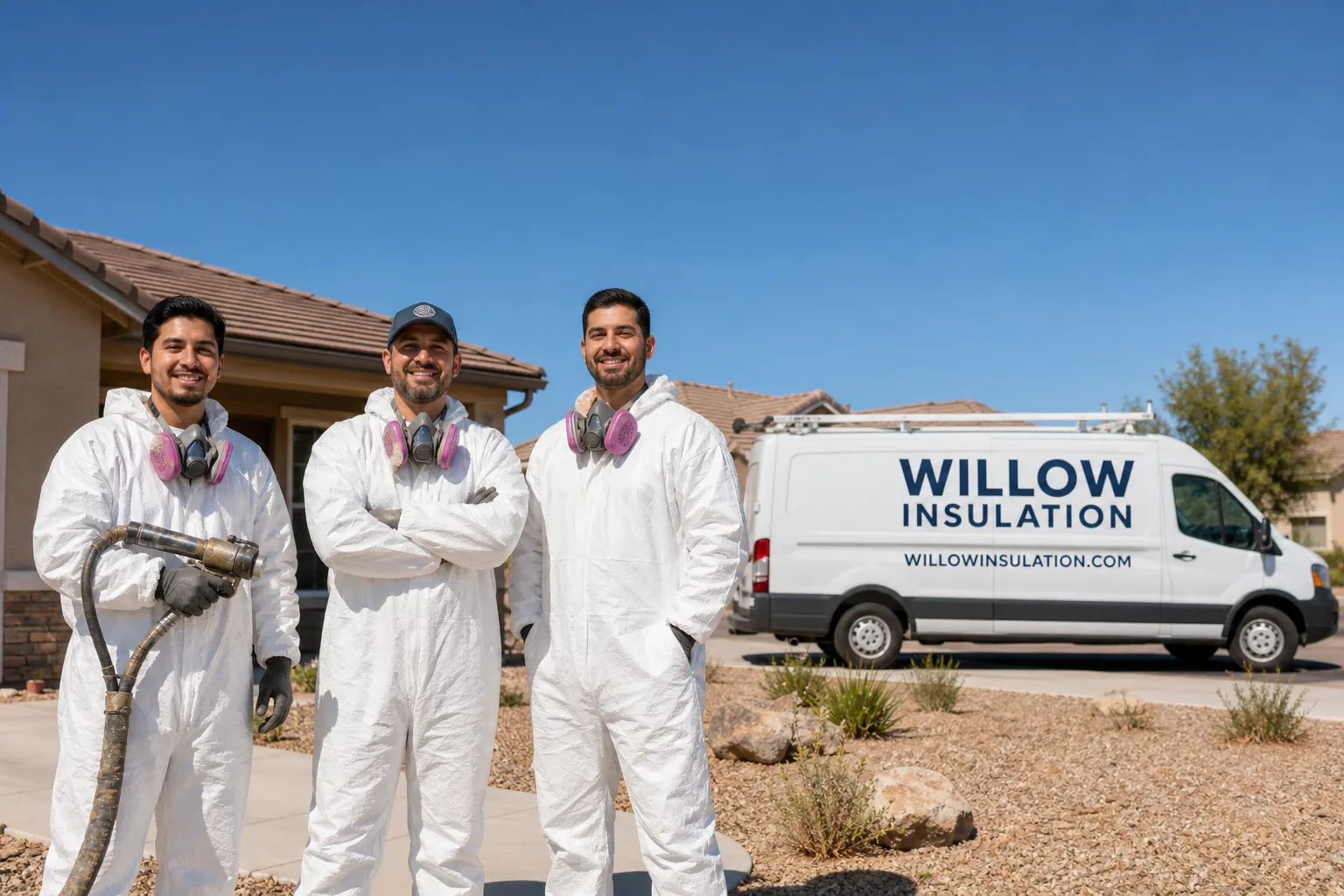
Fast, Reliable Spray Foam Insulation Across Woodcrest
Spray foam insulation in Woodcrest starts differently than in most places. Before any foam goes in, we’re usually pulling out sagged, rodent-tunneled fiberglass batts that have been quietly failing for twenty years. That’s the reality of 92508’s 1980s-to-2000s tract homes, and we’ve seen enough of them to know exactly what’s behind your AC bill spikes and those hot ceilings in August. When you’re ready for a real fix, call Noel Castaneda’s team at (855) 473-6541. We know Woodcrest attics because we’ve been inside hundreds of them.
Why Willow Insulation Is Woodcrest’s Preferred Spray Foam Insulation Company
Woodcrest sits far enough inland that summer heat is relentless, but close enough to Riverside’s commercial core that we can get a crew to your door fast when a heat wave hits. Homeowners here don’t call for insulation upgrades in November. They call in July, when the attic hits 150°F and the bedroom ceiling feels like a radiator. We keep our schedule flexible for exactly that pattern, and we answer the phone with a person who knows Woodcrest streets, not a call center.
Noel Castaneda built Willow Insulation around a simple idea: carry every major insulation material so the recommendation always fits the home, not our warehouse. In Woodcrest, that matters more than most places, because the right answer for a 1990s ranch with rodent-damaged batts isn’t the same as the right answer for a 2005 two-story with an open attic. We install Spray Foam Insulation from Icynene and Demilec, both open-cell and closed-cell, and we pair it with air-sealing work most contractors skip. That’s why Woodcrest homeowners keep calling us back for the next project, and why our review profile here is built on jobs done right the first time.
Spray Foam Attic Insulation in Woodcrest
Spray Foam Attic Insulation in Woodcrest almost always begins with removal, not application. Original paper-faced batts in these 1980s – 2000s tract homes have sagged off the ceiling plane, been tunneled by rats and mice, or both. Spraying foam over that mess just locks the problem in. A proper attic job here means pulling the old material, air-sealing the top plates and eave gaps, then applying closed-cell foam to the underside of the roof deck. That’s the only way to stop the attic from becoming a 150°F oven that bakes your ceiling from above.
A typical spray foam attic job in Woodcrest runs $4,800 – $8,600 depending on square footage and how much rodent-damaged batt needs removal first. For a standard 1,400-square-foot ranch with a pitched roof off Krameria Avenue, expect the lower end. For a larger two-story near Washington Street with a full attic and heavy old batt removal, budget for the higher end.
Hot-Deck Application for Inland Heat
In Woodcrest, the foam needs to go against the hot side: the roof deck. That’s how you stop heat before it enters the attic. Closed-cell Icynene sprayed directly to the deck sheathing cuts the attic temperature dramatically, which means the insulation on your attic floor has less work to do.
Air-Sealing First, Always
Dry-heat cycling in 92508 causes eave and top-plate gaps to open up and leak conditioned air into the attic. If we spray foam without sealing those gaps, your AC bill barely moves. The air-sealing step is where the savings actually come from.
Spray Foam Wall Insulation in Woodcrest
Spray Foam Wall Insulation in Woodcrest homes is a different conversation than attic work, because most of these tract homes were built with thin fiberglass batts in 2×4 exterior walls that lose their effectiveness the moment dry air moves through them. Open-cell foam fills those wall cavities completely, stopping air movement, which is the actual problem. In Woodcrest’s climate, air infiltration through wall penetrations and electrical boxes is a year-round issue, not just when it’s hot.
Wall cavity spray foam in Woodcrest typically runs $2,800 – $5,200 for a full exterior wall retrofit on an average ranch, depending on whether we’re working from the interior drywall side or the exterior sheathing. Homes along areas like Van Buren Boulevard’s older streets, where original construction quality varied, often need more prep work than newer builds near Mockingbird Canyon.
Open-Cell for Interior Walls
For interior partition walls, open-cell foam is the smart material: it stops sound between rooms and adds meaningful thermal performance without the rigidity of closed-cell. Woodcrest homes with bedrooms sharing a wall with the garage benefit immediately.
Closed-Cell Where Moisture Moves
Closed-cell Demilec foam goes where moisture intrusion is possible: rim joists, garage-adjacent walls, and crawlspace band boards. It also adds structural shear strength, which matters in older Woodcrest houses where framing has dried and settled over three decades of heat cycling.
Trusted Brands We Service in Woodcrest
Woodcrest homeowners don’t get steered toward one foam brand because it’s the only one we sell. We install both Icynene and Demilec spray foam, which means open-cell or closed-cell depending on what your attic or walls actually need. For projects where spray foam isn’t the right call, we also carry Owens Corning and Johns Manville fiberglass, plus GreenFiber cellulose. That breadth matters in a place like Woodcrest, where old tract homes often need layered solutions: closed-cell foam on the deck, blown-in cellulose on the attic floor, and fresh batts in the knee walls. We keep common parts and materials stocked for fast turnaround on Woodcrest jobs, so you’re not waiting on a supply run from San Bernardino when the heat is already here.
Common Spray Foam Insulation Problems We See in Woodcrest Homes
- Rodent-tunneled batts. Rats and mice love the original paper-faced fiberglass in 1980s – 2000s tract attics. They tunnel through it, shift it off the ceiling plane, and leave you with effective R-values far below what the label says.
- Sagged batts near the eaves. Woodcrest’s dry heat cycles cause original batts to slump away from the ceiling plane, especially where they’re stapled. Those gaps leak conditioned air straight into the attic all year.
- Failed radiant barriers. Homes built in the 1990s often have foil radiant barriers stapled to the rafters. After fifteen-plus years of 150°F attic heat, they delaminate and stop reflecting anything. Spray foam on the deck replaces this function permanently.
- Unsealed top plates and eave gaps. The most common problem in Woodcrest is also the least visible: gaps where interior walls meet the attic floor. Air pours through them in both directions, and spray foam without air-sealing won’t fix it.
Pricing for Spray Foam Insulation in Woodcrest, CA
For a typical Woodcrest ranch home, attic spray foam with old batt removal and air-sealing runs $4,800 – $8,600. Wall cavity retrofits run $2,800 – $5,200 for full exterior coverage. Rim joist sealing, a smaller but high-impact job, runs $1,400 – $2,300. The wild card in Woodcrest is the condition of what’s already in the attic. If rodents have been active and the batts need full removal, that’s an added line item before foam application. Every quote we give is line-itemed so you can see exactly what’s foam, what’s removal, and what’s air-sealing. Call (855) 473-6541 and we’ll walk your attic with you: free estimate, honest numbers, no pressure.
We Also Serve Cities Near Woodcrest
Willow Insulation works throughout western Riverside County. If you’re in March Air Force Base, Moreno Valley, Riverside, or Mead Valley, our Spray Foam Insulation in Woodcrest crew has likely already been active on your street. Same team, same material breadth, same air-sealing-first approach. Call us and we’ll schedule a visit wherever you are in the 925 corridor.
Serving Woodcrest, CA — Our Local Coverage Area
We’re based in the Woodcrest area and know this community well. Use the map below to see our service coverage — if you’re nearby, we can almost certainly help.
FAQs About Spray Foam Insulation in Woodcrest
Because in Woodcrest’s 1980s – 2000s tract attics, original paper-faced batts have typically sagged and been tunneled by rodents, leaving effective R-values far below code. In our experience, spraying foam over this condition locks in failure. We remove and dispose of the old material, then air-seal before foam goes in. Call (855) 473-6541 for an attic inspection and honest assessment.
Yes. When closed-cell foam is sprayed against the roof deck, the attic stops being a 150°F oven, and your ceilings stop radiating heat into the rooms below. On a ranch-style home off Woodcrest’s older tract streets in 92508, we pulled sagged, rodent-tunneled batts and sprayed Icynene closed-cell foam, and the homeowner’s afternoon hot-ceiling complaint disappeared once the attic stopped acting like an oven.
Yes, but only if the rodent-damaged material comes out first. We remove batts that have been tunneled or contaminated, air-seal the gaps, and then apply foam. Rodent entry points need to be addressed separately, but the insulation job itself is straightforward once the old material is gone. For an exact scope and price, call (855) 473-6541.
No. In Woodcrest, spray foam’s job is summer cooling, not winter warming. Attic temperatures above 150°F in July are the real problem, and foam on the roof deck is the most effective way to cut that heat before it reaches your living space. The fact that it also helps during the occasional cold snap is a bonus, not the reason to install it.
We install Icynene and Demilec spray foam systems. Open-cell Icynene goes in wall cavities and interior partitions where sound control matters; closed-cell Demilec goes on roof decks and rim joists where moisture resistance and structural strength matter. Having both on the truck means the material matches the job, not our inventory. Call (855) 473-6541 to talk through which one fits your Woodcrest home.
Written by Noel Castaneda, Owner at Willow Insulation, serving Woodcrest and western Riverside County since 2008.