
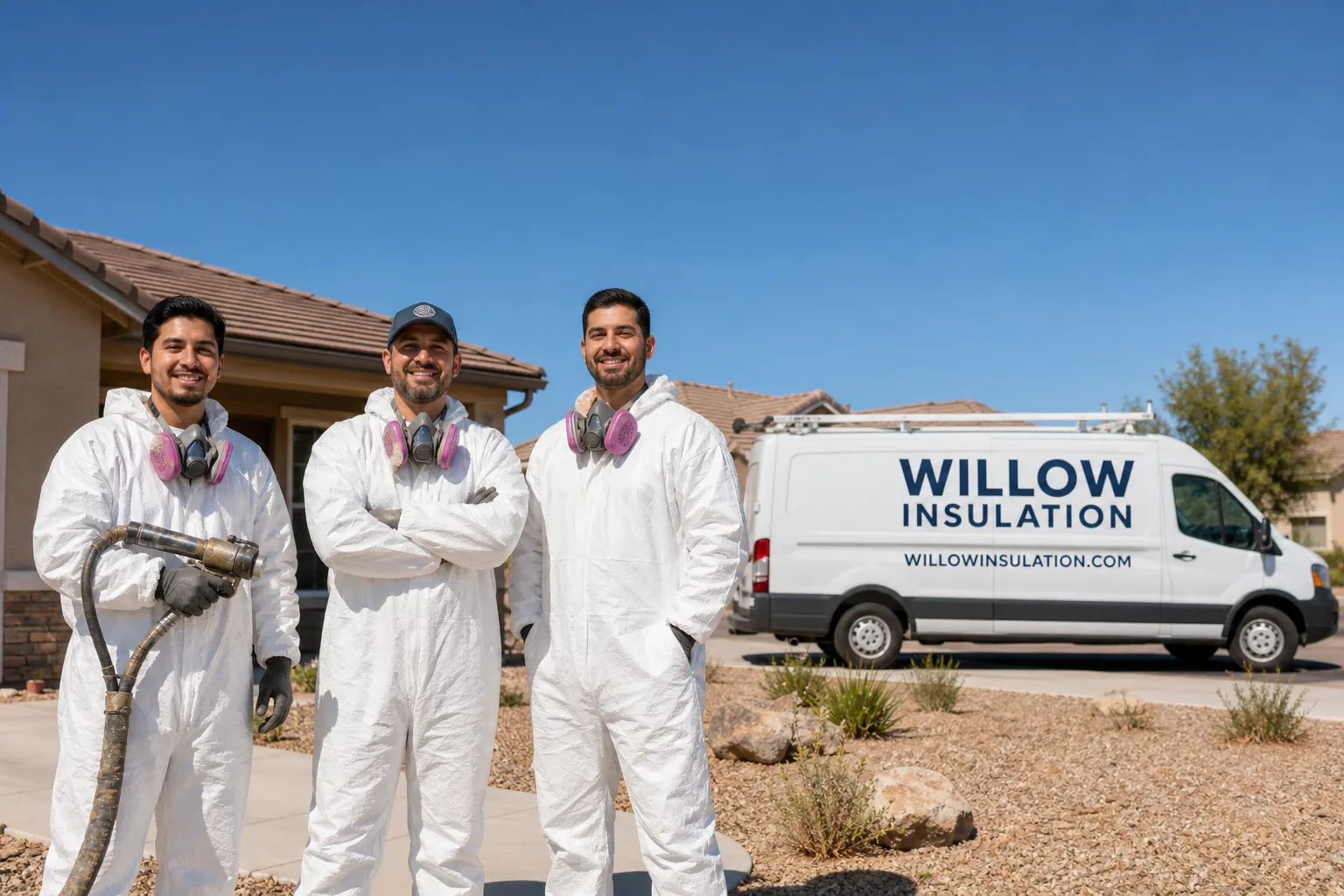
Fast, Reliable Spray Foam Insulation Across Lakeview
Spray foam insulation in Lakeview typically runs $2.50 to $6.50 per square foot installed, with open-cell foam on the lower end and closed-cell on the higher end. Most Lakeview homeowners call us because the AC runs from noon to midnight and the west-facing rooms still feel like a sauna by 5 p.m. We work throughout the 92567 zip code, from the semi-rural lots off Davis Road to the manufactured home communities near Canyon Lake’s north shore. If you’re tired of throwing money at an AC unit that can’t keep up with inland Riverside County heat, call Willow Insulation at (855) 473-6541 and we’ll tell you straight what your home actually needs.
Why Willow Insulation Is Lakeview’s Preferred Spray Foam Insulation Company
We know Lakeview homes in a way a generic insulation contractor from Riverside or Temecula doesn’t. The housing stock here isn’t one thing. It’s a mix of 1970s and 80s tract homes, custom builds on acreage, and a lot of manufactured homes that were never designed for 105°F summers. That mix changes what spray foam should do. A site-built home with a vented attic needs air sealing before foam goes in. A manufactured home needs belly work first. We’ve spent enough time under Lakeview homes to know the difference before we even open the hatch.
Noel Castaneda leads our spray foam crews, and he’s the one who’ll walk you through whether open-cell or closed-cell is the right call for your roof deck or crawlspace. We don’t push one product because it’s what’s in the truck. We carry Icynene and Demilec spray foam systems, plus Rockwool, GreenFiber, Owens Corning, and Knauf products, because some Lakeview jobs genuinely call for a hybrid approach. That’s the difference between a contractor selling you a material and a specialist fitting the material to your house.
Our crews are out in Lakeview every week, not making the occasional trip from Victorville. That means when you call for an estimate, we can usually get someone to your property within a few days, not a few weeks. And if your attic is already at 120°F by late morning in July, we’re not going to make you wait through another heat wave.
Open Cell Spray Foam in Lakeview
Open Cell Spray Foam is the workhorse for Lakeview attics and manufactured home bellies because it expands to fill irregular cavities and delivers an R-value around R-3.5 per inch while also cutting air movement. For a typical Lakeview home, open-cell applied to the roofline or attic floor runs $2.50 to $3.80 per square foot. The real value here isn’t just the R-value. It’s the air sealing. A vented attic in Lakeview can hit 130°F to 140°F in August, and that hot air bleeds into the house through every unsealed top plate, can light, and duct boot. Open-cell foam fills those gaps.
The catch is that open-cell has to be applied correctly in a hot attic. We limit lift thickness and check deck temperature before we spray, because foam applied too thick in one pass on a hot roof deck traps heat and can blister or off-gas. That’s a failure pattern we see from rushed installs, and it’s why we don’t rush.
Belly Insulation for Manufactured Homes
Manufactured homes around Canyon Lake’s outskirts often have thin original belly and ceiling insulation that sagged off the joists years ago. The AC runs constantly but the floors still feel hot and the ducts buried under the home leak cold air into the crawlspace. Open-cell foam sprayed into the belly cavity locks the insulation in place and seals around duct boots and plumbing penetrations.
Attic Ceiling Plane Application
When you spray the ceiling plane of an attic, you’re bringing the attic inside the conditioned envelope of the house. That matters in Lakeview because the attic is the hottest part of the home by a wide margin. We see ducts sitting in 140°F attics all summer, losing cooling before it ever reaches the bedrooms. Foaming the roofline drops that attic temperature dramatically and stops the duct loss at the source.
Spray Foam Insulation Contractors in Lakeview
Spray Foam Insulation Contractors serving Lakeview need to understand two things most Riverside County companies get wrong: manufactured home belly construction and inland attic heat loads above 120°F in summer. That’s the job. We inspect the existing insulation before recommending anything. We check what’s in the attic, what’s under the belly, and whether the top plates and can lights are sealed. Then we tell you what you need, even if the answer is “you need air sealing and a foam lift on the attic floor” rather than a full roofline spray. Closed-cell foam runs $4.50 to $6.50 per square foot and makes sense for specific applications like rim joists and garage ceilings, but open-cell is usually the right value call for a Lakeview attic.
Off Canyon Lake Drive in Lakeview, we opened the belly of a 1980s manufactured home and found the original thin insulation sagging off the joists after years of 100°F+ attic and underfloor heat. We sealed the duct boots and applied open-cell spray foam to the belly cavity and ceiling plane, which stopped the AC from running nonstop by late afternoon. The homeowner noticed the difference the same week: the west-facing rooms finally held temperature through the 5 p.m. peak. That’s the kind of job we do regularly in this area, because that home represents half of Lakeview’s housing stock.
Rim Joist and Band Board Sealing
Older Lakeview homes on raised foundations leak air through the rim joists where the floor meets the foundation wall. Closed-cell foam seals those bays tight and adds structural rigidity. For a typical Lakeview slab or raised foundation home, rim joist sealing runs $300 to $800 depending on linear footage and access.
Garage Ceiling and Bonus Room Applications
If a garage ceiling sits under a hot attic and the room above it never cools down, spray foam on the garage ceiling plane breaks the thermal bridge. We see this a lot in Lakeview homes with converted garages or bonus rooms over the garage. The cost depends on square footage, but a standard two-car garage ceiling typically lands between $1,800 and $3,200.
Trusted Brands We Service in Lakeview
We install Icynene and Demilec spray foam systems, which means we can offer both open-cell and closed-cell from manufacturers with strong technical support and third-party testing. For Lakeview customers who need a hybrid approach, like GreenFiber blown-in cellulose over a foamed attic floor or Owens Corning batts in a garage wall, we stock those materials too. We don’t steer you toward whatever’s in the warehouse. We stock multiple brands so the recommendation is driven by what your home actually needs. If you’re in the 92567 zip code and want to know whether Rockwool, cellulose, or spray foam is the right material for a specific wall or cavity, call us and we’ll explain the trade-offs in plain English.
Common Spray Foam Insulation Problems We See in Lakeview Homes
- Open-cell foam applied too thick in one pass. On a hot attic roof deck, a thick single lift traps heat and can blister or off-gas before it cures. We limit lift thickness and check deck temperature before spraying, which is a step a lot of rushed crews skip.
- Sagging belly insulation on manufactured homes. The original fiberglass under the floor of a 1980s mobile home is almost always sagging or gone by now. Ducts buried in that space leak cold air into the crawlspace and the AC can’t keep up. Spray foam in the belly cavity fixes insulation and air sealing at the same time.
- Unsealed top plates and can lights in vented attics. Foam alone won’t stop hot attic air from bleeding into a Lakeview home if the top plates and light penetrations aren’t sealed first. We seal those before any foam goes in, because foam over a leaky top plate just hides the problem.
- AC ducts cooking in 130°F+ attics. Inland Riverside County attics get hot enough to bake the insulation off ductwork. Foaming the ceiling plane drops that attic temperature by 30 to 40 degrees and keeps the cool air you paid for inside the ducts until it reaches the register.
Pricing for Spray Foam Insulation in Lakeview, CA
Open-cell spray foam in Lakeview runs $2.50 to $3.80 per square foot of applied area. Closed-cell spray foam runs $4.50 to $6.50 per square foot. A typical 1,200-square-foot attic roofline foamed with open-cell lands between $3,000 and $4,800 before any utility rebates. A manufactured home belly and ceiling plane job usually falls between $2,400 and $4,200 depending on access and the condition of the ductwork. What moves the number: how much old insulation has to come out, how many air leaks need sealing first, and whether the attic is walkable. We give you a written line-item estimate before we start, so you know exactly what you’re paying for. Call (855) 473-6541 and we’ll schedule a walkthrough. Estimates are free.
We Also Serve Cities Near Lakeview
Our crews work across the San Jacinto Valley and the Inland Empire, so if you’re in Lakeview or just across the line in Nuevo, Romoland, Good Hope, or Perris, we can get to you fast. We’re based in Victorville, but we’re in the Lakeview area every week. If you’re nearby and wondering whether spray foam is the right fix, call us. For more on how we approach insulation projects, see our Spray Foam Insulation service page.
Serving Lakeview, CA — Our Local Coverage Area
We’re based in the Lakeview area and know this community well. Use the map below to see our service coverage — if you’re nearby, we can almost certainly help.
FAQs About Spray Foam Insulation in Lakeview
Spray foam usually makes more sense for a manufactured home in Lakeview, because the real problem in these homes is usually the belly and the ductwork, not just the attic floor. The thin original belly insulation on homes around Canyon Lake’s outskirts sags and absorbs moisture after a few summers of inland heat, and the ducts buried under the floor leak cold air into the crawlspace. Foaming the belly cavity and ceiling plane seals those leaks and holds insulation in place, which batts alone can’t do. Call (855) 473-6541 and we’ll inspect your belly and attic before recommending anything.
A vented attic in Lakeview routinely hits 130°F to 140°F from June through September, and yes, that temperature changes how spray foam has to be applied. On a hot roof deck, foam applied too thick in one pass traps heat and can blister or off-gas before it cures. We check deck temperature before we spray and limit lift thickness on hot days. That’s not a corner we cut, because a blistered foam lift means tearing it out and starting over.
Yes, spray foam is the most effective material for sealing the hot attic air that forces your AC to run nonstop on a Lakeview summer afternoon. The main leaks are unsealed top plates, can lights, and duct boots, all of which open-cell foam fills and seals in one pass. When we foam a ceiling plane, the attic temperature drops sharply and the AC stops fighting 140°F air. Call (855) 473-6541 for a free attic inspection and we’ll show you exactly where the hot air is getting in.
Open-cell foam is softer, expands more, costs less, and does a better job of air sealing odd-shaped cavities, which is why it’s the right call for most Lakeview attics and manufactured home bellies. Closed-cell foam is denser, adds structural strength, and acts as a vapor barrier, which makes it the better choice for rim joists, garage ceilings, and anywhere moisture is a concern. In Lakeview’s dry inland climate, open-cell is usually the right value, but we’ll recommend closed-cell where the application calls for it.
Yes, we inspect the existing insulation before we recommend anything. A lot of the 1970s and 80s homes in Lakeview have settled fiberglass batts that have compressed to a fraction of their original R-value, and manufactured homes often have belly batts that are completely gone. The condition of that old insulation changes the recommendation. Sometimes the fix is foaming over the top. Sometimes the old stuff has to come out first. We’ll tell you what we found and what it means before we quote a price. Call (855) 473-6541 to schedule a walkthrough.
Written by Noel Castaneda, Owner at Willow Insulation, serving Lakeview and the Inland Empire since 2019.