
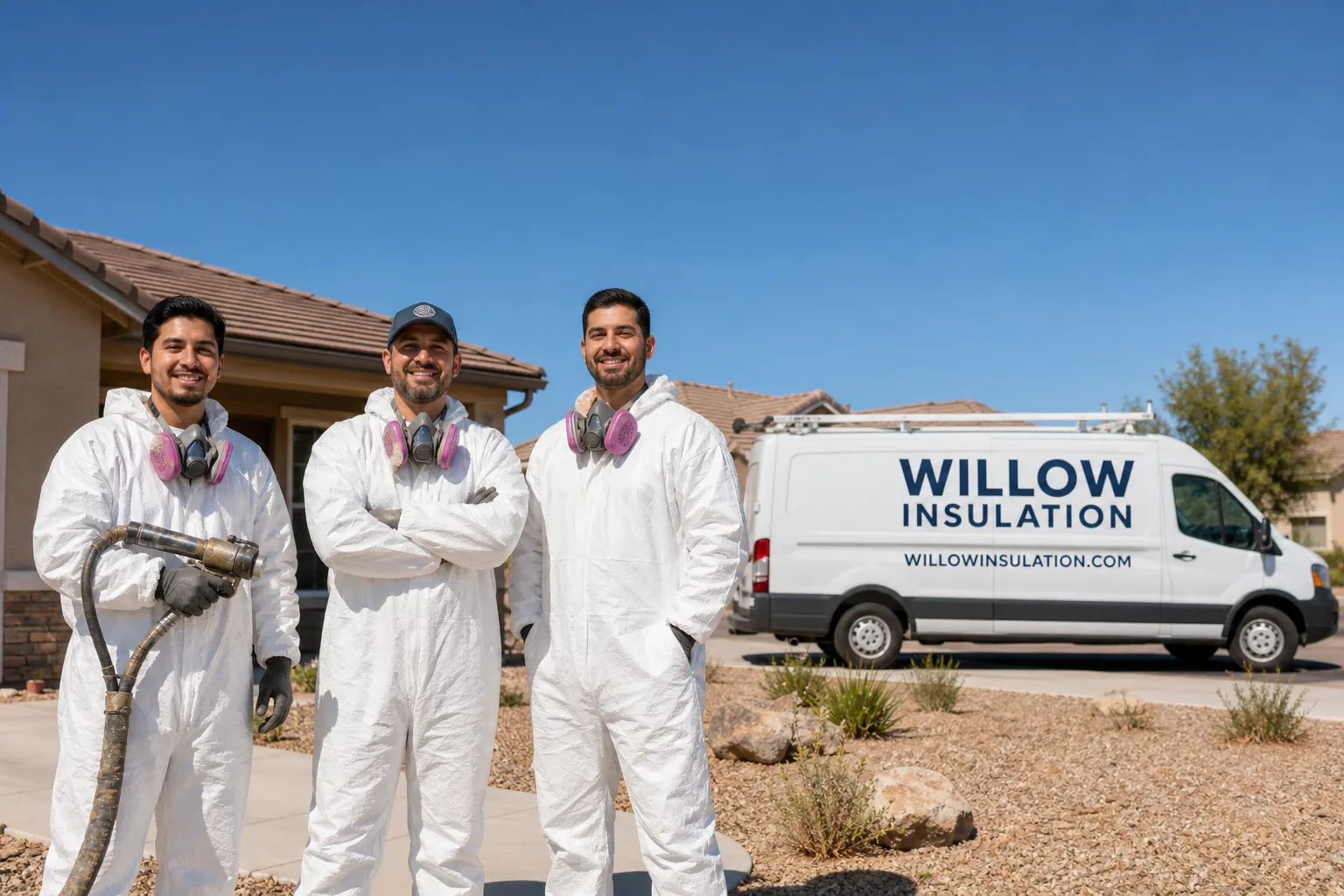
Fast, Reliable Spray Foam Insulation Across Good Hope
Spray foam insulation in Good Hope runs $1.50 to $4.50 per board foot installed, with most whole-home or major-area projects landing between $3,000 and $7,500 depending on the space and foam type. If you live off State Street or along the rural lots west of Highway 74, you’re dealing with attic temperatures that climb past 140°F in July and August, which means standard insulation approaches simply don’t hold up the way they do closer to the coast. We’re Willow Insulation, led by Noel Castaneda, and we install both Icynene and Demilec spray foam systems across Good Hope’s older manufactured homes, pier-and-beam crawls, and garages. Call (855) 473-6541 and we’ll schedule a free assessment.
Why Willow Insulation Is Good Hope’s Preferred Spray Foam Insulation Company
Good Hope is a small, unincorporated community, and our crews know the difference between a home on a graded ranch lot and one tucked into a tighter parcel near the San Jacinto River wash. That local familiarity matters, because the homes here weren’t built with modern insulation in mind. Many of them are manufactured or older stick-built with original thin attic batting, which means the work isn’t a simple swap. It’s an upgrade from a thermal shell that was never adequate for inland Riverside County summers.
Noel Castaneda built Willow Insulation around a simple principle: the right insulation for your home, not our warehouse. That means we carry Owens Corning, Rockwool, GreenFiber, and both Icynene and Demilec spray foam, so the recommendation is driven by your roof pitch, your crawl space condition, your budget, and the way your home actually breathes in 100°F dry heat. We don’t steer Good Hope homeowners toward one foam product because it’s what’s on the truck. We stock specific materials because this particular housing stock demands them.
Response time to Good Hope from our Victorville base is typically same-week for assessment and within two weeks for installation, depending on project scope. We inspect attics, crawl spaces, belly boards, and skirting before quoting anything, because a spray foam estimate without knowing what’s under the floorboards isn’t worth the paper it’s written on.
Key Takeaways
- Good Hope’s extreme attic heat (140°F+) means spray foam must be applied early morning or with heat-resistant formulations to cure and bond correctly.
- Manufactured homes in Good Hope often have belly boards and skirting as the primary thermal weak point, not the attic.
- We install both Icynene and Demilec systems, so open-cell and closed-cell options are both genuinely available here.
- Free assessments and honest material recommendations across Good Hope, including ZIP 92572 neighborhoods.
Crawl Space Spray Foam Insulation in Good Hope
Crawl Space Spray Foam Insulation in Good Hope is the single most cost-effective upgrade we perform for manufactured and pier-and-beam homes in this community, because the open underside of the home is where the desert heat does its worst work. In a standard Good Hope manufactured home, the attic can be 140°F while the crawl space is 120°F with hot air moving through gaps in the skirting and belly board. Closed-cell foam applied directly to the underside seals those pathways and stops the floor from radiating heat into the living space. A typical crawl space spray foam job in Good Hope runs $2,800 to $5,500 for a 1,200 to 1,800 square foot home, depending on access clearance and the condition of existing underpinning materials.
Sealing the Belly Board and Skirting
We recently sprayed closed-cell foam in the crawl space of a manufactured home on a rural lot off State Street in Good Hope. The belly board was sagging and the skirting had gaps, so we applied Icynene closed-cell foam directly to the underside and sealed the skirting with rigid foam board. That stopped the floor from radiating heat into the living space and closed the air highway that had been pulling 110°F air under the home all afternoon. If your skirting is cracked, loose, or missing sections, no amount of attic work will fix the problem.
Surface Prep Before Foam
This is where most generic spray foam contractors fail in Good Hope. Dusty pier-and-beam crawl spaces are common here, because the soil is dry and fine. Foam applied to a dirty, dusty surface will not bond, leaving air pockets that let hot desert air infiltrate. We clean, dry, and where needed apply a bonding primer to the underside before spraying. This step alone is the difference between foam that lasts 20 years and foam that peels off in two.
Garage Spray Foam Insulation in Good Hope
Garage Spray Foam Insulation in Good Hope is a targeted job that fixes two specific local conditions: garages that become furnaces by mid-morning and garages that leak dust into the house. In Good Hope, garages are often attached to the home but built with uninsulated walls and a roof deck that turns the whole space into a heat sink by noon. We spray closed-cell Demilec foam to the garage ceiling and wall cavities, which drops interior garage temperatures 20 to 30°F and blocks the dust and fine particulate common to this dry corridor from working its way through the shared wall into your living space. A typical attached garage ceiling and shared wall in Good Hope runs $1,800 to $3,200.
Garage Roof Deck Sealing
The roof deck above a Good Hope garage is usually just plywood and shingles, no thermal barrier at all. We spray foam directly to the underside of the deck, which creates an air seal and a radiant barrier in one pass. For homes where the garage is used as a workshop or for storage of temperature-sensitive items, this is the highest-value dollar you’ll spend.
Dust Infiltration Through Shared Walls
Good Hope sits in a dry, dusty inland corridor. The shared wall between an attached garage and the house is a common entry point for dust, insects, and hot air. Spray foam expands into every crack and seam, sealing the wall cavity in a way fiberglass batts physically cannot. If you can see daylight or feel air moving around the edges of the garage entry door, that’s a leak path we close.
Trusted Brands We Service in Good Hope
We carry Icynene and Demilec spray foam systems, which matters because open-cell and closed-cell foams are genuinely different materials for genuinely different jobs. Icynene open-cell is softer, breathes, and works well for interior walls and sound control. Demilec closed-cell is denser, structural, and acts as its own vapor barrier, which is what we reach for in Good Hope crawl spaces and manufactured home undersides. We also stock GreenFiber cellulose and Owens Corning fiberglass for Good Hope homes where blown-in or batt insulation is the smarter play. That’s the whole point: we’re not married to one product line. You’re never steered toward the wrong material for the job.
Common Spray Foam Insulation Problems We See in Good Hope Homes
- Foam that failed to bond in dusty crawl spaces. The dry, fine soil under Good Hope’s pier-and-beam homes leaves a coating of dust on joists and subflooring. Foam sprayed over that dust lifts off and leaves air pockets that let hot air back in. We clean and prep every surface before spraying.
- Belly board foam that cracked when the home shifted. Manufactured homes move. If the foam is applied over a loose or damaged belly board, that movement transfers into the foam and creates thermal breaks. We inspect and repair the belly board first, then apply foam that can flex with the home.
- Attic foam that cured too fast and off-gassed. Spray foam applied to a 140°F attic roof deck cures too quickly. It loses adhesion and can trap off-gassing without ventilation. We schedule Good Hope attic jobs for early morning or use a heat-resistant Demilec formulation rated for high-temperature application.
- Garage ceiling foam that pulled away from the deck. The same heat problem applies in garages. A good-looking foam job that was sprayed at 2 p.m. in August may be delaminating by October. We plan Good Hope installs around the heat, not around our schedule.
Pricing for Spray Foam Insulation in Good Hope, CA
Here’s what we actually charge in Good Hope. Open-cell spray foam runs $1.50 to $2.50 per board foot. Closed-cell runs $2.50 to $4.50 per board foot. A crawl space in a manufactured home typically lands between $2,800 and $5,500. A garage ceiling and shared wall runs $1,800 to $3,200. Attic roof deck spraying runs $4,000 to $8,000 depending on square footage and roof pitch. Not every job needs closed-cell, and we’ll tell you if open-cell or even blown-in GreenFiber is the better value for your home. Call (855) 473-6541 for an exact quote. Estimates are free and we don’t quote work we haven’t seen.
We Also Serve Cities Near Good Hope
Our crews cover the entire inland corridor around Good Hope, including Good Hope itself as well as Perris, Romoland, Mead Valley, and March Air Force Base. If you’re in any of these nearby communities and need Spray Foam Insulation work done right, call (855) 473-6541 and we’ll schedule a site visit.
Serving Good Hope, CA — Our Local Coverage Area
We’re based in the Good Hope area and know this community well. Use the map below to see our service coverage — if you’re nearby, we can almost certainly help.
FAQs About Spray Foam Insulation in Good Hope
Spray foam outperforms fiberglass and blown-in cellulose in Good Hope because it air-seals, not just slows heat transfer. In a place where attics hit 140°F and floors radiate heat up from crawl spaces, an air seal is the difference between an AC unit that cycles off and one that runs all afternoon. Spray foam also maintains its R-value at high temperatures better than most traditional batts, which effectively lose performance as the heat climbs.
Yes, and we do it regularly. Closed-cell foam applied to the underside of a manufactured home creates both insulation and an air barrier. The key is proper prep: the belly board must be intact or repaired first, the surface must be clean, and the foam must be rated for the high crawl space temperatures common in Good Hope. We use a Demilec closed-cell formulation for this work. Call (855) 473-6541 for a free crawl space assessment.
Early morning, before the attic roof deck climbs past 100°F. In Good Hope, we start attic spray jobs at first light from May through September. This ensures proper adhesion and prevents rapid curing that can trap off-gassing. If an early start isn’t possible, we switch to a heat-resistant Demilec formula designed for high-temperature application.
Spray foam doesn’t settle, period. That’s the structural advantage. Older Good Hope homes often have blown-in insulation that’s settled to half its rated depth, which leaves large thermal gaps at the top of the attic. Spray foam fills every cavity and stays exactly where it’s applied for the life of the building. You can’t overstate how much that matters in a 140°F attic.
Yes, and for Good Hope specifically, closed-cell foam on the garage ceiling and shared wall is one of the most effective heat and dust controls we install. It drops garage temperatures 20 to 30°F and seals the wall cavity so the dust that blows through this dry corridor stays out of your house. It’s a specific solution to a specific Good Hope problem.
Written by Noel Castaneda, Owner at Willow Insulation, serving Good Hope and the surrounding Riverside County communities.