
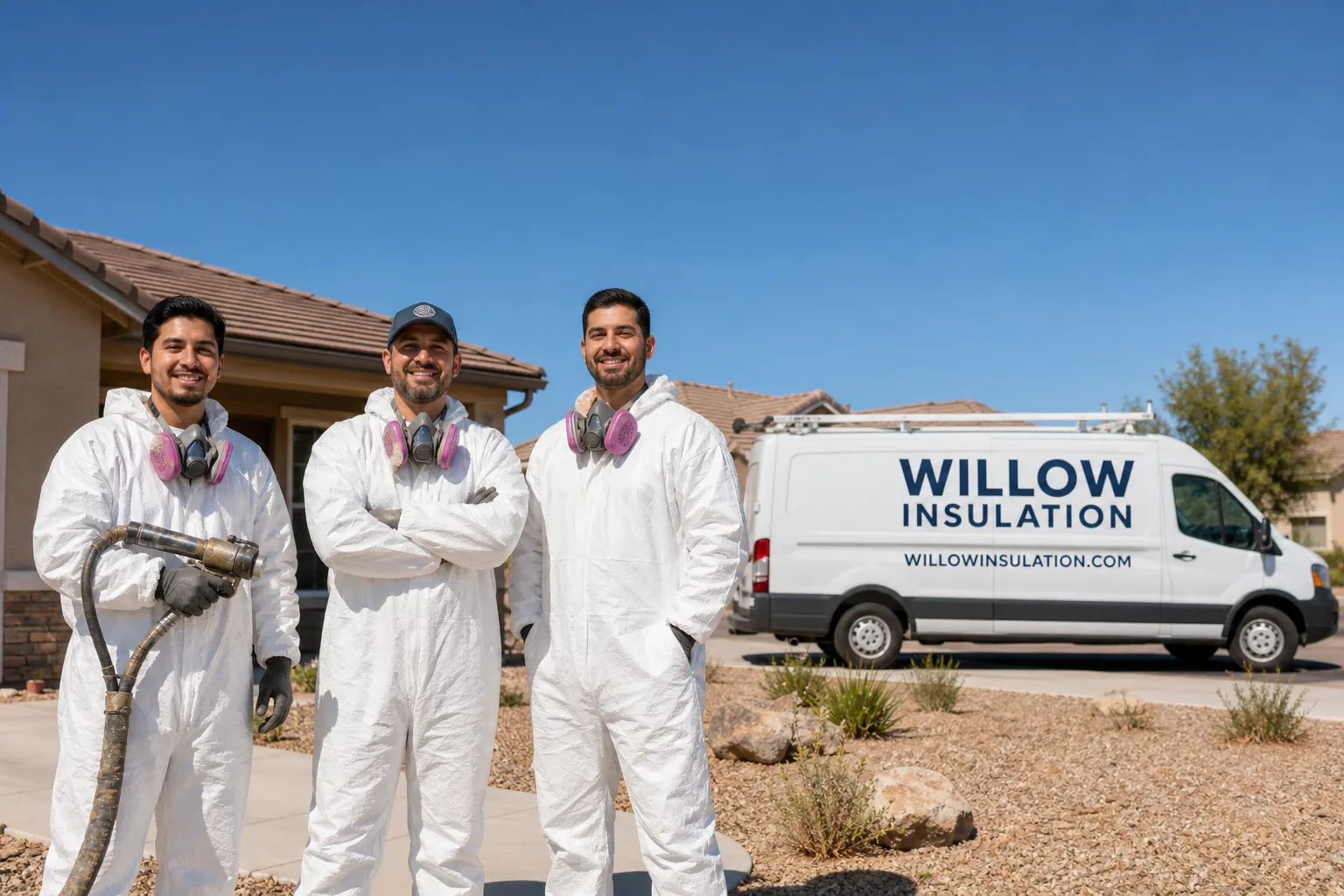
Fast, Reliable Attic Insulation Across El Cerrito Corona
Attic insulation in El Cerrito Corona is less about winter warmth and more about surviving the inland foothill summer. Most homes in the 92881 tract were built from the 1980s through the 2000s with builder-grade batts that have spent decades baking under sustained Riverside County heat. We know this housing stock well, and we know what it takes to fix it. If your upstairs rooms spike past 85 degrees by mid-afternoon or your AC runs nonstop from June through September, the attic is usually the culprit. Call Willow Insulation at (855) 473-6541 and we’ll send a specialist who understands El Cerrito Corona’s specific heat profile, not a crew that treats every attic the same.
Why Willow Insulation Is El Cerrito Corona’s Preferred Attic Insulation Company
Homeowners across El Cerrito Corona call us because we show up knowing what their house will throw at us. The vaulted ceilings, the attached garages with baked attic access hatches, the ductwork running through unconditioned space at 140 degrees in August. None of it surprises us. Led by Noel Castaneda, our crew has worked the foothill-edge tracts long enough to predict what we’ll find before we climb the ladder.
We’re material-agnostic, which matters more in El Cerrito Corona than almost anywhere else. A flat-ceiling tract home in the valleys can take standard blown-in fiberglass and call it done. Your home might need a cathedral-ceiling assembly with Rockwool tight to the deck and a radiant barrier beneath it. We carry eight manufacturer brands, so we’ll never steer you toward whatever happens to be on the truck.
When you call, you’ll get a straight answer on timing. Most El Cerrito Corona assessments happen within a few business days, and we’ll give you a written scope and price before any work starts. No one on our team will push a product that doesn’t fit your roof geometry or your cooling-season pain.
Attic Ventilation in El Cerrito Corona
Attic Ventilation in El Cerrito Corona is the missing piece in a lot of retrofit conversations. In a foothill climate with long dry summers, an under-ventilated attic can sit at 130 to 150 degrees for hours every afternoon. That heat radiates downward through the ceiling drywall, forces your ductwork to deliver air that’s already warmed, and shortens the life of your AC equipment. Proper ventilation means balanced intake at the soffits or eaves and exhaust at the ridge or gable ends, sized to the attic’s square footage and roof pitch.
Ridge and Soffit Systems for Foothill Heat
Homes in the 92881 area with vaulted or cathedralized sections often have limited attic volume, which makes trapped heat worse, not better. A ridge vent paired with adequate soffit intake gives that heat a continuous exit path. We see a lot of El Cerrito Corona roofs where the original builder installed ridge vents but starved them for intake, which effectively does nothing. The fix is straightforward once it’s measured correctly.
When Ventilation Alone Isn’t Enough
If your attic floor insulation is compressed and baked out, adding ventilation helps, but it won’t restore lost R-value. Ventilation addresses heat rejection. Insulation addresses heat transfer through the ceiling. In most El Cerrito Corona retrofits, you need both done in the right order. A typical attic ventilation upgrade in this market runs $900 to $2,200 depending on roof complexity and existing framing.
Radiant Barrier in El Cerrito Corona
Radiant Barrier in El Cerrito Corona is one of the highest-impact upgrades for homes that face direct afternoon sun with minimal attic depth to work with. A radiant barrier is a reflective foil layer installed on the underside of the roof rafters. It reflects radiant heat back toward the roof deck instead of letting it saturate the attic air. In El Cerrito Corona’s cooling-dominant climate, a properly installed radiant barrier can drop attic temperatures by 20 to 30 degrees on peak summer afternoons.
Foil Under the Deck for Sun-Exposed Roofs
West- and south-facing roof planes in the foothill tracts take the worst of the inland sun. We install perforated foil laminates directly to the rafter undersides, keeping the reflective surface facing the roof deck with a small air gap for performance. This works especially well in homes where the attic is shallow and adding more blown-in insulation isn’t practical.
Pairing Radiant Barrier with Cathedral Ceilings
For El Cerrito Corona homes with vaulted great rooms and no accessible attic, radiant barrier works differently. It gets installed as part of the roof assembly during a cathedral-ceiling retrofit, often layered between the insulation and the interior finish. We were called out to a semi-custom home in the 92881 foothill tract where the vaulted great-room ceiling ran directly against the roof deck, leaving no flat attic to blow into and a second-story bonus room that baked through August afternoons. Our tech specified a cathedral-ceiling approach, with a rigid Rockwool layer tight to the deck and a radiant barrier beneath the finished ceiling, then added ridge-and-soffit ventilation to purge the trapped heat. The bonus room came off its afternoon heat spike and the AC stopped short-cycling through the worst of the inland summer. Radiant barrier work in this market typically runs $1.50 to $2.75 per square foot of roof surface, with cathedral applications landing at the higher end.
Trusted Brands We Service in El Cerrito Corona
We install across a broad portfolio, and that breadth matters here because El Cerrito Corona homes demand different materials for different roof geometries. Owens Corning fiberglass batts cover the standard flat-attic retrofits. GreenFiber cellulose works for blown-in top-ups where access is good. For cathedral ceilings and fire-rated assemblies, Rockwool mineral wool is the right call. And when a full building envelope or tight space calls for spray foam, we run both Icynene open-cell and Demilec closed-cell systems. We never stock one brand and force it onto every job. Call (855) 473-6541 and we’ll match the material to your roofline, your budget, and your cooling load.
Common Attic Insulation Problems We See in El Cerrito Corona Homes
- Sun-baked builder batts in 1980s-2000s tract homes. The original fiberglass batts in many El Cerrito Corona attics have been through 30-plus inland summers. Heat doesn’t just age them; it compresses them, and compressed fiberglass loses a big share of its rated R-value. What looks like R-30 insulation is often performing closer to R-19 or worse.
- Vaulted ceilings with no attic to insulate. A standard blow-in job has nowhere to go when the ceiling drywall is nailed directly to the roof rafters. We see this constantly in semi-custom and two-story El Cerrito Corona homes. Forcing insulation into those cavities without careful planning leaves voids at the deck and wasted material.
- Radiant heat gain overwhelming passive ventilation. Long dry cooling seasons mean the roof deck absorbs heat all afternoon and radiates it into whatever attic space exists. If your attic has no active ventilation or insufficient soffit intake, the AC system fights heat from above while trying to cool the rooms below.
- Ductwork baking in unconditioned attics. Many El Cerrito Corona HVAC ducts run through attic space that regularly hits 130-plus degrees. Even with decent ceiling insulation, the cool air traveling through those ducts picks up heat before it reaches the registers. Air-sealing and insulating the attic floor, or moving the thermal boundary to the roofline, fixes the root cause.
Pricing for Attic Insulation in El Cerrito Corona, CA
Attic insulation projects in El Cerrito Corona run a wide span because the housing stock varies so much. A straightforward blown-in top-up over an accessible flat attic runs $1,200 to $2,800 for a typical 1,500 to 2,200 square foot home. Full attic insulation replacement with air sealing runs $3,000 to $6,500 depending on attic depth and access. Cathedral-ceiling retrofits with Rockwool, ventilation, and radiant barrier are the most involved jobs here, typically $7,000 to $14,000 for a great room or vaulted section. What drives cost in El Cerrito Corona specifically is roof geometry: more vaulted area means more labor and more careful detailing. We give free written estimates with no pressure. Call (855) 473-6541 for a number that reflects your actual attic, not a national average.
We Also Serve Cities Near El Cerrito Corona
Willow Insulation covers the broader foothill and valley corridor beyond El Cerrito Corona. We work regularly in Corona, Home Gardens, Eastvale, and Norco, carrying the same material-agnostic approach and the same brand portfolio into every job. If you’re in a nearby ZIP and dealing with vaulted ceilings, sun-baked insulation, or under-ventilated attic space, our El Cerrito Corona team can help. For details on our full range of services, see our Attic Insulation page.
Serving El Cerrito Corona, CA — Our Local Coverage Area
We’re based in the El Cerrito Corona area and know this community well. Use the map below to see our service coverage — if you’re nearby, we can almost certainly help.
FAQs About Attic Insulation in El Cerrito Corona
Yes, and this is one of the most common jobs we take on in the 92881 foothill tracts. When there’s no accessible attic, we insulate at the roof deck instead of the ceiling plane, using rigid Rockwool or closed-cell spray foam tight to the deck with a radiant barrier layered in. It’s a more involved job than a standard blow-in, but it’s the only way to actually stop heat transfer through a vaulted ceiling. Call (855) 473-6541 and we’ll assess your roofline and give you a real plan with a real price.
Because El Cerrito Corona sits in the inland foothill transition zone where summer heat spikes well above coastal-basin averages and the cooling season runs long and dry. Attic temperatures here routinely exceed 130 degrees for hours daily. That means your insulation’s main job is rejecting radiant heat and reducing AC load, not just holding warmth in. Coastal neighborhoods need insulation for winter; you need it to survive August.
Most El Cerrito Corona homes need a combination. Insulation slows heat moving through the ceiling. Ventilation exhausts heat already inside the attic. A radiant barrier reflects heat before it enters the attic air at all. Skipping any one of these leaves a gap in the system. We’ll measure your attic temperatures, check your existing R-value, and recommend the right sequence for your roof orientation and framing. Call us for a free assessment at (855) 473-6541.
Sometimes. If the existing batts are dry, evenly installed, and not compressed, we can air-seal the attic floor and blow fresh insulation right over them. But in El Cerrito Corona, decades of heat often compress fiberglass to the point where it’s performing far below its label. In those cases, removing the old material and starting clean is the better investment. We’ll show you what’s actually in your attic before recommending anything.
We carry eight manufacturer brands across four material categories: fiberglass, mineral wool, spray foam, and cellulose. That includes Owens Corning and CertainTeed fiberglass, Rockwool mineral wool, Icynene and Demilec spray foam, and GreenFiber cellulose. The range exists so we can match the material to your specific roof geometry and heat problem, not the other way around. Call (855) 473-6541 and we’ll walk you through what fits your home.
Written by Noel Castaneda, Owner at Willow Insulation, serving El Cerrito Corona and the surrounding foothill communities.