
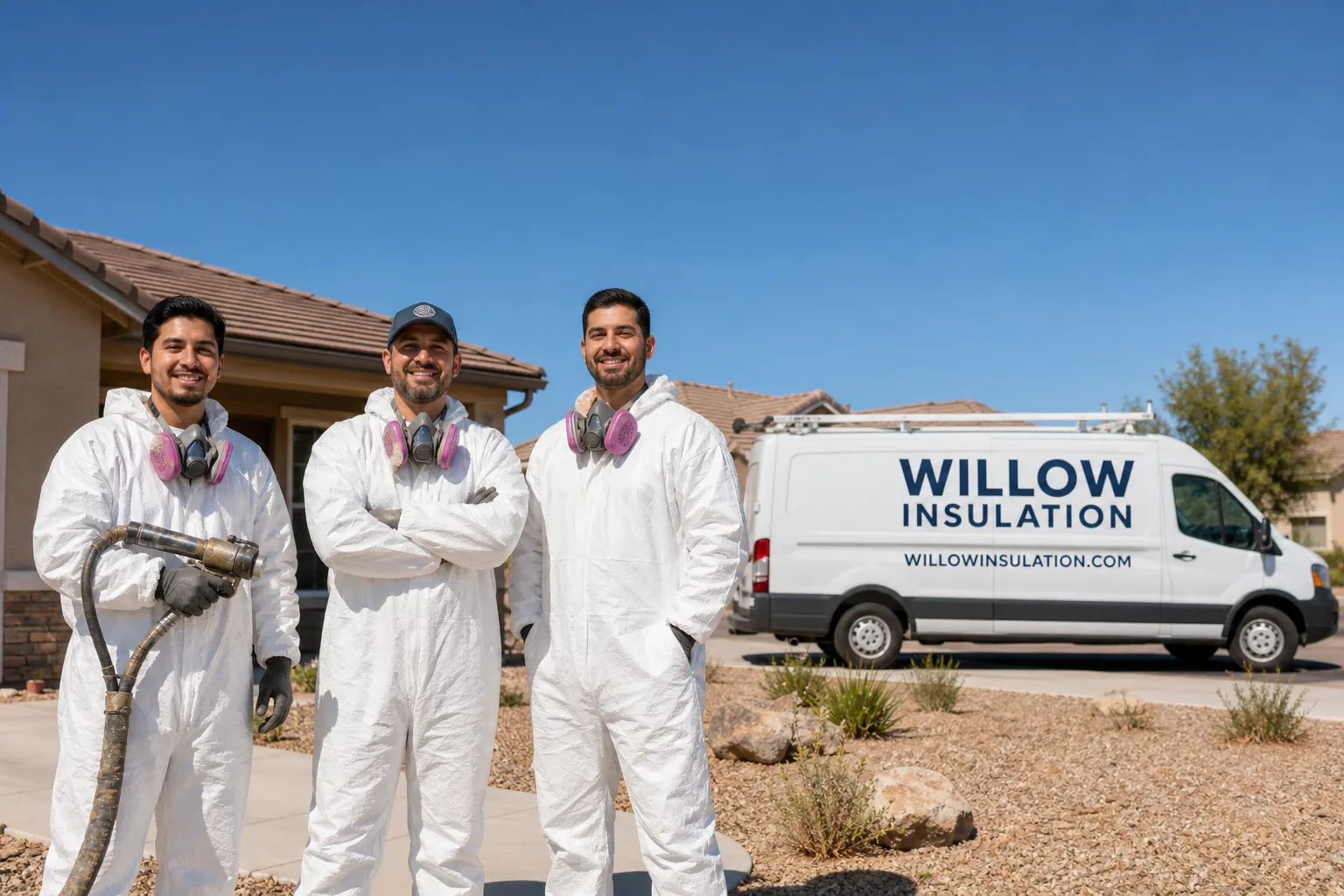
Fast, Reliable Spray Foam Insulation Across Walnut
Spray foam insulation in Walnut typically runs $2.80 to $6.50 per board foot installed, with most full wall-cavity or rim-joist jobs landing between $1,800 and $7,200 depending on scope. We know Walnut’s housing better than most crews because we’re in these attics and crawlspaces every week. If you live off Amar Road, Lemon Avenue, or up in the 91789 hills, call (855) 473-6541 and we’ll get a specialist out to look at your specific house, not a generic checklist.
Why Willow Insulation Is Walnut’s Preferred Spray Foam Insulation Company
Noel Castaneda built Willow Insulation around a simple working principle: the material follows the house, never the other way around. That matters in Walnut because the tract homes here, the 1960s through 1980s wood-frame stucco houses with low-slope tile roofs, punish generic insulation decisions. We carry Spray Foam Insulation systems from Icynene and Demilec, which means we can spec open-cell where the house needs breathability and closed-cell where it needs structural rigidity and vapor control. One broad portfolio, no pressure to push a single product line.
Homeowners across Walnut call us because we understand the failure patterns that show up in this specific housing stock. Original kraft-faced batts crack and sag. Attic temperatures spike past 140°F in July. Detached workshops on the larger lots sit unconditioned for years, then someone wants them turned into a home office or a gym, and the walls are open studs with zero insulation. We’ve seen all of it, repeatedly, and we know what fixes it without wasting a trip.
Walnut homeowners regularly tell us the same thing: the estimate was honest, the crew showed up when they said they would, and the foam cured properly even in the summer heat. We don’t rush the cure window to squeeze in another job. A spray foam application that’s sprayed too thin or over a degraded surface in a 140°F attic won’t bond, and then you’re paying twice.
Spray Foam Wall Insulation in Walnut
Spray Foam Wall Insulation in Walnut is the highest-value fix for the tract homes here, because the original wall batts in many 1960s and 1970s houses on streets like La Puente Road and Grand Avenue have settled into compressed, useless mats at the bottom of the wall cavities. Closed-cell foam, typically 2 to 3 inches, fills those cavities completely, seals the wall against air leakage, and adds to the structural strength of the framing. Homeowners tackling a remodel or opening walls for rewiring get the best opportunity; the foam goes in while the studs are exposed, and you close up once instead of having us come back later.
Open-cell for Interior Walls
Interior wall cavities and ceilings where you want sound control, think a home theater room or a bedroom next to a busy hallway, often call for open-cell foam. It’s softer, more forgiving, and does a better job of killing airborne sound transmission at a lower cost per board foot. At about $2.80 to $4.20 per board foot in Walnut, open-cell makes sense for interior partitions where structural strength isn’t the goal.
Closed-cell for Exterior and Unconditioned Walls
Closed-cell is the workhorse for exterior walls, garage ceilings, and any surface that could see moisture or temperature swing. It runs $4.00 to $6.50 per board foot in Walnut, and we use Demilec and Icynene closed-cell systems for the vapor-control and R-value-per-inch performance Walnut’s hot-dry summers demand. A 2×4 wall filled with closed-cell foam outperforms a 2×6 wall stuffed with fiberglass batts, and it seals the air leaks batts can’t.
Rim Joist Spray Foam in Walnut
Rim Joist Spray Foam in Walnut homes is the single most cost-effective air-sealing upgrade available to this era of construction. In a 1970s stucco tract home off Lemon Avenue, the rim joist, that horizontal band where the floor framing meets the foundation wall, is typically uninsulated or holding a scrap of fiberglass that the original builder stuffed in and forgot. Open-cell or closed-cell foam sprayed into those cavities stops the stack effect that pulls hot attic air down through the walls in summer and lets conditioned air escape all year. A full rim joist treatment in Walnut typically runs $1,100 to $2,600 depending on the home’s footprint and access.
Closed-cell for Rim Joists
We specify closed-cell for rim joists in Walnut almost without exception. The rim sits close to grade, where soil moisture and termite activity concentrate, and closed-cell foam’s rigidity and moisture resistance protect the framing better than open-cell. Two inches of closed-cell at the rim joist also stops the air leakage that makes a Walnut living room feel drafty in January, even when the windows are closed.
Access and Crawlspace Work
Some Walnut homes on slabs leave the rim joist accessible only from inside the garage or through a tight crawlspace hatch. Our crew works in that confined space carefully, prepping the surface so the foam bonds cleanly. We’ve done enough Walnut rim joists to know where the plumbing chases and electrical runs hide in these tract layouts, which speeds the work without cutting corners.
Trusted Brands We Service in Walnut
Willow Insulation installs spray foam systems from Icynene and Demilec, and we keep a full inventory of both open-cell and closed-cell kits on hand for Walnut jobs. That means when we open a wall on a tract home off Grand Avenue or start a rim joist seal in a 91788 house, we aren’t waiting on a parts order. We also carry GreenFiber cellulose and Owens Corning fiberglass for hybrid applications, like when a homeowner wants closed-cell foam on the walls but a blown-in cellulose upgrade on the attic floor. The right material for the job, not the one we happen to have the most of. That’s the point.
Common Spray Foam Insulation Problems We See in Walnut Homes
- Foam sprayed over failed kraft-faced batts. In older tract homes off Amar and Lemon, the original paper facing on R-11 attic batts dries out and cracks in the inland heat, letting the batts sag away from the roof deck. Spraying foam directly over that degraded surface means the foam has nothing solid to bond to. We remove and replace the old material first, then spray a clean, prepared surface.
- Thin or rushed applications in hot attics. Walnut attics routinely exceed 140°F in July and August. Foam sprayed too thin or without the proper cure window in that heat can shrink, crack, or form voids you won’t see until the next utility bill. We match foam depth and cure time to the actual attic heat load here, not a generic Los Angeles-area spec.
- Detached workshops left out of the scope. Larger Walnut lots often include a detached garage or workshop that shares a wall with the main house or sits right next to it. When that outbuilding is left unconditioned and uninsulated, it drags down the performance of the whole property. We regularly treat those workshops with closed-cell spray foam to make them usable, conditioned spaces.
- Open studs in half-finished garage conversions. We see a lot of Walnut homeowners who started a garage conversion, got the framing open, and then stalled. If the studs are exposed, that’s the moment to spray. Foaming closed walls later means cutting drywall, patching, and repainting. Catching it while it’s open saves real money.
Pricing for Spray Foam Insulation in Walnut, CA
Open-cell spray foam in Walnut runs $2.80 to $4.20 per board foot, and closed-cell runs $4.00 to $6.50 per board foot. A typical rim joist job lands between $1,100 and $2,600. Full wall-cavity work on a single room starts around $1,800 and climbs with square footage and access difficulty. What moves the number in Walnut: whether the old kraft-faced batts need removal first, whether the surface is a clean open stud or a wall that needs drilling and filling, and whether we’re working in a 140°F attic that requires a slower, more careful application. Call (855) 473-6541 for a free estimate, and we’ll give you a real number based on your house, not a phone-screen guess.
We Also Serve Cities Near Walnut
Willow Insulation runs crews to South San Jose Hills, Rowland Heights, West Covina, and Pomona every week. If you’re in a neighboring city with the same 1960s-to-1980s tract housing and the same inland heat, we can bring the same material-agnostic approach and the same one-trip discipline. Same phone: (855) 473-6541.
Serving Walnut, CA — Our Local Coverage Area
We’re based in the Walnut area and know this community well. Use the map below to see our service coverage — if you’re nearby, we can almost certainly help.
FAQs About Spray Foam Insulation in Walnut
No. In Walnut’s 1960s through 1980s tract homes, the original kraft paper facing on R-11 batts has usually dried out, cracked, and let the insulation sag off the roof deck. Spray foam applied over that degraded surface won’t bond and won’t perform. We remove the failed batts and prep the surface first, then spray. That’s a removal-and-replace job, not a top-off. Call (855) 473-6541 if you’re not sure what’s in your attic right now.
Spray foam is primarily a summer product in Walnut. Attic temperatures here climb past 140°F in July and August, and closed-cell foam on the roofline or rim joist blocks that radiant heat from driving into your living space. Winter heat loss matters too, but in this climate, the cooling-load and attic-heat performance is the main reason to spray. We spec foam depth for the actual heat load, not a generic spec.
Yes, and those outbuildings are often the best candidates for spray foam. On the larger Walnut lots, detached workshops and oversized garages usually have open stud walls and no insulation at all. Closed-cell foam fills the cavities, seals the air leaks, and makes the space genuinely usable year-round. We recently sprayed the walls and sealed the rim joist in a workshop off Amar Road while the framing was open, and the homeowner closed up his shop the same day.
We access the rim joist from the crawlspace or the garage interior, remove whatever scrap of fiberglass is sitting there from the original build, and spray two inches of closed-cell foam into each joist bay. This stops the air movement that pulls hot attic air into the walls during a Walnut summer. For a 1970s stucco tract home, the access is usually tight but straightforward, and our crew has done enough of them to move quickly without damaging the stucco or the sill plate.
Most Walnut spray foam jobs get done in one visit, as long as the surface is accessible and the scope is clear. Wall cavities with open studs, rim joists in an exposed crawlspace, and open attic decks are all one-trip work. The exceptions are jobs where old kraft-faced batts need removal and surface prep first, or where access requires cutting drywall. We’ll tell you before we start whether your job is a one-trip or needs a prep pass. Call (855) 473-6541 and we’ll schedule an assessment.
Written by Noel Castaneda, Owner at Willow Insulation, serving Walnut and the eastern San Gabriel Valley.