
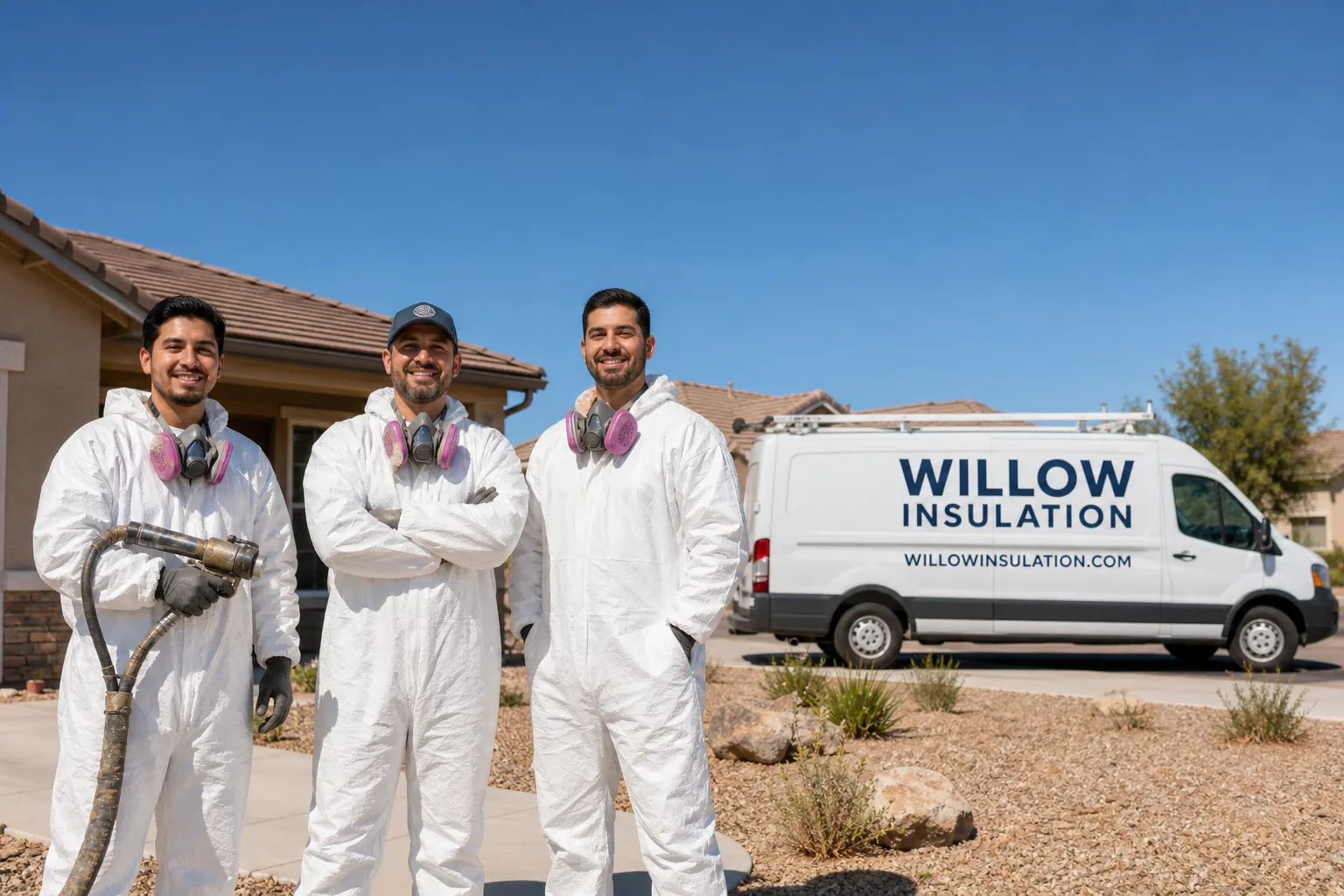
Fast, Reliable Spray Foam Insulation Across Hacienda Heights
For hillside homes off Hacienda Boulevard and the 1960s tracts that climb toward the Puente Hills, spray foam insulation in Hacienda Heights works hardest during the afternoon heat. We install both open-cell and closed-cell foam, and we know this area’s vaulted ceilings and tight attic clearances well enough to plan the job around them, not just spray and hope. Whether you’re off Tetley Street or up near Kwis Avenue, we’re close enough to schedule quickly and show up with the right rig for your roofline. Call (855) 473-6541 for a free estimate on sealing your house properly.
Key Takeaways
- Spray foam in Hacienda Heights is judged on cooling season performance first – attic temperatures here outpace coastal LA every summer afternoon.
- Hillside ranch homes with vaulted or exposed-beam ceilings usually need foam applied to the roof deck, not the attic floor.
- We carry both Icynene and Demilec foam systems, so open-cell and closed-cell recommendations are driven by your roofline, not our inventory.
- Typical spray foam attic work in the 91745 ZIP runs $2,800 to $6,400 depending on square footage and cavity depth.
Why Willow Insulation Is Hacienda Heights’s Preferred Spray Foam Insulation Company
Our Spray Foam Insulation team has worked enough hillside homes in this community to know what the 1960s builders left behind. Many of the ranch houses north of Valley Boulevard still carry original R-7 to R-11 attic batts, and the vaulted ceilings that look great in the living room make conventional attic-floor insulation nearly useless. We plan foam placement around those frames. Homeowners here tell us the same thing: the upstairs is unbearable by 4 p.m. from June through September, and the AC never shuts off. That’s the problem we solve.
Noel Castaneda runs our spray foam crews, and his approach keeps both the venting and the envelope in mind. A tight house with blocked soffits is a moisture problem waiting to happen, and that failure mode shows up here more than anywhere else we work. We also get called out after other contractors foam a low-clearance attic floor and leave the homeowner with a hotter attic and a musty smell in the drywall. Fixing that mistake takes more time than doing it right the first time.
Spray Foam Insulation Contractors in Hacienda Heights
Spray Foam Insulation Contractors in Hacienda Heights are dealing with a housing stock that doesn’t respond well to generic attic treatment. The job here usually starts with mapping the roofline: flat-ceiling tract homes can take foam on the attic floor, but vaulted and exposed-beam ceilings push the foam up to the roof deck. That’s a different install with different venting requirements, and it’s why we send an experienced lead on every hillside house, not just a two-person crew with a hose.
Roof Deck Application for Vaulted Ceilings
In homes where there’s no usable attic floor above the living space, we spray closed-cell foam directly to the underside of the roof sheathing. That seals the cavity and brings the thermal boundary to the roofline. We add baffles at every soffit vent before spraying so the intake air keeps moving behind the foam.
Attic Floor Application for Standard Ceilings
For the flatter tract homes across Hacienda Heights, open-cell foam on the attic floor usually makes more sense on cost and performance. We seal the top plates and any duct penetrations first, then spray to the depth your ceiling framing allows. Prices in this area typically run $2,800 to $6,400 for full attic work, with roof deck applications trending higher because of the prep and ladder time.
Spray Foam Attic Insulation in Hacienda Heights
Spray Foam Attic Insulation in Hacienda Heights has to contend with July and August afternoons when attic temperatures climb well past 130 degrees. That heat radiates down through the ceiling drywall and overloads the air handler, which is why foam’s air-sealing matters as much as its R-value here. An older ranch home with original batts and unsealed duct boots is leaking conditioned air into a hot attic, and foam addresses both sides of that problem at once.
Duct Sealing With Every Attic Job
Before we spray, we walk the attic and check every supply boot, return plenum, and top plate. Hacienda Heights ranch homes from the 60s and 70s are notorious for leaky duct connections, and foam’s airtight envelope is wasted if the ducts are blowing cooled air into the insulation itself. We seal those paths as a matter of course, then spray over them.
Closed-Cell for Low-Clearance Hillside Rooms
When clearance is tight, closed-cell gives you more insulative performance per inch than open-cell or batts. Two inches of Icynene closed-cell on a vaulted roof deck does more for an upstairs bedroom than six inches of old fiberglass ever could. It also stiffens the roof assembly, which matters on the older hillside frames off Hacienda Boulevard.
Trusted Brands We Service in Hacienda Heights
We carry Icynene and Demilec foam systems on our trucks serving Hacienda Heights, which gives us both open-cell and closed-cell options for every roofline we encounter. The material-agnostic approach isn’t a marketing line for us. Some hours, an open-cell Demilec fill is the right call for a standard tract attic; other days, a hillside vaulted ceiling needs the structural and thermal punch of closed-cell Icynene. We also stock Owens Corning and GreenFiber for hybrid jobs where one part of the house needs blown-in coverage and another needs foam. Having all of it on hand means we never steer a Hacienda Heights homeowner toward a material just because it’s what’s left on the truck.
Common Spray Foam Insulation Problems We See in Hacienda Heights Homes
- Blocked soffit vents on hillside houses. Low-clearance vaulted ceilings leave very little room for air to move, and a crew that sprays the attic floor without baffles will trap heat and moisture under the roof deck. We see this most often on the hillside streets east of Hacienda Boulevard, and it’s the first thing we inspect when called in to repair an earlier foam job.
- Under-thickness foam on sun-baked west-facing roofs. Intense afternoon sun on unshaded ranch roofs makes thin foam underperform and can leave a lingering odor during initial cure. We spec foam depth for the Hacienda Heights sun load, not a code minimum that assumes a milder coastal climate.
- Duct leakage defeating the air seal. A 1970s tract home with original sheet-metal ducts and fiberglass boots will lose a large share of its cooled air before it reaches the register. Foam on the attic floor doesn’t fix that by itself. We seal duct boots, returns, and top plates as part of every spray job in the 91745 ZIP.
- Foam applied to the wrong plane on exposed-beam ceilings. When the living room ceiling is the roofline, foam on the attic floor is doing nothing for that room. We’ve fixed a number of Hacienda Heights homes where a previous contractor sprayed the flat attic section and left the vaulted family room uninsulated because they didn’t know how to handle it.
Why Hacienda Heights’ Vaulted Hillside Ranches Need a Different Approach
Hacienda Heights sits east of the Puente Hills in the warm inland valley, where summer highs regularly run ten to fifteen degrees above what the coast sees. That means insulation here is judged almost entirely on cooling performance. A material that handles a mild coastal winter fine will fail a Hacienda Heights house in August if it can’t slow radiant heat from a hot roof deck. The surrounding hills also create microclimates: a home tucked into the shaded north slope off Kwis Avenue performs differently than an exposed stucco ranch on a south-facing cut near Colima Road. We plan material and depth with that exposure in mind.
And then there’s the ceiling problem. Many of the hillside homes built in the late 1960s along streets like Tetley Street and Los Robles Avenue used vaulted or exposed-beam ceilings for the living space. That design choice, which looks wonderful inside, left almost no attic clearance above the drywall. Standard blown-in insulation on the attic floor can’t reach those vaulted cavities, and even where it can, it tends to block soffit airflow in a way that traps heat and pulls moisture into the wood deck. In those homes, the right answer is usually spray foam applied directly to the roof deck with baffles installed at every soffit vent before we spray. That detail – the baffle work in a tight hillside roofline – is the difference between a house that gets cooler and a house that starts smelling musty a year later.
One job comes to mind: a 1968 hillside ranch off Hacienda Boulevard with an exposed-beam ceiling and only about 18 inches of clearance at the ridge. Our crew sprayed 2 inches of Icynene closed-cell foam directly to the roof deck to seal the vaulted cavity, then added baffles to keep the soffit vents breathing. We sealed the duct boots and top plates with the same pass, and the homeowner reported the upstairs bedrooms holding noticeably cooler through the August afternoons than the old R-11 batts ever managed. That’s the kind of result that only comes from treating the roofline as the insulative boundary, not the attic floor.
Pricing for Spray Foam Insulation in Hacienda Heights, CA
For a standard single-story attic in Hacienda Heights, open-cell spray foam on the attic floor runs roughly $2,800 to $4,900 depending on square footage and how much old insulation removal is needed. Roof deck applications for vaulted or exposed-beam ceilings run higher, typically $4,200 to $6,400, because of the extra prep, baffle installation, and ladder work involved. Rim joist and garage ceiling jobs fall between $900 and $2,600. Closed-cell foam runs about twice the material cost of open-cell, but it delivers roughly double the R-value per inch, which can make it the more economical choice in tight hillside cavities. The biggest cost variables in Hacienda Heights are ceiling configuration and sun exposure, not ZIP code. Call (855) 473-6541 and we’ll give you a written number based on your actual roofline, free of charge.
We Also Serve Cities Near Hacienda Heights
Beyond Spray Foam Insulation in Hacienda Heights, our crews regularly take on homes in La Puente, Valinda, Avocado Heights, and West Puente Valley. Most of those areas share the same 1960s ranch housing and inland-valley heat load, so the duct-sealing and roof-deck experience we build here carries over directly. Call and ask about scheduling in any of these communities; we’re already in the area.
Serving Hacienda Heights, CA — Our Local Coverage Area
We’re based in the Hacienda Heights area and know this community well. Use the map below to see our service coverage — if you’re nearby, we can almost certainly help.
FAQs About Spray Foam Insulation in Hacienda Heights
Yes. That’s actually the most common configuration we handle on the hillside streets east of Hacienda Boulevard. We spray closed-cell foam directly to the underside of the roof deck, with baffles installed at every soffit vent first to keep intake airflow moving behind the foam. The finished look leaves the beams exposed and the ceiling plane sealed, which is what these houses need. Call (855) 473-6541 and we’ll walk your roofline before quoting anything.
Because the attic heat load in Hacienda Heights is intense all summer, often reaching 130 degrees or more on flat, unshaded ranch roofs. Foam’s air-sealing blocks that heat from radiating down through the ceiling and reduces the strain on your air conditioner, which is the primary concern here. Heating matters too, but a cool upstairs bedroom in August is the test Hacienda Heights insulation has to pass.
We install Icynene and Demilec spray foam systems, covering both open-cell and closed-cell applications. We also carry Owens Corning and GreenFiber for homes that need a mix of foam and blown-in coverage. The brand choice follows the roofline and the house, not the other direction.
We install baffles at each soffit vent before spraying the roof deck or attic floor. That creates a defined air channel between the sheathing and the foam. In Hacienda Heights’ low-clearance hillside ranches, this step is essential; skipping it traps heat and moisture under the roof deck and causes bigger problems than the original insulation gaps. Call (855) 473-6541 if a previous foam job left your attic feeling humid or smelling musty.
Yes, always. We seal supply boots, return plenums, and top plates before we spray, because the airtight envelope foam creates isn’t worth much if the ducts are leaking cooled air into the foam itself. Most 1960s and 1970s ranch homes here still have original duct connections that need this treatment. It’s part of every Hacienda Heights spray foam attic job, not an add-on we pitch later.
Written by Noel Castaneda, Owner at Willow Insulation, serving Hacienda Heights and the San Gabriel Valley since 1999.