
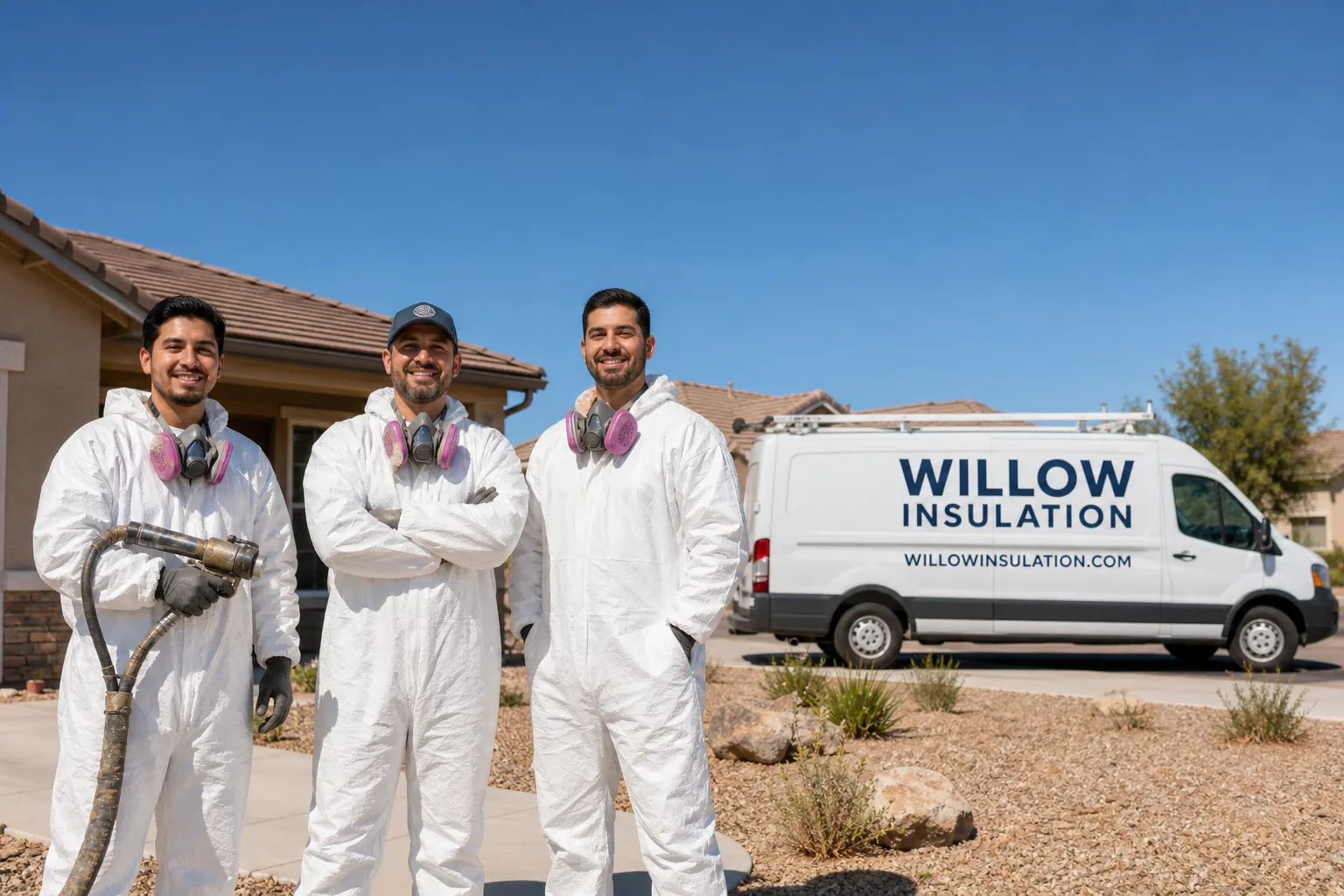
Fast, Reliable Spray Foam Insulation Across Avocado Heights
Spray foam insulation in Avocado Heights typically runs $2.50 to $6.00 per board foot installed, with most whole-attic projects landing between $3,800 and $9,500 depending on whether you go open-cell or closed-cell. Willow Insulation serves the 91746 area with crews who know the horse-property streets and 1950s-70s ranch homes here better than any contractor driving in from the coast. If you need a straight answer on cost or whether your attic can even handle foam, call (855) 473-6541 and we’ll tell you what we’d recommend, not just what we’d sell.
Why Willow Insulation Is Avocado Heights’s Preferred Spray Foam Insulation Company
Our Spray Foam Insulation team has spent years working inside Avocado Heights attics, which means we’ve seen the same failures over and over: disintegrated radiant barriers, batts squashed flat by decades of heat, and ridge vents sealed shut by original 1960s construction. We carry eight manufacturer brands, including Owens Corning, Johns Manville, and Knauf, so the recommendation comes from what your stucco ranch actually needs, not what our warehouse happens to stock.
Noel Castaneda built Willow Insulation around one idea: the right material for the home, not the other way around. That matters on Avocado Heights properties where a west-facing exterior wall behaves completely differently from a detached garage or tack room on the same lot. Homeowners here tell us the same thing after we finish: the rooms that baked by 2 p.m. finally stay level, and the AC stops cycling nonstop through August.
We carry both Icynene and Demilec spray foam systems, so we can specify open-cell for sound and air sealing or closed-cell for structural strength and moisture resistance on rim joists and low-slope roof decks. One crew handles the assessment, the prep, and the spray. You’re not coordinating three subcontractors from El Monte.
Spray Foam Insulation Contractors in Avocado Heights
Spray foam insulation contractors in Avocado Heights have to deal with something most crews in newer suburbs never see: a main ranch house and a detached garage or outbuilding that were never designed as one thermal system. The job here starts with finding where air is actually moving across the top plates, through the old venting, and around window framing on west-facing walls. Then we decide whether open-cell or closed-cell belongs in each cavity, and whether the old batts need to come out first.
Air Sealing Older Ranch Homes
Most 1950s-70s single-story stucco homes in Avocado Heights were built with minimal attention to air sealing. Gaps around plumbing penetrations, electrical boxes, and top plates let hot attic air push straight down into living space. Closed-cell spray foam seals those leaks and adds R-value in one pass, which is why we often start there on older homes.
Detached Garage and Outbuilding Treatment
On the horse-property lots along the quieter streets, a detached garage or tack room is its own thermal envelope. Treating the main house while ignoring the outbuilding leaves heat bleeding back in through the afternoon. We spray rim joists and exposed decking in those structures separately, and the difference is immediate when the west sun hits.
Spray Foam Attic Insulation in Avocado Heights
Spray foam attic insulation in Avocado Heights has to address the condition these 1960s attics are actually in, not the condition they were in when the house was built. On a west-facing ranch off the horse-property streets, we opened an attic where the original radiant barrier had turned to dust and the fiberglass batts were compressed flat, with ridge vents blocked by the original construction. We air-sealed the top plates and penetrations, sprayed two inches of closed-cell Icynene against the hot deck, then blew fiberglass over it. Mid-afternoon attic temperature dropped from well past 140°F, and the west wall finally stopped cooking the rooms by 2 p.m.
Closed-Cell Against the Roof Deck
For Avocado Heights homes with low-slope roofs and limited attic space, closed-cell spray foam applied directly to the underside of the roof deck creates an unvented attic. That’s useful when ridge vents are blocked and the original venting was never adequate anyway. It also adds structural rigidity to older roof assemblies that have taken five decades of valley heat.
Open-Cell for Interior Walls and Rim Joists
Open-cell foam works well on interior walls between the main house and an attached garage, and on rim joists where a home meets its foundation. It expands to fill odd cavities in older custom builds, and it cuts noise transmission, which matters on larger lots where a neighbor’s equipment or stable activity carries across the property line.
Trusted Brands We Service in Avocado Heights
Willow Insulation installs spray foam from both Icynene and Demilec, so you get a real recommendation between open-cell and closed-cell chemistry rather than a brand pitch. We also carry fiberglass and mineral wool lines from Owens Corning, Johns Manville, and Knauf for homes where a hybrid approach makes more sense than full foam. Because we stock these materials for 91746 jobs, we can usually schedule your Avocado Heights project without waiting on a distributor shipment from across the valley. When you call for a quote, we’ll tell you which brand fits the job and why, in plain English.
Common Spray Foam Insulation Problems We See in Avocado Heights Homes
- Blocked ridge vents from original 1960s construction. The venting was never sized right or has been painted over and sealed by decades of heat, so even new foam traps hot air unless the assembly is corrected first.
- Disintegrated radiant barriers and compressed batts. We see radiant barrier that crumbles to the touch and fiberglass that’s lost all its loft. Spraying foam over that without air-sealing the top plates just hides the old failure under new material.
- Detached garages and outbuildings left untreated. On horse properties, the main house gets all the attention while the garage or tack room stays uninsulated, creating a separate envelope that radiates heat back onto the property.
- West-facing walls that bake by mid-afternoon. The afternoon sun on stucco drives heat deep into wall cavities, and without foam on rim joists and roof decks, the interior never recovers until late evening.
Pricing for Spray Foam Insulation in Avocado Heights, CA
Open-cell spray foam in Avocado Heights runs $2.50 to $4.00 per board foot, while closed-cell runs $4.50 to $6.00 per board foot. A rim joist job on a 1960s ranch typically lands between $1,500 and $3,200. Garage ceiling spray foam on a detached two-car garage runs $2,000 to $4,800. Whole-attic projects on the stucco homes here generally fall between $3,800 and $9,500, depending on foam type, deck area, and whether old batts need removal. Every estimate is free, and we walk the attic with you before quoting. Call (855) 473-6541 to schedule one.
We Also Serve Cities Near Avocado Heights
Willow Insulation brings the same material-agnostic approach to Spray Foam Insulation in Avocado Heights and nearby communities across the San Gabriel Valley. You’ll find us working in West Puente Valley, La Puente, Valinda, and El Monte on the same day we’re scheduled in 91746. The attics may look a little different, but the heat, the stucco, and the blocked vents are the same story.
Serving Avocado Heights, CA — Our Local Coverage Area
We’re based in the Avocado Heights area and know this community well. Use the map below to see our service coverage — if you’re nearby, we can almost certainly help.
FAQs About Spray Foam Insulation in Avocado Heights
Yes, and it’s more about keeping heat out than keeping it in. Closed-cell foam against a west-facing roof deck or rim joist stops the late-day heat from pushing into living space, which is the real problem in Avocado Heights from May through October. Mild winters just mean cold-weather performance is not what you’re solving for. Call (855) 473-6541 and we’ll explain the difference open-cell versus closed-cell makes on your specific home.
Yes, but the blocked vents have to be addressed as part of the job, not ignored. On low-slope roofs we often convert to an unvented attic by spraying closed-cell directly against the underside of the deck, which sidesteps inadequate original venting entirely. We’ll inspect the ridge and soffit condition before recommending foam type. Call (855) 473-6541 to schedule a look.
Usually yes, because on Avocado Heights horse properties those outbuildings are separate thermal envelopes that radiate heat back toward the main house. We spray rim joists and exposed ceilings in garages and tack rooms to cut that afternoon heat load. The job scope is smaller, which keeps the cost proportionate. Call (855) 473-6541 for a free estimate either way.
We don’t recommend it. Spraying foam over failed material hides the old problem instead of fixing it, and the air-sealing layer never reaches the surfaces it needs to seal. We remove the degraded material, air-seal the top plates and penetrations, then spray foam or go hybrid with fresh blown fiberglass. Call (855) 473-6541 and we’ll show you exactly what’s in your attic before quoting.
We install both Icynene and Demilec spray foam systems, covering open-cell and closed-cell applications. We also carry Owens Corning, Johns Manville, and Knauf fiberglass for hybrid jobs where foam alone isn’t the right call. The brand follows the project, not the other way around. Call (855) 473-6541 for a material recommendation based on your home’s actual condition.
Written by Noel Castaneda, Owner at Willow Insulation, serving Avocado Heights and the San Gabriel Valley.