
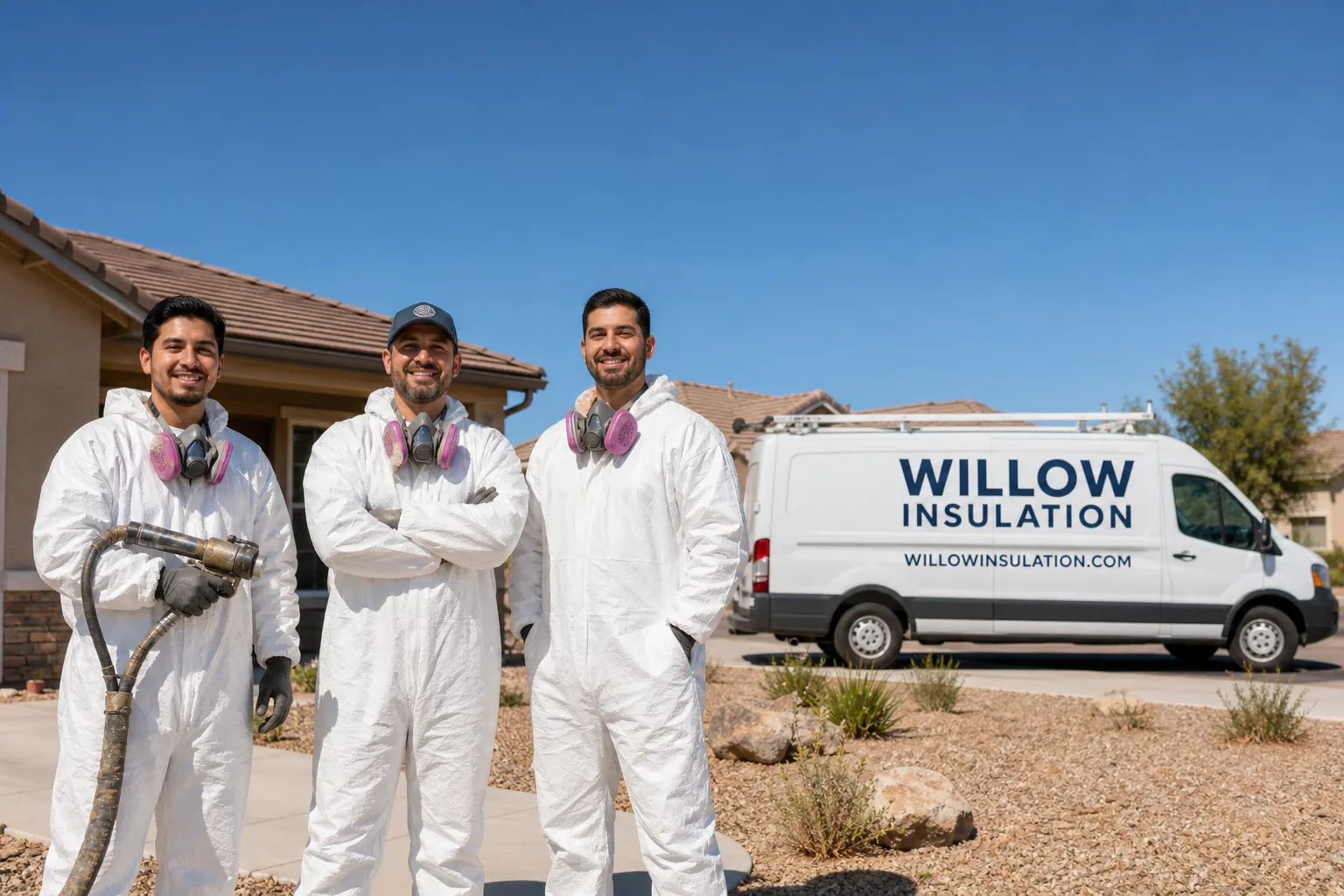
Fast, Reliable Spray Foam Insulation Across Duarte
Spray foam insulation in Duarte typically runs $2.50 to $6.50 per square foot installed, depending on whether you need open-cell or closed-cell and where we’re applying it. Most Duarte homes fall into two camps: mid-century ranch houses on the valley floor where attic heat is the main enemy, and foothill custom builds where Santa Ana winds and complex rooflines change the entire approach. We serve all three Duarte ZIP codes, 91008, 91009, and 91010, and we know the difference between them matters. Call (855) 473-6541 for a free estimate, and we’ll tell you straight what your house actually needs.
Why Willow Insulation Is Duarte’s Preferred Spray Foam Insulation Company
Willow Insulation approaches every Duarte home the same way we approach every job: material first, brand second. We carry spray foam systems from Icynene and Demilec, plus fiberglass, mineral wool, and cellulose, so the recommendation you get reflects your attic, your roofline, and your energy bills, not whatever happens to be sitting in our warehouse. Noel Castaneda built this company around that principle, and it shows in the work. When we walk a 91008 foothill attic with cathedral ceilings and exposed beams, we’re not guessing. We’ve seen how wind scouring moves loose-fill toward the downwind eaves and how poorly adhered foam fails at the upwind edge. That local knowledge changes what we specify.
Duarte homeowners call us because the temperature swing between a Santa Ana afternoon and a cool mountain night is hard on a house. We’ve worked in the Bradbury-adjacent foothills, through the flat tract neighborhoods off Huntington Drive, and everywhere in between. Our Spray Foam Insulation team knows which side of Duarte you’re on just by looking at your roofline, and we quote accordingly. Most Duarte jobs are scheduled within a few days of the assessment, and we keep our calendar flexible for foothill homes where the wind shows up earlier than expected.
We’re state-licensed and insured, and Noel Castaneda personally reviews every Duarte project before the crew rolls out. You’re getting a specialist, not a general contractor who occasionally touches insulation.
Crawl Space Spray Foam Insulation in Duarte
Crawl Space Spray Foam Insulation in Duarte matters more than most homeowners realize, especially in 91010 valley ranch homes where marine-layer humidity creeps in under the floor and lingers. A typical crawl space spray foam job in Duarte runs $1,800 to $4,200 depending on square footage and access. We apply closed-cell foam to the rim joists and foundation walls, which seals the envelope from below and stops the damp, musty air that rises into your living space every time the AC kicks on.
In the older post-war tracts of Duarte, crawl spaces are shallow and tight. That’s not a problem for our crews, but it does mean the foam has to be applied carefully around plumbing, ductwork, and electrical runs. Rushing this part of the job leads to gaps, and gaps defeat the entire purpose.
Closed-Cell Rim Joist Sealing
Rim joists are the single biggest air leak in most Duarte crawl spaces. We spray closed-cell foam directly against the rim board and sill plate, creating an air and moisture seal that fiberglass batts simply can’t match. For Duarte homes with 1950s-era floor framing, this also stiffens the structure slightly and cuts the draft that comes up through the baseboards in winter.
Moisture Control for Valley Floor Homes
Homes in 91010 sit low, and the marine layer puts moisture in the soil and the air. Spray foam on the crawl space walls and floor joists keeps that moisture in the ground where it belongs, not migrating up through your hardwood or laminate. If you’re smelling must in a hallway closet, the crawl space is usually the source.
Garage Spray Foam Insulation in Duarte
Garage Spray Foam Insulation in Duarte is one of the highest-return projects we do for homes where the garage shares a wall with living space. A standard two-car garage in Duarte runs $2,200 to $5,000 for full ceiling and shared-wall foam, depending on whether we’re also doing the door panel cavity. In foothill homes off Royal Oaks or along Mount Olive Drive, an uninsulated garage becomes an oven by mid-afternoon, and that heat radiates into the adjacent rooms all evening.
We spray open-cell foam on the ceiling and the wall shared with the house. Open-cell is the right call for garage ceilings because it’s lighter, quieter, and lets the roof deck breathe while still cutting heat transfer dramatically. For garages that double as workshops or home gyms, we often recommend closed-cell against the exterior wall for moisture resistance and structural rigidity.
Garage Ceiling Foam for Attached Garages
Attached garages are the biggest unaddressed heat leak in most Duarte homes. The ceiling cavity is usually just drywall with maybe a thin layer of fiberglass above it. Spraying two to three inches of open-cell foam up there drops garage temperatures by 15 to 20 degrees in summer and stops that heat from pressing against the living space wall. In Duarte’s hot, dry summers, that’s the difference between a family room that holds 75 degrees and one that fights your AC all afternoon.
Shared Wall Sealing
The wall between garage and house needs an air seal, not just insulation. Car exhaust, paint fumes, and the heat from a sun-baked door panel all push through any gap around outlets or baseboards. Closed-cell spray foam on that wall seals it tight and adds enough R-value to matter. We see this most often in Duarte’s mid-century ranch homes, where the garage sits directly against the kitchen or a bedroom.
Trusted Brands We Service in Duarte
Willow Insulation installs spray foam from Icynene and Demilec, and we also work with Owens Corning and Johns Manville for fiberglass batts where the project calls for a hybrid approach. We’re not tied to one manufacturer, which means our Duarte customers get an honest recommendation based on the house. Closed-cell foam in a crawl space, open-cell in a garage ceiling, Rockwool mineral wool in a party wall, GreenFiber cellulose in an attic floor. A single trade, every material, which is why we can match the product to the job instead of forcing the job onto the product.
We keep our equipment and material supply organized for quick turnaround in Duarte, so we’re not putting you on a six week wait because we ran out of the right foam. When Noel schedules a foothill attic air-sealing job, the material is on the truck before the crew leaves Victorville.
Common Spray Foam Insulation Problems We See in Duarte Homes
- Wind-scoured attics in 91008 foothill homes. Santa Ana winds funnel down the canyons and hit the upwind eaves hard, pushing loose-fill insulation toward the downwind side and leaving bare spots where heat pours in. Spray foam applied without accounting for this fails at the upwind edge because the roof deck is dusty or uneven, and the foam doesn’t get the adhesion it needs.
- Cathedral ceiling thermal bridging. Custom homes in the Bradbury-adjacent foothills often skip insulation at the beam pockets and rafter edges. The exposed beams look great, but they conduct heat straight through the roof assembly, and you get condensation on the beam faces in winter. Spray foam needs to fully encase the rafter bays and the beam pockets to stop that conduction path.
- Foam over old loose-fill without air sealing in 91010. Valley ranch homes from the 1950s and 1960s usually have a dusting of loose-fill in the attic, and some contractors just spray foam right over it. That traps marine-layer moisture underneath and rots the knee walls and top plates. The loose-fill has to come out, or at minimum get properly sealed at every penetration, before foam goes on.
- Ignoring the garage as part of the envelope. We see a lot of Duarte homes where the main attic got insulated twenty years ago but the attached garage was skipped. In a flat-floor ranch with single-pane windows, that uninsulated garage adds a constant heat load to the adjacent bedroom or kitchen, and the homeowner wonders why one room never cools down.
Pricing for Spray Foam Insulation in Duarte, CA
Open-cell spray foam in Duarte runs $2.50 to $4.00 per square foot installed, and closed-cell runs $4.50 to $6.50 per square foot. A crawl space encapsulation in a 91010 ranch typically lands between $1,800 and $4,200 total. A garage ceiling and shared wall in a foothill custom home runs $2,200 to $5,000. A full attic air-seal with spray foam and loose-fill removal in a 91008 cathedral ceiling home can run $6,500 to $14,000 depending on the roofline complexity and access. The wind-scoured eaves work we described adds cost because it requires careful surface prep and a closed-cell layer at the windward edge, usually adding $800 to $2,500 to the job. Every estimate is free, and we give you an honest number before any work begins. Call (855) 473-6541 and we’ll walk your attic with you.
We Also Serve Cities Near Duarte
Willow Insulation serves Spray Foam Insulation in Duarte and the surrounding San Gabriel Valley communities. We’re active in Bradbury, Monrovia, Baldwin Park, and Mayflower Village. If you’re right over the Duarte line, give us a call anyway. We schedule jobs across the area every week and we’ll work you into the route.
Serving Duarte, CA — Our Local Coverage Area
We’re based in the Duarte area and know this community well. Use the map below to see our service coverage — if you’re nearby, we can almost certainly help.
FAQs About Spray Foam Insulation in Duarte
Santa Ana winds hit the upwind side of foothill attics with enough force to move loose-fill insulation and degrade foam that isn’t properly adhered to the roof deck. We specify closed-cell foam at the windward eaves and make sure the deck is clean before spraying, because a dusty or uneven surface means the foam won’t bond. Call (855) 473-6541 for an attic inspection before the next wind event.
Yes, closed-cell spray foam reduces heat gain during hot afternoons and slows heat loss when mountain air drops temperatures after sunset. It forms an air seal as well as an insulation layer, so the big day-night swing in Duarte stops pressing through your ceiling. Most homeowners notice the difference within the first week, especially in rooms that used to heat up by 3 p.m.
For a 1950s or 1960s ranch on the valley floor, the priority is the attic floor and the shared garage wall. We recommend removing the old loose-fill, air sealing every penetration, and applying closed-cell foam to the attic floor or the roofline, plus open-cell on the garage ceiling. This addresses the marine-layer moisture and the single-pane window gaps working against you. Estimates are free.
Spray foam fills the rafter bays and encases the beam pockets, which stops the thermal bridging that causes uneven temperatures and condensation on the beams. We use Icynene open-cell for the main cavity on most cathedral ceilings, then a closed-cell layer at the windward eave where Santa Ana scouring is worst. The exposed beam look stays; the hot and cold spots don’t.
Duarte follows Los Angeles County building codes, which generally require insulation work to meet current R-value standards for the climate zone and may require a permit if we’re altering the building envelope in a significant way. Willow Insulation handles the paperwork side for every Duarte job, and Noel Castaneda reviews code compliance on every quote. Call (855) 473-6541 and we’ll tell you exactly what your project requires.
Written by Noel Castaneda, Owner at Willow Insulation, serving Duarte and the San Gabriel Valley with material-agnostic insulation expertise.