
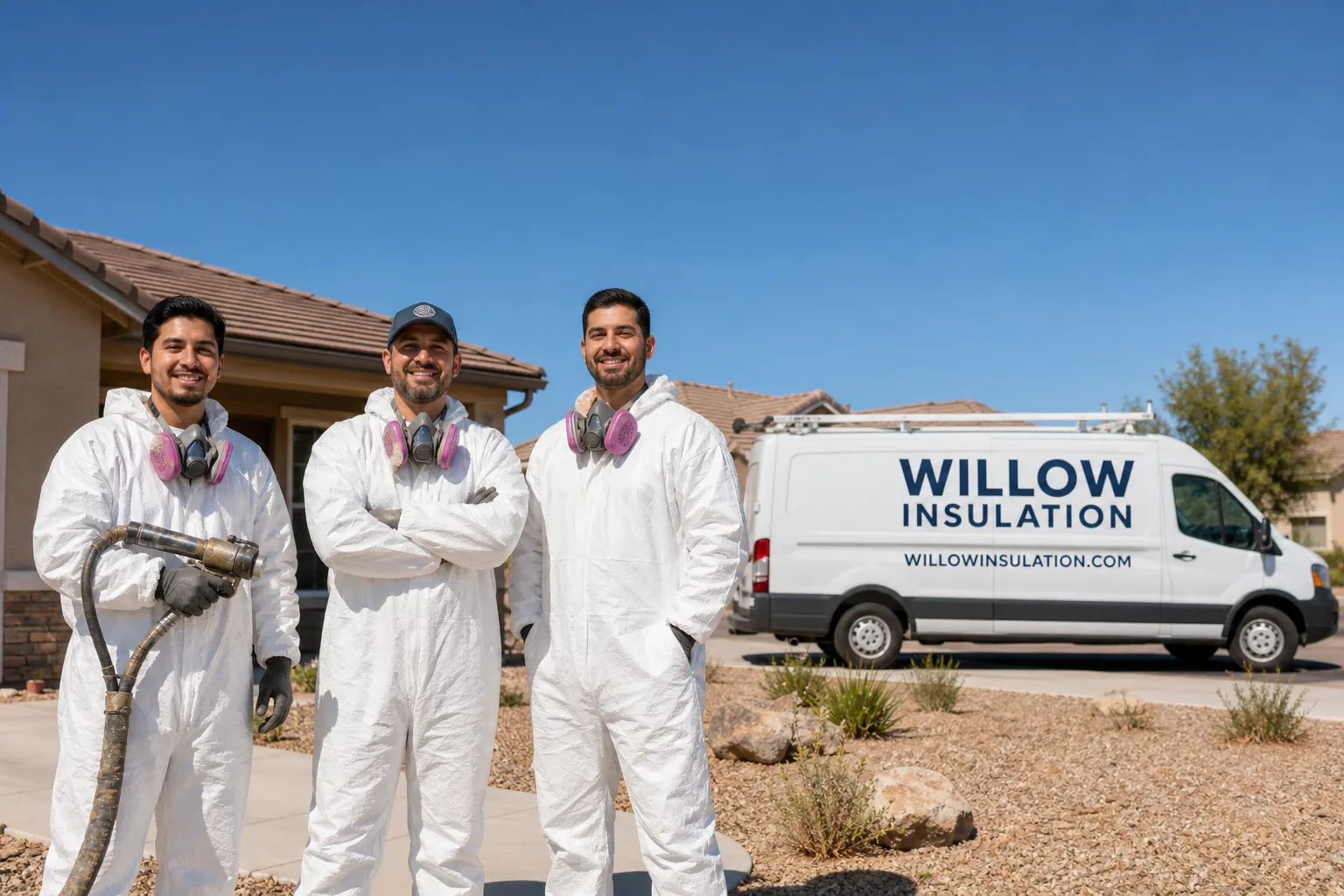
Fast, Reliable Spray Foam Insulation Across Monrovia
Spray foam insulation in Monrovia typically runs $2.50 to $6.50 per board foot installed, with most full wall and rim joist projects landing between $3,200 and $9,800 depending on scope. The foothill climate here demands a material that seals against both the brutal attic heat and the dust and ember pressure that comes off the San Gabriels. We’re Willow Insulation, and we’ve worked enough homes from the flatland bungalows near Old Town up into the hillside streets north of Foothill Blvd to know that a block-by-block approach is the only honest way to spec foam in 91016 and 91017. Call (855) 473-6541 and we’ll talk through what your specific house actually needs.
Why Willow Insulation Is Monrovia’s Preferred Spray Foam Insulation Company
We carry Icynene and Demilec on the truck, which means the recommendation you get is driven by your walls and your roof profile, not by whatever single brand a contractor happens to have a deal with. That matters in Monrovia because the housing stock swings wildly within half a mile: a 1922 Craftsman near Myrtle Avenue has completely different cavity realities than a 1970s tract home off Huntington Drive or a custom build climbing into the foothills off Canyon Boulevard.
Noel Castaneda, who leads our crews, has walked enough of these homes to know when open-cell is the right call and when a hillside wall needs closed-cell for moisture and ember resistance. We quote the material that fits the envelope. Homeowners in Monrovia regularly tell us the same thing: another contractor pushed one product, and we gave them two or three real options with straight numbers behind each.
We respond quickly to Monrovia calls because it’s part of our core service area, not an out-of-the-way afterthought. When you call (855) 473-6541, you get a specialist who understands the city’s thermal and WUI realities without you having to explain them.
Spray Foam Wall Insulation in Monrovia
Spray foam wall insulation in Monrovia is the process of applying expanding polyurethane foam directly into wall cavities, where it seals air leaks, blocks moisture migration, and adds structural rigidity. Homeowners here reach for it when exterior walls are open during a remodel, when plaster-and-lath walls show signs of draft and dust trouble, or when an older home simply cannot hold a consistent temperature across the foothill day-night swing.
In the older Craftsman and Spanish bungalow stock around Old Town and the numbered streets, spray foam wall insulation is often the only practical way to get real R-value into a balloon-frame wall without tearing out the original plaster. We use low-pressure Icynene open-cell or Demilec closed-cell depending on what the cavity and the exposure demand. A typical single-story 1920s home in 91016 runs $4,800 to $8,200 for full exterior wall foam, including substrate prep and trim masking.
For mid-century and 1960s-80s tract homes, the walls usually have at least nominal framing insulation, but the thermal bridging at studs and the air leakage through unsealed top plates and outlet boxes is where the heat gets in. Closed-cell foam at 2 inches in the cavity hits the air-seal target and adds meaningful R-value per inch. Those projects typically land in the $3,800 to $6,400 range depending on square footage and accessibility.
Hillside WUI preparation for wall foam
North of Foothill Blvd, the wall assembly does double duty. The same closed-cell Demilec that insulates the wall also slows moisture intrusion during Santa Ana-driven low-humidity periods and adds a measure of ember resilience when paired with proper vent screening. We stage these jobs differently than flatland work: exterior penetrations get sealed first, then the foam goes in behind the sheathing with the WUI detailing completed in the same pass.
Plaster and balloon-frame cavity sealing
On a 1920s Spanish bungalow in the 300 block of North Canyon Boulevard, our crew removed failing fiberglass batts from balloon-frame walls and applied Icynene closed-cell spray foam to seal the cavities and rim joists. The homeowner had been battling dust infiltration and uneven room temperatures; after we foamed the walls and rim joists and screened the gable vents with ember-resistant mesh, the home held temperature evenly through a Santa Ana wind event and the dust issue disappeared. That’s the kind of outcome Monrovia’s older homes can actually get when the substrate prep and vent work are part of the same job.
Rim Joist Spray Foam in Monrovia
Rim joist spray foam in Monrovia is the application of closed-cell foam across the band joist where the floor framing meets the foundation, sealing the single largest air-leakage point in most raised-floor homes. Any Monrovia house with a crawlspace and floor joists running to an exterior band is losing conditioned air through that seam, and in the foothill temperature swings we see off the San Gabriels, that leak translates directly into cold floors in winter and hot, drafty rooms in summer.
Mid-century tract homes toward the foothills deserve particular attention here. The rim joist in those houses is often bare wood with nothing more than a fiberglass batt stuffed loosely against it. Wind-washing off the chaparral slopes robs whatever R-value that batt might have claimed, and the thermal bridging through the band joist undermines any wall foam installed above it. Closed-cell Demilec at 2 inches across the full rim and down the sill plate solves both problems: it air-seals the seam and creates a thermal break. Typical rim joist work for a 1,400 to 1,800 square foot Monrovia home runs $1,400 to $2,800.
Wind-washing resistance at the band joist
When Santa Ana winds push dry air against a hillside home’s foundation line, the pressure differential pulls conditioned air out and pulls dusty, dry outdoor air in at the rim. Closed-cell foam holds against that pressure in a way fiberglass never will. We also seal the sill plate to the foundation top where we can reach it, closing a gap most homeowners never see but feel every winter morning.
Moisture control in older crawlspaces
Monrovia’s older homes often have vented crawlspaces that breathe chaparral air directly. Rim joist foam reduces the amount of that dry, debris-laden air entering the floor assembly. Paired with proper vent screening uphill, it makes the whole crawlspace behave more predictably year-round.
Trusted Brands We Service in Monrovia
We install and service spray foam systems from Icynene and Demilec, two manufacturers whose chemistries genuinely differ. Open-cell Icynene fits interior cavity work and sound-dampening between rooms; closed-cell Demilec handles exterior assemblies, rim joists, and WUI-adjacent walls where moisture and ember resistance matter. We also stock GreenFiber and Owens Corning materials for jobs in Monrovia where foam is only part of the answer, like a hillside home that needs mineral or cellulose backfill in hard-to-reach cavities alongside the foam work. We keep local inventory ready so a Monrovia project doesn’t stall waiting on parts from a warehouse two counties over.
Common Spray Foam Insulation Problems We See in Monrovia Homes
- Foam applied without ember-resistant vent screening in hillside WUI zones. Attic and crawlspace vents that draw directly off chaparral-covered slopes sit exposed if nobody screens them. We see this on north-of-Foothill homes where a previous contractor sprayed the roofline but left the vents open, leaving the assembly vulnerable to ember intrusion during fire season.
- Spray foam over old plaster and balloon-frame walls without substrate prep. The 1910s-1930s homes near Old Town often have lime plaster over wood lath, and foam applied straight over a dusty, unstable surface can fail to bond and leave voids behind custom finishes. It looks covered until the first temperature swing pulls it free.
- Rim joists left unfoamed in mid-century tract homes. The 1960s-80s stock around Huntington Drive and up toward Bradbury frequently has wall insulation added but the band joist untouched. That single omission drags the whole envelope’s performance down, especially during Santa Ana wind events.
- Foam spec mismatched to the altitude gradient. A hillside custom home in 91016 has a completely different thermal and wind exposure profile than a flatland tract house a mile south. Cracked foam, condensation at transitions, and uneven cure are the tells we find when someone applied a valley-floor spec to a foothill wall.
Pricing for Spray Foam Insulation in Monrovia, CA
A typical full wall spray foam project in Monrovia runs $3,200 to $9,800, with rim joist work between $1,400 and $2,800 and garage ceiling or roof deck applications between $2,100 and $5,400. Open-cell foam runs $2.50 to $3.80 per board foot installed; closed-cell, which is the more common spec in hillside and WUI-adjacent zones north of Foothill, runs $3.90 to $6.50 per board foot. The altitude and fire-season exposure of your specific street changes those numbers, and so does wall accessibility in an older balloon-frame home versus a tract house with standard framing. Call (855) 473-6541 for a free on-site estimate in Monrovia. We give you the number before any work starts; no vague ranges, no hand-waving.
We Also Serve Cities Near Monrovia
Beyond our Monrovia work, our crews regularly handle Spray Foam Insulation projects in Mayflower Village, Duarte, Bradbury, and Arcadia. The same foothill realities drive every spec we write in those cities, and we stage materials so a call from any of them gets the same fast local response.
Serving Monrovia, CA — Our Local Coverage Area
We’re based in the Monrovia area and know this community well. Use the map below to see our service coverage — if you’re nearby, we can almost certainly help.
FAQs About Spray Foam Insulation in Monrovia
Yes. Hillside homes north of Foothill Blvd fall under Wildland-Urban Interface code requirements that flatland addresses in 91016 never face, so any attic or crawlspace vent that draws directly off the chaparral slopes must be paired with ember-resistant screening. We install the screening as part of the foam job, not as an add-on you chase down later. If you’re unsure whether your specific street falls inside the WUI boundary, call (855) 473-6541 and we’ll check it against current local maps.
In most cases, yes. The key is substrate prep: we clean and stabilize the lath and plaster from the accessible side, then apply low-pressure open-cell Icynene that expands gently into the cavity without bowing or blowing out the old finish. Where the plaster is already failing, we stabilize it first or section the wall. Every old home gets a cavity inspection before any foam goes in. Call (855) 473-6541 for an honest assessment of your specific walls.
Because those band joists are the biggest open leak in the envelope: bare wood, a loosely stuffed batt, and a direct path for Santa Ana wind-washing to strip conditioned air and push dusty, dry outside air through the floor assembly. Closed-cell foam at the rim and sill plate seals the seam and creates the thermal break those houses were never built with. It’s the highest-return foam application we do in Monrovia’s 1960s-80s tract stock.
Yes, directly. A closed-cell foam application at the roof deck stops heat from entering the attic in the first place, which is the single biggest driver of the extreme attic temperatures Monrovia sees during summer heat waves off the valley floor. Garages and cathedral ceilings get the same benefit. The roof deck line item on a typical Monrovia house runs $2,100 to $5,400 depending on slope and depth.
The material spec and the detailing both change. Hillside custom homes in 91016 get closed-cell Demilec more often, because the assembly has to handle ember exposure, steeper wind pressures, and the steeper temperature swings right at the base of the San Gabriels. Flatland tract homes can often use open-cell for interior work and a lighter closed-cell touch at the rim and band joists. The wrong spec on either side of Foothill Blvd costs you comfort and money. Call (855) 473-6541 and we’ll write the quote for the street you actually live on.
Written by Noel Castaneda, Owner at Willow Insulation, serving Monrovia and the surrounding foothill communities.