
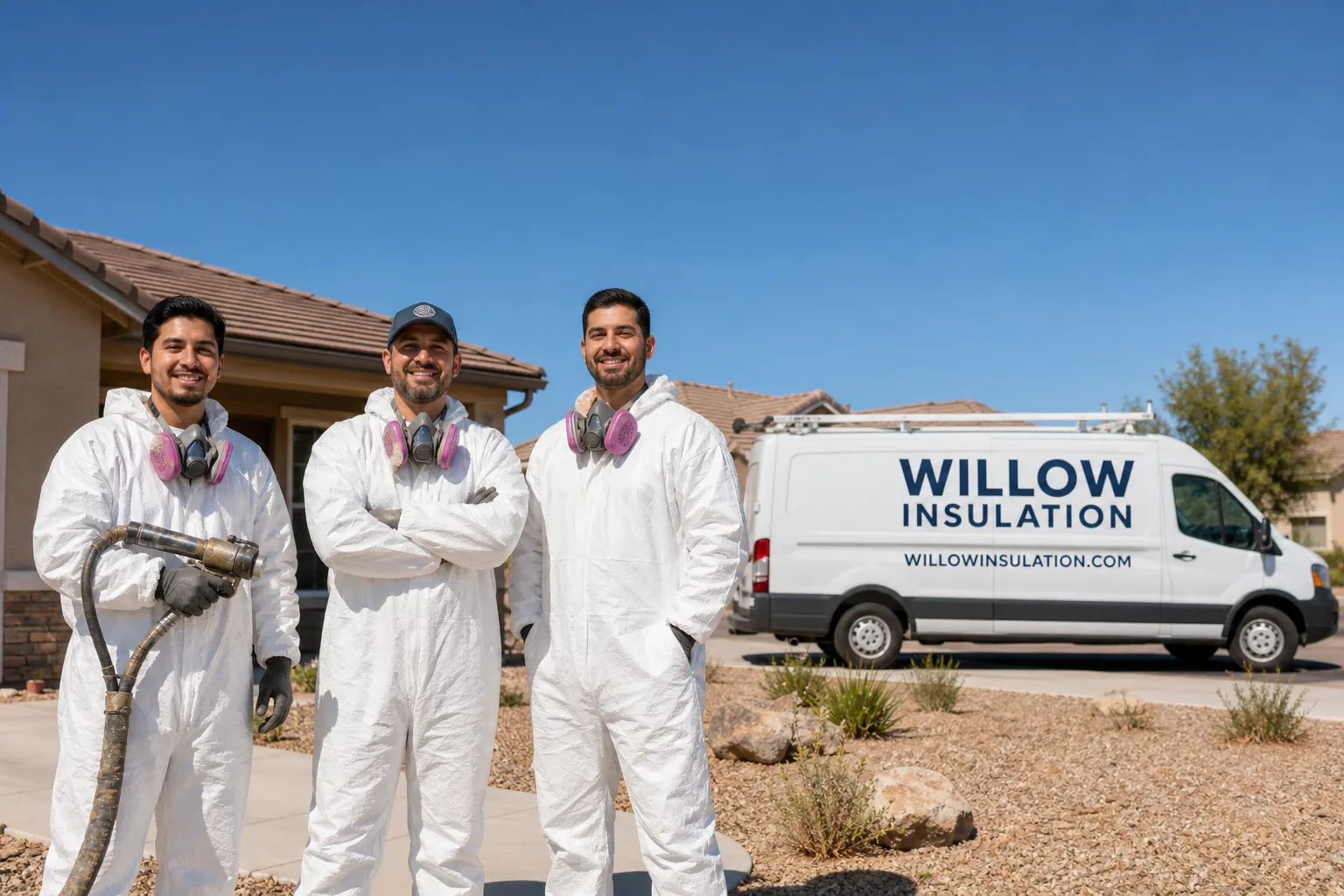
Fast, Reliable Spray Foam Insulation Across Morongo Valley
Spray foam insulation in Morongo Valley has to work harder than almost anywhere else in California. At 3,000 feet on the high-desert plateau, your home faces 100°F+ summer afternoons, hard winter freezes, and the relentless Morongo Valley wind that pushes dust and grit through the pass. Most spray foam installers from the Coachella Valley floor or down the hill simply don’t spec for those combined conditions. We do, because we’ve been working the high desert long enough to know that a foam job that works in Palm Springs will fail up here. You need a team that understands closed-cell and open-cell chemistry, wind-driven abrasion, freeze-thaw stress, and the irregular framing common in Morongo Valley’s older self-built homes. That’s us. Call (855) 473-6541 for a free assessment and we’ll be honest about whether spray foam is the right tool for your specific envelope.
Why Willow Insulation Is Morongo Valley’s Preferred Spray Foam Insulation Company
We’re the Spray Foam Insulation contractor that Morongo Valley homeowners call when a previous foam job has failed, or when they’re building something unconventional and need a specialist who can think through the details. Noel Castaneda started Willow Insulation with a simple rule: carry the right material for the job, not the material that’s easiest to sell from a warehouse. That’s why we install both Icynene and Demilec spray foam systems, covering open-cell and closed-cell applications, and why we also offer Rockwool mineral wool and GreenFiber cellulose when they’re the better fit. Homeowners here appreciate that we’ll tell them when spray foam isn’t the answer. That honesty builds trust, and it’s why our customers in Morongo Valley keep referring us to their neighbors on Hess Boulevard, up Highway 62, and out toward the Big Morongo Canyon Preserve.
We know the local building patterns. We’ve opened walls on 1970s cabins and found framing that was never square, with gaps and bays that a one-size-fits-all foam quote would never catch. We’ve seen what wind-driven dust does to exposed open-cell foam in rim joists. And we’ve fixed plenty of jobs that started as a cheaper bid from an out-of-area crew. When you call us, you’re calling a team that has already learned the lessons of this specific valley, so you don’t pay for them twice.
Garage Spray Foam Insulation in Morongo Valley
Garage spray foam insulation in Morongo Valley is one of the most effective upgrades you can make, especially for attached garages that turn into ovens by 2 p.m. in July. The big issue here is the southwest-facing wall, which gets hammered by afternoon heat before the wind kicks up. We typically apply closed-cell foam to garage ceilings and the shared wall between the garage and living space, which stops heat from loading the garage slab and radiating into the house overnight. A typical garage ceiling application in Morongo Valley runs $1,200 to $2,800, depending on square footage, the condition of the existing framing, and whether we need to repair wind-damaged areas first. We also air-seal the top plates and any penetrations where wind-driven dust pushes through.
Rim Joist and Perimeter Sealing
The rim joist is where your floor framing meets the foundation wall, and it’s also the number one place Morongo Valley wind gets into a home. We use closed-cell foam here because it acts as both insulation and a rigid air barrier. In older Morongo Valley homes with uneven sill plates and gaps you could slide a putty knife through, this small job delivers an outsized difference: fewer drafts, less dust, and stable floor temperatures in winter.
Garage Ceiling with Living Space Above
If you have a bonus room or bedroom above your garage, that ceiling foam matters more than almost any other surface in the house. We’ve measured 140°F garage ceilings in Morongo Valley during late-summer afternoons. That heat conducts straight up into the floor above, which is why that room never cools down. Closed-cell foam on the garage ceiling cuts that heat transfer dramatically, and the difference in that room is noticeable within a season.
Closed Cell Spray Foam Insulation in Morongo Valley
Closed cell spray foam insulation in Morongo Valley is our default recommendation for newly built additions, rim joists, roof decks, and anywhere wind-driven grit or moisture is a concern. Closed-cell foam cures dense and rigid, with an R-value around 6.5 per inch, and it’s the only spray foam that doubles as a fully adhered air barrier and a Class II vapor retarder. In Morongo Valley’s freeze-thaw conditions, that density matters: closed-cell foam stays locked to irregular framing where open-cell can pull away. Expect to pay $1.50 to $2.60 per board foot installed in Morongo Valley, with attic or roof-deck projects typically landing between $4,000 and $9,000 depending on cavity depth and access.
Roof Deck and Attic Applications
We use closed-cell foam on roof decks when the attic is full of HVAC ducts, or when the ceiling is too low to insulate conventionally. The wind-driven dust issue makes open-cell a poor choice for exposed attic surfaces up here. Closed-cell with a code-approved ignition barrier holds its R-value for decades, even in dusty, gusty conditions.
Freeze-Thaw Protection for Older Framing
Morongo Valley homes from the 1960s through the 1980s often have framing lumber that moves with humidity and temperature. That movement cracks brittle foam and pulls it away from studs, creating the air gaps that wind then exploits. Closed-cell foam is elastic enough to flex with that lumber, which is why we spec it for these older self-built cabins. It’s not the cheapest option, but it’s the option that survives this climate.
Trusted Brands We Service in Morongo Valley
We stock and install both Icynene and Demilec spray foam systems, which means we can match the foam chemistry to the job instead of pushing one brand into every cavity. Demilec closed-cell formulations are our go-to for roof decks and rim joists in Morongo Valley because of their density and air-sealing performance. Icynene open-cell foams work well in interior wall cavities where sound reduction matters and the surface isn’t exposed to abrasive wind. We also carry Owens Corning and GreenFiber products for projects where a hybrid approach makes more sense than a full foam envelope. Having all of these under one roof means your recommendation comes from the project’s requirements, not our inventory. That’s the whole point of being material-agnostic.
Common Spray Foam Insulation Problems We See in Morongo Valley Homes
- Wind-abraded open-cell foam in exposed attic and rim joist areas: The dust and fine grit that tears through the Morongo Pass acts like sandpaper on soft foam surfaces. We often find open-cell foam that has lost an eighth-inch of material from its face, which quietly eats away at R-value every season.
- Foam pulling away from irregular framing after freeze-thaw cycles: Older self-built homes in Morongo Valley rarely have uniform stud spacing or plumb walls. When temperature swings freeze and thaw moisture around those irregular cavities, brittle or poorly-applied foam separates from the lumber and creates hidden air channels.
- Condensation and mold forming on cold surfaces behind thin foam applications: Summer attic heat loads the building, winter winds strip the heat back out, and where the two meet, moisture condenses. We’ve found mold developing behind thin or incomplete spray foam jobs around skylights and rooflines throughout the Morongo Valley area.
- Garage ceiling foam that looks chewed up or spongy: This is the telltale sign of wind-driven grit erosion, and it’s more common on homes east of Hess Boulevard where the pass wind hits hardest. If you can press a finger into the foam face and it crumbles or powders, the surface has already degraded and needs remediation.
Pricing for Spray Foam Insulation in Morongo Valley, CA
Spray foam pricing in Morongo Valley runs higher than Palm Springs flat-land pricing because the material specs are different and access to rural properties adds labor. Here’s what you can expect in the 92256 zip code:
- Open-cell wall cavity injection: $0.80 to $1.40 per board foot installed
- Closed-cell rim joist sealing (perimeter of home): $1,200 to $2,500 total
- Garage ceiling closed-cell application: $1,200 to $2,800 depending on square footage
- Full roof deck closed-cell insulation: $4,000 to $9,000 for a typical 1,200 to 1,800 sq ft Morongo Valley home
- Wind-damaged foam remediation and re-application: $800 to $2,400 depending on how much material must be removed first
Cost is driven by foam type, cavity depth, access to the work area, and whether we’re replacing previously failed foam. We provide itemized written quotes before any work begins, and the estimate is free. Call (855) 473-6541 and we’ll come out to Morongo Valley, inspect your specific surfaces, and give you a number you can actually plan around.
We Also Serve Cities Near Morongo Valley
Willow Insulation serves the entire Morongo Valley area and the surrounding high-desert and pass communities, including Cabazon, Banning, Calimesa, and Yucaipa. Our Victorville home base keeps us close enough for same-week scheduling to all of these areas, and we’re comfortable working on the rural ranch properties and mountain-adjacent lots that define the corridor.
Serving Morongo Valley, CA — Our Local Coverage Area
We’re based in the Morongo Valley area and know this community well. Use the map below to see our service coverage — if you’re nearby, we can almost certainly help.
FAQs About Spray Foam Insulation in Morongo Valley
Yes, for open-cell foam left exposed in attics or rim joists, the wind-driven dust through the Morongo Pass physically abrades the foam surface and slowly reduces its R-value. The fix is closed-cell foam with a protective coating or ignition barrier, which stands up to the grit far better. Call us at (855) 473-6541 if your existing foam looks powdery or chewed up, and we’ll tell you honestly whether it needs remediation or replacement.
Closed-cell foam cures dense and rigid with high tensile strength, so it stays adhered to irregular framing during the rapid freeze-thaw swings common at Morongo Valley’s 3,000-foot elevation. Open-cell foam is softer and more likely to pull away from studs or rafters when moisture freezes and expands inside the cavity. For older self-built homes with uneven framing, closed-cell is the durable choice.
Yes, closed-cell spray foam is the best single material for handling both. Its high R-value per inch blocks summer heat gain from the attic down to the living space, and its air-sealing properties stop winter heat loss and wind infiltration from reversing that equation. Morongo Valley’s dual-season climate demands a material that works on both sides of the thermal equation, and closed-cell delivers that. Call (855) 473-6541 for an assessment of which surfaces on your home would benefit most.
That chewed-up appearance is almost certainly wind-driven grit erosion from the Morongo Pass winds, and it means the foam surface has already degraded. You should have it inspected by a spray foam specialist who can determine whether the damage is cosmetic or structural to the insulation’s performance. We remove the failed foam, re-apply closed-cell foam with a protective coating where needed, and air-seal the top plates so the wind stops pressurizing the garage attic.
Yes, spray foam is often the best option for older self-built cabins in Morongo Valley precisely because it conforms to irregular framing and fills the odd cavities that batts and rolls can’t. The key is choosing the right foam type for the surface. Closed-cell works for rim joists, roofs, and wind-exposed areas, while open-cell can be appropriate for interior walls where sound dampening matters. We’ve worked on dozens of these properties off Hess Boulevard and throughout 92256, and we’ll spec the material based on what your cabin actually needs.
Written by Noel Castaneda, Owner at Willow Insulation, serving Morongo Valley and the surrounding high-desert communities.