
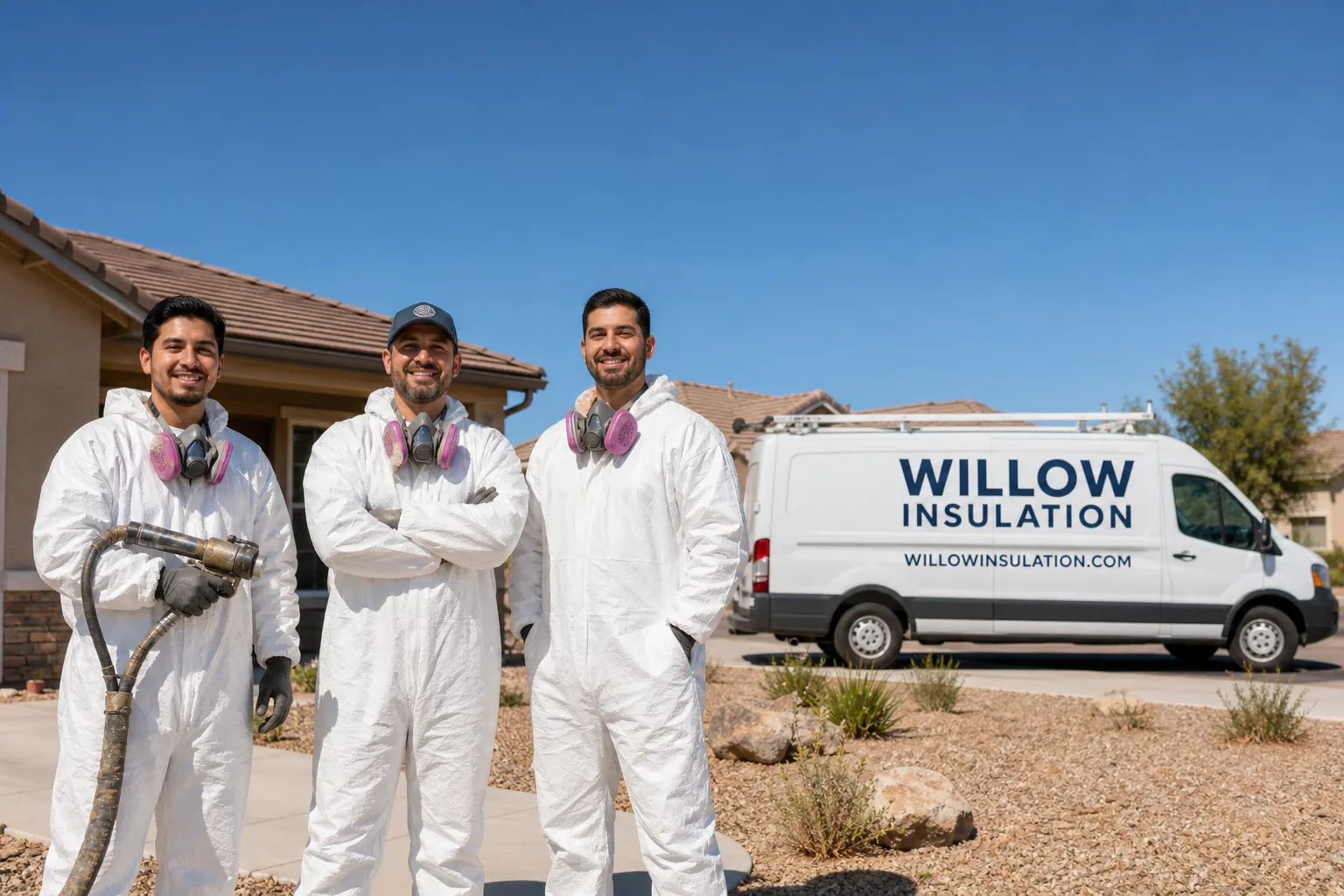
Fast, Reliable Spray Foam Insulation Across Highgrove
If you live in Highgrove and your cooling bills keep climbing every July, the problem is probably in your attic and walls, not your AC unit. Spray foam insulation in Highgrove typically runs $2.40 to $4.10 per board foot for open-cell and $3.20 to $5.90 for closed-cell, with most whole-attic jobs landing between $4,800 and $11,500 depending on square footage and access. Our crews work Highgrove homes off Center Street, Main Street, and the neighborhoods around Highgrove Elementary every week. Call (855) 473-6541 and we’ll give you an honest read on what your house actually needs.
Why Willow Insulation Is Highgrove’s Preferred Spray Foam Insulation Company
Most Highgrove homes were built between the 1950s and early 1980s, and we’ve crawled through enough of their attics to know exactly what’s waiting up there: settled fiberglass, unsealed rim joists, and wall cavities that were never insulated at all. That’s not a knock on the homes themselves. It’s just what builders did in this part of the Inland Empire before energy codes got serious. Homeowners across the 92313 zip code call us because we don’t flinch at a 62-degree attic in January or a 150-degree one in August. We schedule around Highgrove’s heat, show up on time, and don’t pad the scope once we’re in your attic.
Noel Castaneda, our owner, has built Willow Insulation around one idea: carry enough materials and methods that the answer is always driven by the house, not by what’s sitting in the warehouse. If your Highgrove home needs open-cell Icynene in a vaulted ceiling but a neighbor’s 1960s ranch needs closed-cell Demilec on a rim joist, we can do both on the same day. That’s the advantage of running eight brands from Owens Corning to GreenFiber under one specialist crew. You’re never steered toward the wrong material because it’s the only thing we stock.
We’re based in Victorville but our trucks are in Highgrove weekly, and we know the streets here. We know that a tract home off Center Street with original aluminum windows loses cool air differently than a newer infill place on the east side. That kind of local knowledge is what lets us give you an accurate recommendation the first time, not after three follow-up visits.
Spray Foam Wall Insulation in Highgrove
Spray Foam Wall Insulation in Highgrove is often the single biggest change a homeowner can make in an older house, because most of these 1950s-to-1980s builds went up with empty wall cavities. Open-cell Demilec sprayed into stud bays runs $1.90 to $3.10 per board foot, while closed-cell Icynene runs $2.90 to $4.60 per board foot, and a typical 1,500-square-foot exterior wall retrofit in Highgrove lands between $5,200 and $9,800. In a city where July attics hit 150°F by noon, walls that hold insulation matter almost as much as the attic itself, because they stop heat from radiating inward all afternoon and evening.
Open-Cell for Wall Cavities
Open-cell foam expands slowly and fills odd framing, which matters in Highgrove’s older homes where stud spacing isn’t always a tidy 16 on center. It also breathes, so minor moisture in a wall assembly doesn’t get trapped. For most Highgrove wall retrofits where the drywall is already off for a remodel, open-cell Demilec gives you strong air sealing at a lower material cost than closed-cell.
Closed-Cell When Moisture or Space Is Tight
Closed-cell Icynene packs about R-6.5 per inch and acts as a vapor barrier, which makes it the right call for Highgrove homes where wall cavities are shallow or where you’re insulating a rim joist area that catches humidity. It’s more expensive per board foot, but in a 2×4 wall it delivers meaningful R-value without furring out the studs. We’ll tell you straight if open-cell does the job; we won’t upsell you into closed-cell you don’t need.
Rim Joist Spray Foam in Highgrove
Rim Joist Spray Foam in Highgrove targets a part of the house most homeowners have never looked at, and it’s where a surprising amount of heat sneaks in. The rim joist, that band of framing where your floor meets the foundation, is usually uninsulated in Highgrove’s older stock. A rim joist spray foam job in Highgrove runs $1,400 to $3,200 for a typical single-story home, with closed-cell Icynene at $3.20 to $4.80 per board foot being the standard choice because of its rigidity and moisture resistance. On a 1962 tract home off Center Street, our crew found original fiberglass batts collapsed to R-5 and a rim joist so heat-soaked that the homeowner’s AC ran nonstop. We sprayed 2 inches of closed-cell Icynene on the rim joist and 3 inches of open-cell Demilec in the wall cavities, starting at 6 a.m. to beat the attic heat; by afternoon the attic temp had dropped 20°F and the homeowner reported the AC cycling normally for the first time that summer.
Why the Rim Joist Gets Hotter Than You’d Think
In Highgrove’s semi-arid climate, the soil around your foundation radiates heat for hours after sunset. That heat transfers through the exposed rim joist band and into the floor system, warming the whole lower level of the house. Closed-cell foam stops that transfer at the source. Older homes from the 1950s to 1980s often have completely open rim joists, sometimes with a thin fiberglass batt shoved in sideways that does almost nothing.
Balloon-Frame and Other Older Details
Some Highgrove homes from the 1950s used balloon framing, where wall cavities run continuously from the foundation to the attic with no fire blocking. That’s a problem for spray foam because material can escape into the wall and leave gaps. We check for that before we spray, and we adjust our approach, installing blocking or using a slower-rise open-cell foam so the material stays where it’s supposed to.
Trusted Brands We Service in Highgrove
Willow Insulation installs both Icynene and Demilec spray foam systems, which matters because those two brands cover the full span of open-cell and closed-cell applications you’ll actually encounter in Highgrove homes. If a project calls for a recycled-content blown-in product instead, we carry GreenFiber cellulose. And for fiberglass batts or mineral wool in non-foam applications, we stock Owens Corning and Rockwool. Carrying this many brands from one contractor is unusual in the Inland Empire. It means the recommendation you get is the one that fits your house, not the one that clears our shelf space. It also means we’re not waiting on a single supplier when Highgrove homeowners need a job scheduled quickly.
Common Spray Foam Insulation Problems We See in Highgrove Homes
- Flash-curing in afternoon attics. Foam applied after 10 a.m. in a 150°F+ attic can rise too fast, causing poor adhesion and voids behind the foam. That’s why we start Highgrove attic work at dawn and stop spraying before the substrate gets too hot.
- Unsealed rim joists and balloon-frame walls. Older Highgrove homes from the 1950s through 1980s often have open rim joists and, in some cases, continuous wall cavities where foam escapes and leaves gaps. We inspect for both before we ever load a rig.
- UV degradation at open vents. Exposed spray foam near open attic vents gets chalky and brittle within a few years from Highgrove’s intense sun. We cover or shield any foam that would otherwise sit in direct UV.
- Settled legacy fiberglass giving false confidence. A lot of Highgrove attics still have the original batts from when the house was built, now compressed to R-5 or R-6 and doing almost nothing. Adding spray foam over or around that without addressing the air leaks first wastes money.
Pricing for Spray Foam Insulation in Highgrove, CA
Expect to pay $2.40 to $4.10 per board foot for open-cell spray foam in Highgrove and $3.20 to $5.90 for closed-cell. A full attic air seal with open-cell on a 1,200-square-foot ranch typically lands between $4,800 and $7,200. A rim joist package runs $1,400 to $3,200, and wall cavity retrofits run $5,200 to $9,800 for a 1,500-square-foot exterior. The things that move the number in Highgrove specifically: access (vaulted or low-slope attics cost more), whether old insulation has to be removed first, and how early in the day we need to start. Call (855) 473-6541 and we’ll give you a written, fixed quote before any work starts.
We Also Serve Cities Near Highgrove
Willow Insulation runs crews from Highgrove into Highgrove‘s neighboring communities every week. We handle spray foam, attic, and blown-in work in Grand Terrace, Colton, Loma Linda, and Rubidoux. If you’re in one of those towns and need a specialist who knows the heat profile of this part of the Inland Empire, you’ll get the same crew, the same Spray Foam Insulation expertise, and the same straight answers. Nobody gets a different price just because they’re one exit further down the 215.
Serving Highgrove, CA — Our Local Coverage Area
We’re based in the Highgrove area and know this community well. Use the map below to see our service coverage — if you’re nearby, we can almost certainly help.
FAQs About Spray Foam Insulation in Highgrove
Spray foam needs to be installed early in Highgrove because attic temperatures routinely exceed 150°F by midday in summer, and foam applied to a substrate that hot rises too quickly and cures with poor adhesion. We schedule Highgrove attic work to start at or before 6 a.m. during the hot months so the foam has a stable surface to bond to. If your project is in a shaded or interior wall area, the timing matters less, and we’ll tell you that too. Call (855) 473-6541 to schedule around the heat, not against it.
Spray foam alone usually cuts cooling costs significantly in a 1960s Highgrove home, but the biggest results come from pairing it with proper attic ventilation and air sealing around the rim joist. If your home still has original single-pane windows, those will keep leaking heat no matter how good the insulation is. We’ll tell you what to tackle first and what can wait. Call (855) 473-6541 and ask for Noel Castaneda’s crew; we give honest scope recommendations, not a sales pitch.
Closed-cell spray foam works best for rim joists in Highgrove because its density and moisture resistance handle the heat radiating from the soil and the humidity swings in a crawlspace or basement band area. Icynene’s closed-cell product is our usual recommendation for rim joist work in the 92313 zip code. Open-cell works in some applications, but for rim joists in this climate, closed-cell is the more durable choice. Call (855) 473-6541 and we’ll do a quick inspection before you commit.
Highgrove’s older homes affect spray foam preparation because many have balloon framing, unsealed rim joists, and settled legacy insulation that has to be evaluated before spraying. We check for open wall cavities where foam could escape, old fiberglass that should be removed, and UV exposure points that need shielding. Preparation takes longer on a 1958 home than on a 2015 infill, and we quote accordingly. Call (855) 473-6541 and we’ll walk your attic with you if you want to see what we’re seeing.
Spray foam insulation in Highgrove needs almost no maintenance as long as it was installed correctly and any UV-exposed areas are covered, because cured foam doesn’t settle or sag. The main thing to watch is whether any foam near open attic vents gets direct sunlight, which will degrade it over a few years if left exposed. A quick annual visual check is enough for most homes. Call (855) 473-6541 if you want us to inspect an existing foam install; we’ll tell you if it’s holding up or if it was applied at the wrong time of day.
If your Highgrove home is fighting the Inland Empire heat every summer, the fix usually starts in the attic and walls, not with a bigger AC unit. Willow Insulation brings eight manufacturer brands, dual spray foam capability with Icynene and Demilec, and crews who understand that Highgrove attics demand dawn scheduling and heat-tuned specs. Call (855) 473-6541 today for a free estimate. Noel Castaneda and our team will give you a straight answer on what your house needs and what it should cost.
Written by Noel Castaneda, Owner at Willow Insulation, serving Highgrove and the surrounding Inland Empire communities.