
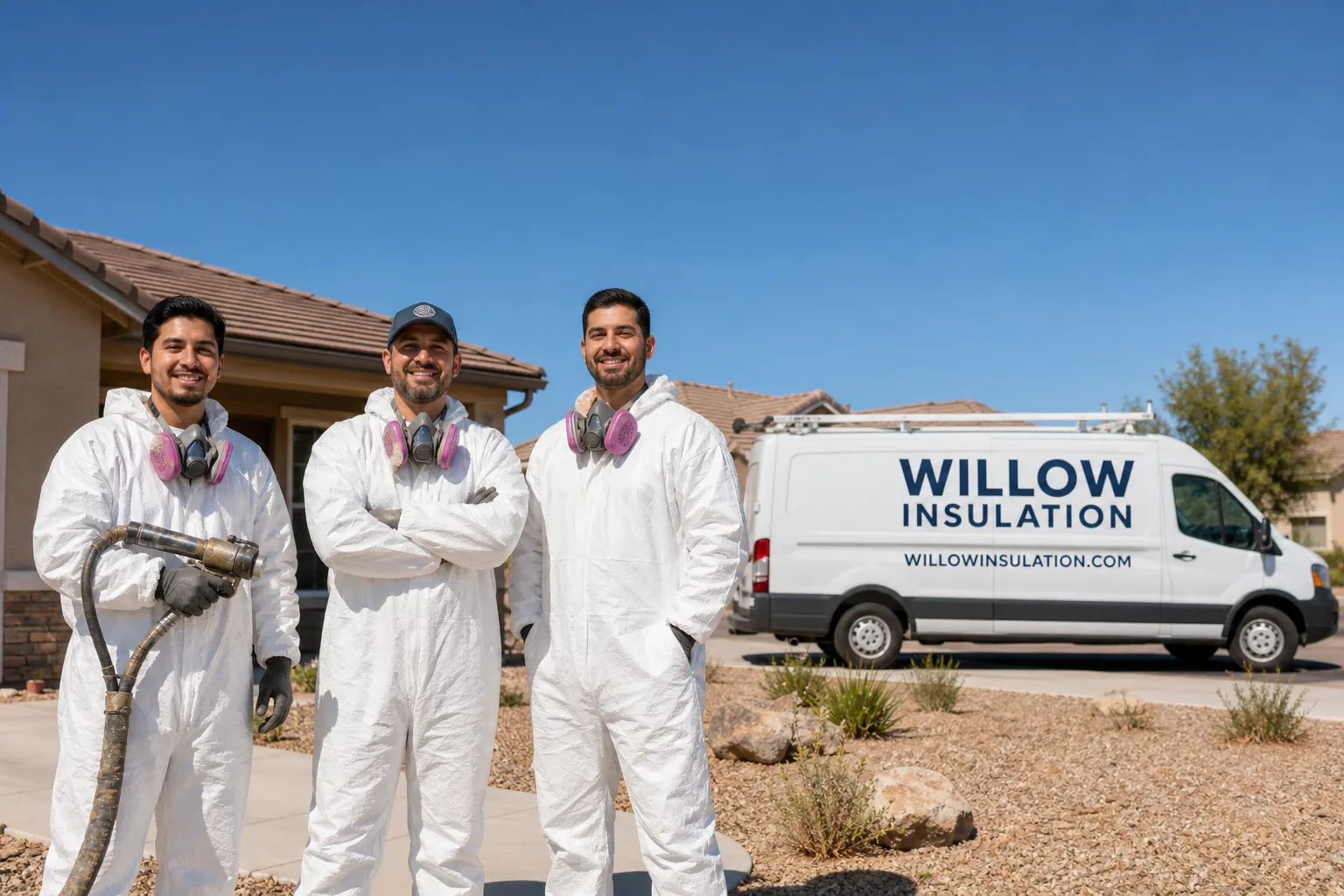
Fast, Reliable Spray Foam Insulation Across Chino
Spray foam insulation in Chino costs roughly $2.25 to $4.75 per board foot for open-cell and $3.50 to $6.50 for closed-cell, with most attic jobs landing between $4,500 and $12,000 depending on square footage and foam type. We’re Willow Insulation, and we work throughout 91708 and 91710 weekly. When attic temperatures in Chino climb past 140°F in July and your upstairs rooms won’t drop below 85°F, that’s the problem we solve. Call (855) 473-6541 and we’ll walk your attic with you, measure the roof deck, and show you exactly where your cooling dollars are leaking out.
Why Willow Insulation Is Chino’s Preferred Spray Foam Insulation Company
Noel Castaneda built Willow Insulation around a simple idea: carry the material that fits the home, not the other way around. That matters in Chino because the city has two very different housing stocks. A 1960s single-story off Riverside Drive in 91710 needs something entirely different from a 2005 Preserve-area tract home off Pine Avenue in 91708. We stock both Icynene and Demilec spray foam systems, which means we’re not going to recommend the one foam we happen to have on the truck. The recommendation comes from what your attic actually needs.
Chino homeowners call us after summers spent fighting a thermostat that runs all afternoon and never catches up. The fix usually starts in the attic. We’ve sprayed foam in dozens of homes across the city, from older postwar neighborhoods near Chino High to newer builds east of the 71. The teams know the local building patterns well enough to spot the failure points before we even open the hatch.
Response time to Chino from our Victorville yard runs about 45 to 60 minutes for assessments. Same-week installs are common outside peak summer demand. We carry a strong local reputation among Chino customers, earned one attic at a time. When we say we know what your house needs, it’s because we’ve crawled through enough Chino attics to recognize the pattern immediately.
Spray Foam Insulation Contractors in Chino
Spray foam insulation contractors in Chino do two main jobs: seal the thermal boundary where conditioned air meets attic heat, and add R-value where the existing insulation has failed. In Chino’s climate, the first job matters more than the second. When the Santa Ana winds push 100°F air across the Chino Valley in September, the difference between a sealed attic and a leaky one shows up on your bill within days. A typical contractor-applied spray foam job here runs $2.25 to $4.75 per board foot for open-cell, installed at 3 to 5.5 inches in attic assemblies, and $3.50 to $6.50 per board foot for closed-cell at 2 to 3 inches.
Open-cell for valley heat
Open-cell foam expands aggressively and fills the gaps between rafters and top plates. For most Chino attics, open-cell at the roofline is the workhorse fix. It air-seals and insulates in one pass. We typically specify Icynene open-cell here because it holds its shape through the 40°F-plus temperature swings between summer afternoons and fall nights without cracking or pulling away from the deck.
Closed-cell for roof decks and ducts
Closed-cell earns its price when the roof deck is tight, the HVAC ducts run through the attic, or there’s a moisture concern. At R-6.5 to R-7 per inch, it packs more thermal resistance into less depth. In Chino homes where the furnace and supply trunks run through unconditioned attic space, closed-cell encapsulation around ductwork delivers the biggest single comfort improvement we see.
Spray Foam Attic Insulation in Chino
Spray foam attic insulation in Chino works differently depending on which side of the city you live in. In 91710 postwar homes, the original blown-in fiberglass or mineral wool has usually settled to half its rated depth after decades of valley heat cycling. You might have R-19 written on the framing and R-9 in reality. Spray foam applied to the roofline bypasses the settled floor insulation entirely and creates a new thermal boundary at the deck. In 91708 Preserve-area homes, the attic floors are often insulated to minimum code, but the roof decks are unsealed, and the attic reaches 140°F by 2 p.m. Spray foam locks that heat out of the living space. Typical attic jobs in Chino run $4,500 to $12,000 depending on deck surface area and foam type.
Roofline sealing for 91708 builds
The Preserve-area homes have open attic spaces and plenty of vents. That’s fine for winter ventilation and terrible for summer cooling. We spray the underside of the roof deck, sealing the ridge and soffit vents. The attic becomes semi-conditioned. Upstairs bedrooms stop fighting the 40°F differential between the ceiling drywall and the attic air.
Encapsulating settled attic floors
In older Chino homes, we often leave the settled insulation in place and address the attic floor’s air leakage separately. Spray foam goes along the soffit-to-wall junctions and any chase penetrations. That stops the chimney effect that pulls conditioned air out of the house through every gap in the top plates. It’s the reason a 1963 home off Central Avenue can hold temperature as well as a new build.
Trusted Brands We Service in Chino
Willow Insulation installs both Icynene and Demilec spray foam systems, and we carry fiberglass, mineral wool, and cellulose lines from Owens Corning, Johns Manville, Knauf, and GreenFiber. That breadth means the material recommendation comes from the job, not from inventory. For spray foam specifically, the duel between Icynene open-cell and Demilec closed-cell covers every attic profile we see in Chino. We keep both systems stocked for Chino customers, which means no week-long waits for material when your attic’s already hitting 135°F.
Common Spray Foam Insulation Problems We See in Chino Homes
- Builder-grade open-cell shrinking at the roof deck. When Chino summers push attic temperatures past 140°F repeatedly, cheap open-cell foam can off-gas and pull back from the decking, opening hairline air gaps along the rafters. We see this in 2000s-era Preserve homes where the original installer used the cheapest available system. The fix is a proper Icynene or Demilec application at the correct depth.
- Settled original insulation trapping heat pockets. In 91710 homes, the original blown-in insulation compacts to half its depth, leaving the attic floor uneven. If you spray foam directly over it without addressing the air gaps at the soffits and top plates first, the foam seals the uneven floor but leaves thermal bypasses at the wall junctions. The result looks sealed and isn’t.
- Dairy-dust clogged foam pores. Chino’s agricultural history means fine particulates still drift across the city when the Santa Ana winds kick up. We’ve pulled back attic hatches in homes off Euclid Avenue and found a thin layer of dust settled on open-cell foam. That dust works into the foam’s open pores over time and reduces its effective R-value. Closed-cell at the roofline avoids this entirely.
- Upstairs rooms running 10 to 15 degrees hotter than downstairs. This is the number one call we get from 2000s-era Chino homes with vaulted ceilings and bonus rooms over garages. The roof deck radiates heat through the ceiling assembly all afternoon. Open-cell foam at the roofline stops the radiant transfer, and the temperature delta drops fast.
Pricing for Spray Foam Insulation in Chino, CA
Open-cell spray foam in Chino runs $2.25 to $4.75 per board foot installed. Closed-cell runs $3.50 to $6.50. A standard 1,500-square-foot attic with roofline application runs $4,500 to $9,000 for open-cell and $7,000 to $12,000 for closed-cell, depending on deck geometry, duct encapsulation needs, and prep work. Rim joist spray foam for a typical Chino home adds $900 to $1,800. Garage ceiling applications run $2,500 to $5,500. The two biggest cost factors are the attic’s deck surface area and whether the existing insulation needs removal or containment first. We quote both foam types side by side so you can see the trade-off. Estimates are free. Call (855) 473-6541 and we’ll measure your attic before we talk numbers.
We Also Serve Cities Near Chino
Our crews cover Chino and the surrounding Chino Valley communities, including Los Serranos, Ontario, Montclair, and Eastvale. If you’re in a neighboring city and want the same material-agnostic approach from our Spray Foam Insulation team, we’re usually 30 to 60 minutes out. You’ll get the same dual-brand foam choice and the same attic-level assessment whether you’re off the 71 in Chino or up against the foothills in Montclair.
Serving Chino, CA — Our Local Coverage Area
We’re based in the Chino area and know this community well. Use the map below to see our service coverage — if you’re nearby, we can almost certainly help.
FAQs About Spray Foam Insulation in Chino
Yes, in most cases spray foam can be applied at the roofline without touching the settled insulation on the attic floor. The existing blown-in material stays in place, and the foam creates a new thermal and air boundary at the roof deck. In some Chino homes we recommend removing the old material first if it’s blocking soffit access or if there’s evidence of rodent activity, but the default approach is to leave it and spray the deck above it. Call (855) 473-6541 and we’ll tell you which path fits your attic during the free assessment.
Spray foam air-seals while it insulates, and batts do not. In Preserve-area homes with open attics and soffit vents, fiberglass batts on the attic floor slow conductive heat transfer but do nothing to stop the hot attic air from pushing through recessed lights, wiring penetrations, and top-plate gaps. Spray foam at the roofline seals every one of those bypasses and turns the attic into a buffer space instead of an oven. That’s why a 2005 tract home with foam at the deck can run its AC noticeably less than an identical neighbor with fresh batts.
Yes. Closed-cell spray foam at the roofline and soffit junctions physically blocks the fine dust and wind-driven particulates that blow across the Chino Valley during Santa Ana events. Open-cell foam filters some dust but its open pores can slowly load with particulates over time. If dust intrusion is a specific concern, we recommend closed-cell at the deck or open-cell with a sealed attic assembly that eliminates the vented air path entirely. The dust stops entering because the air stops entering.
For Chino’s hot-valley climate, we spec open-cell foam at 5 to 5.5 inches at the roofline, which delivers roughly R-18 to R-20 and air-seals the assembly. Closed-cell at 3 inches delivers R-19.5 to R-21 with a vapor barrier and higher compressive strength. The 140°F-plus attic temperatures here mean the air-sealing matters more than the raw R-value. A 5-inch open-cell application on the deck of a Chino attic will cut the radiant heat transfer into the ceiling below far more effectively than R-38 of settled blown-in on the floor.
Usually, yes. The upstairs-hot problem in 2000s-era Chino homes is almost always a roof-deck radiant-heat issue rather than an HVAC balancing issue. When the attic hits 140°F and the ceiling drywall underneath is uninsulated or undermaterialized, the upstairs rooms act like a convection oven. Spray foam at the roofline stops the heat before it enters the ceiling cavity. We’ve seen upstairs temperatures drop by 8 to 12 degrees on a triple-digit afternoon after a single-day foam application. Call (855) 473-6541 and we’ll come measure your ceiling cavities and deck surface. The estimate is free, and we’ll show you the exact cost for your home before you commit.
Contact Willow Insulation for Spray Foam in Chino
If your Chino home is fighting the valley heat and losing, spray foam is the most durable fix we know. Noel Castaneda and the Willow Insulation crew work in Chino every week, from older 91710 ranchers to Preserve-area builds in 91708. We carry both Icynene and Demilec spray foam systems, and we’ll recommend the one your attic actually needs. Call (855) 473-6541 for a free estimate and honest numbers before the next heat wave hits.
Written by Noel Castaneda, Owner at Willow Insulation, serving Chino since our founding from Victorville, CA.