
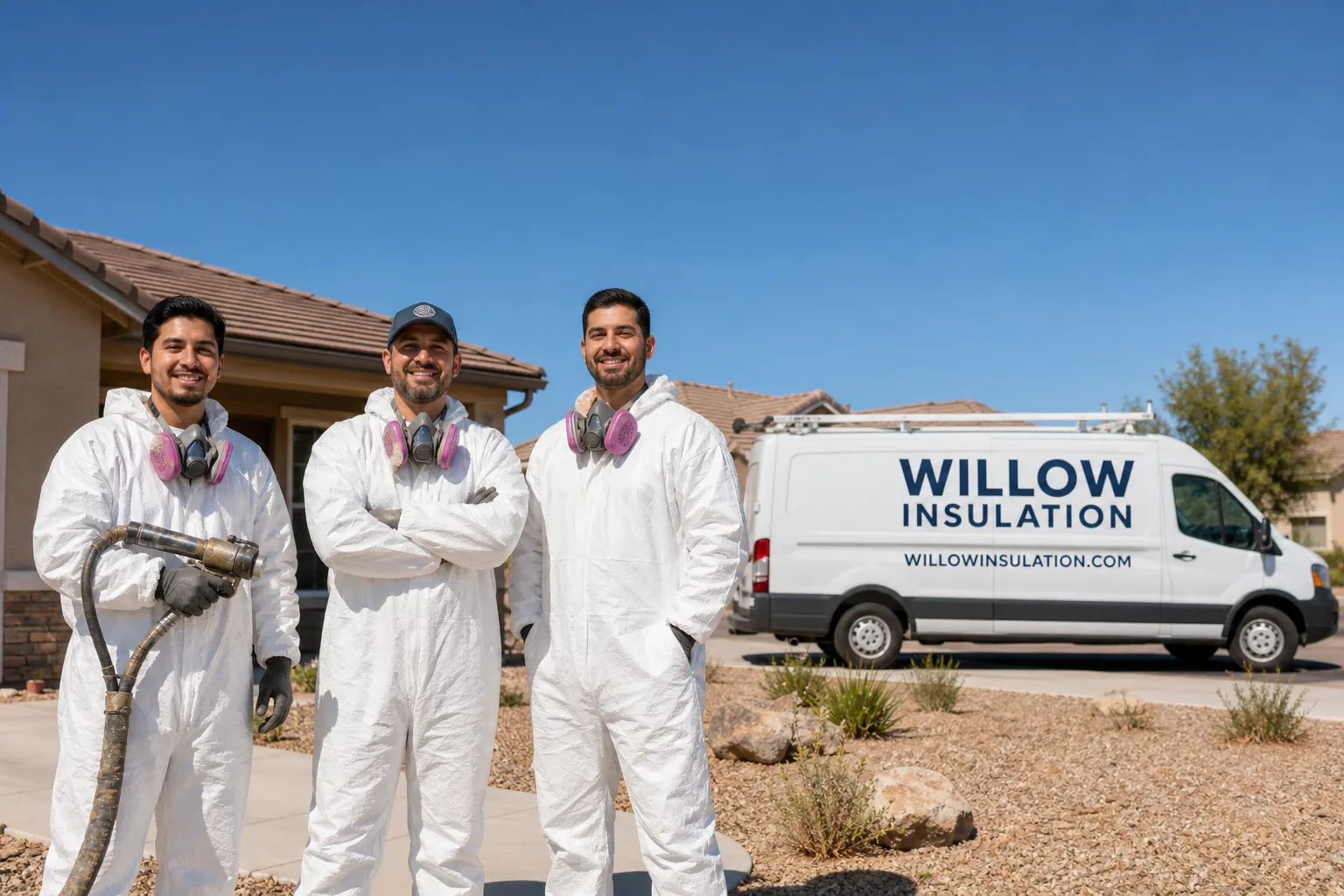
Fast, Reliable Attic Insulation Across Valinda
Most Valinda attics are fighting a losing battle against heat. In this unincorporated San Gabriel Valley pocket, summers routinely push past 100°F, and the original insulation in 1950s and 60s tract homes has long since compacted, drifted, or been chewed through. What most homeowners feel first is a ceiling that stays warm hours after sunset and a bedroom that never quite cools down. Our Attic Insulation team works across every Valinda street from Stimson Avenue to the neighborhoods off Amar Road, and the fix usually starts with something most contractors skip: the soffit vents. If your attic can’t breathe, new insulation won’t solve the problem. Call (855) 473-6541 and we’ll come out, climb up, and show you what’s actually going on before we recommend anything.
Why Willow Insulation Is Valinda’s Preferred Attic Insulation Company
We’ve been inside enough Valinda attics to know the patterns. The 91744 housing stock is mostly single-story stucco ranch homes with low-pitch roofs and wood-frame attics. The original loose-fill from that era settles to a fraction of its advertised depth. The soffit vents get buried. The wiring, much of it knob-and-tube-era or early romex, runs low across the joists where careless installers can create genuine hazards. We train our crews to see these conditions before they touch a bag of insulation. That’s why homeowners in Valinda call us for a second opinion after another company quoted them a simple top-up without ever opening the attic hatch.
Noel Castaneda built Willow Insulation on a simple idea: carry the right material for the house, not the house for the material. Our broad portfolio across Owens Corning, Johns Manville, and Demilec means we’re never steering you toward the one product sitting in our warehouse. You get the recommendation that fits your attic, your wiring situation, and your budget. And because we carry everything from cellulose blown-in to closed-cell foam, we don’t have to pass up the best solution because we can’t install it.
When a Valinda homeowner calls, we can typically get a specialist out the same week. Good insulation work is measured and careful, not rushed, but we also know that a 100°F week is not the time to wait three weeks for someone to show up. Our local scheduling keeps response times short, and our crews know the streets, the access issues, and the parking realities of Valinda’s older neighborhoods.
Attic Ventilation in Valinda
Attic Ventilation is the single most overlooked piece of an insulation job in Valinda, and it’s where we start almost every time. In these low-pitch post-war attics, the original soffit vents are typically choked by decades of settled insulation and debris, which means the attic becomes a sealed heat chamber. Restoring airflow is the foundation before any new R-value goes in. That work typically involves clearing the soffit line, installing baffles to keep new fill from re-blocking the intake path, and verifying that a ridge or gable exhaust path exists. In Valinda, a ventilation-first approach usually runs $450 to $1,200 depending on how many soffit bays are blocked and whether the home needs additional exhaust vents added.
Clearing and Baffling the Soffit Line
This is the unglamorous first step that separates a lasting fix from a repeat visit. We pull back the settled fill along the eaves, expose the original vent openings, and install foam or cardboard baffles to keep the path open. In most Valinda attics, the soffit vents are still there but functionally dead, covered by a two-inch mat of compacted cellulose or fiberglass that drifted outward over fifty years.
When a Powered Attic Vent Makes Sense
Some Valinda ranches have such limited ridge area that passive airflow alone won’t move enough heat out. A thermostatically controlled powered vent can pull hundreds of cubic feet per minute through the attic, which matters on days when ambient temperatures cross the century mark and the roof deck bakes. We’ll recommend it when the math supports it, not because it’s an easy add-on.
Radiant Barrier in Valinda
Radiant Barrier is the most effective way to cut heat transfer in a Valinda attic, and it’s a specific product with a specific job: reflecting radiant heat from the underside of the roof deck before it becomes an air temperature problem. In Valinda’s dry inland climate, where 90 to 105°F days are routine from June through September, a radiant barrier installed on the rafter undersides can reduce attic temperatures by 15 to 25 degrees in direct sun. A typical Valinda single-story home runs $1,500 to $3,200 for a proper radiant barrier install, depending on roof area and whether the attic is accessible enough to work in safely.
Radiant Barrier With New Batts or Blown-In
The best results come when the radiant barrier and the insulation work together. The barrier knocks down the infrared load from the roof deck, and the insulation below handles the remaining conducted and convected heat. We install the barrier first, then lay or blow the insulation, so the final system functions as one layer instead of two independent products competing for the same ceiling plane.
What Radiant Barrier Won’t Do
It won’t replace insulation. A radiant barrier without adequate R-value underneath is like a sunshade over an uninsulated wall, it helps but the room still gets hot. In Valinda’s post-war homes we typically pair the barrier with R-38 fiberglass batts or a matching blown-in depth, so the ceiling assembly delivers the full thermal break you’re paying for.
Trusted Brands We Service in Valinda
We carry and install products from Owens Corning, Johns Manville, and Demilec on Valinda jobs, which means we’re never stuck recommending a compromise when a specific material is the right call. Owens Corning batts and rolls dominate our batt insulation work in Valinda’s tight, low-clearance attics. Johns Manville gives us a proven option for blown-in and roll products when project conditions favor a different density or coverage pattern. Demilec spray foam covers homes where venting is impossible or where a homeowner wants the added air-sealing that foam delivers. We stock the common sizes and densities for Valinda’s typical ranch floorplans, so turnaround on quoted work stays short without a supply-house run in the middle of your install.
Common Attic Insulation Problems We See in Valinda Homes
- Settled and drifted loose-fill: The 1950s and 60s fill in Valinda attics has compacted to a fraction of its original depth, and it migrates toward the center of the attic over time, leaving bare runs near the eaves and around the HVAC platform. You can’t see it from the access hatch, and it’s the reason so many Valinda homes have hot ceilings despite “having insulation up there.”
- Blocked soffit vents from decades of debris and drifting fill: The original intake path is buried, turning the attic into a heat trap that pushes radiant heat back through the ceiling drywall no matter how many new batts get layered on top. Clearing the vents is the first move, before any R-value math matters.
- Knob-and-tube-era and early romex wiring running low across the joists: These wires sit exactly where new loose-fill wants to go, and burying them under insulation can create an overheating hazard. We route, protect, or recommend rewiring before any fill is added in a Valinda attic, and we won’t cut that corner.
- Low-pitch roofs making every attic tighter and hotter: The ranch and low-slung tract layouts that define Valinda don’t leave much attic cubic footage to begin with, so the heat load concentrates fast. That’s why ventilation and radiant barrier work matter more here than in newer two-story neighborhoods where attics are taller and better vented by design.
Pricing for Attic Insulation in Valinda, CA
A full attic insulation project in Valinda, including ventilation prep and new insulation, typically lands between $2,800 and $5,500 depending on attic size, access difficulty, and how much of the existing material needs to be removed first. A straightforward blown-in top-up over cleared vents runs $1,400 to $2,800 for a typical 91744 ranch. Batt insulation replacement with Owens Corning R-38 batts runs $2,200 to $4,500 on a standard Valinda single-story. Radiant barrier adds $1,500 to $3,200 when installed alongside insulation. The variables that move the price in Valinda are attic height, wiring conditions that need addressing, and whether the old fill contains debris that requires a full removal before new material goes in. Call (855) 473-6541 for a written quote, estimates are free and we show you exactly what’s in your attic during the walkthrough.
We Also Serve Cities Near Valinda
Our crews work throughout the San Gabriel Valley and the adjacent foothills, so we’re out in La Puente on a regular rotation, and we run West Covina, South San Jose Hills, and Hacienda Heights on a weekly basis. Our Valinda presence is part of a larger local footprint, and we schedule by neighborhood rather than by zip code.
Serving Valinda, CA — Our Local Coverage Area
We’re based in the Valinda area and know this community well. Use the map below to see our service coverage — if you’re nearby, we can almost certainly help.
FAQs About Attic Insulation in Valinda
In almost every case we see, the soffit vents are blocked by settled insulation or debris, so the attic traps heat and pushes it back through your ceiling regardless of what’s sitting on top of it. The fix starts with clearing the vent path and installing baffles, then evaluating whether the existing R-value is doing any meaningful work at all. Call (855) 473-6541 and we’ll show you the actual condition of your attic before recommending anything.
For Valinda’s inland heat, R-38 is the working minimum for a vented attic, and R-49 makes sense when the attic can support it and the ceiling plane is sealed properly. The R-value number only matters if the ventilation and air-sealing are right first, adding R-49 on top of a blocked, suffocated attic is money spent on paper performance.
Yes, this is standard work for our crews in Valinda’s 1950s and 60s homes. We identify the wiring paths before any fill or batts go in, keep combustible insulation away from conductors, and recommend routing or rewiring where the existing configuration would create a hazard. We won’t bury live wiring under new insulation and call it done.
It makes a measurable difference, especially on west-facing roof planes that take direct afternoon sun. On a 103°F day, a properly installed radiant barrier can drop attic temperatures by 15 to 25 degrees, which changes how hard your HVAC system has to work. It works best as part of a system with cleared vents and adequate insulation underneath.
We work low and slow in tight attics, and we carry materials that fit through narrow access hatches and into shallow joist bays. Batts often work better than blown-in fill in very low clearance because the material stays where it’s placed and doesn’t drift into the soffit line, and we know which Valinda homes need that approach before we start.
Written by Noel Castaneda, Owner at Willow Insulation, serving Valinda and the San Gabriel Valley.