
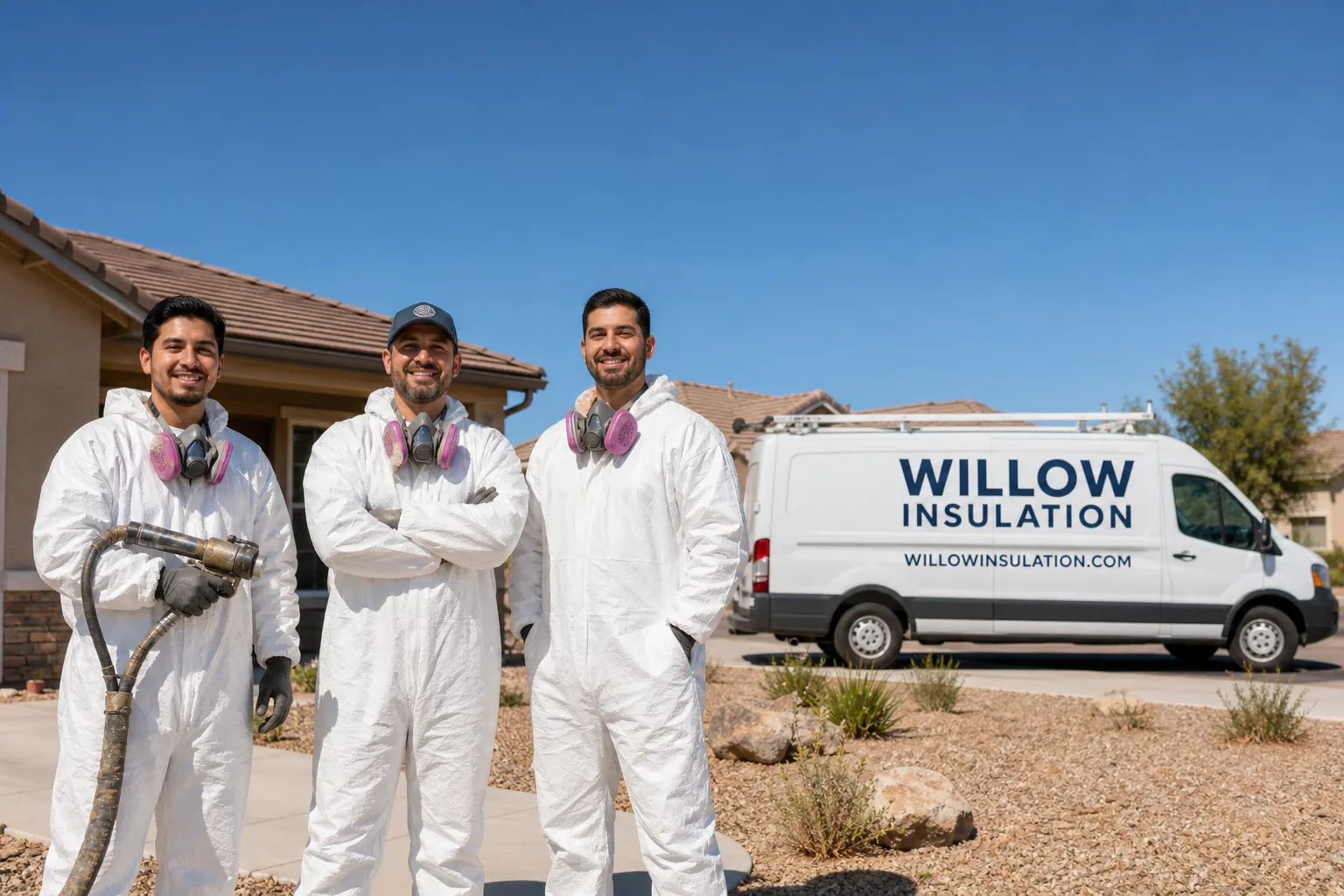
Fast, Reliable Spray Foam Insulation Across Wrightwood
Spray foam insulation in Wrightwood runs $2.20 – $6.80 per square foot installed, with most whole-home projects landing between $4,800 and $14,000 depending on the roof deck, crawlspace, or wall cavity involved. We work throughout the 92397 zip code year-round, including the snow months when other contractors pull back. Our crews know Lone Pine Canyon Road, Highway 2, and the cabin clusters off Angeles Crest because we’re up here regularly, not once a season. If your A-frame or mountain cabin is leaking heat through the roof, call (855) 473-6541 and we’ll schedule a walkthrough within days, not weeks.
Why Willow Insulation Is Wrightwood’s Preferred Spray Foam Insulation Company
Wrightwood homeowners call us because we show up ready for real mountain conditions. Our Spray Foam Insulation team has worked on mid-century cabins, ski leases, and full-time residences across the village, and we understand what a 1960s tongue-and-groove ceiling means for an insulation plan. Noel Castaneda personally reviews job specs that involve cathedral ceilings or tricky roof planes. That level of attention is why our Wrightwood customers tend to hear about us from their neighbors rather than a billboard.
We’re not a general handyman service dabbling in foam. We’re insulation specialists carrying eight manufacturer lines, including Icynene and Demilec spray foam systems, GreenFiber cellulose, and Owens Corning fiberglass. That matters in Wrightwood because the right answer for a vaulted A-frame roof is often different from the right answer for a pier-and-beam crawlspace. Having the full portfolio means we recommend what actually fits the house, not what’s sitting in the truck.
Response time to Wrightwood from our Victorville base is straightforward: we route crews up Highway 138 through Phelan and arrive with equipment sized for tight mountain driveways. No drama, no rescheduling because of a little snow. We plan around the weather window and get the foam applied when it needs to be.
Garage Spray Foam Insulation in Wrightwood
Garage Spray Foam Insulation in Wrightwood usually targets the ceiling cavity between the garage and the finished space above, or the rim joist where the garage walls meet the foundation. In mountain homes, garages are often unheated and built with minimal framing depth, which makes them a major source of cold air that soaks through shared walls into living areas. We see this constantly in homes where the master bedroom sits above a garage and the floor feels ten degrees colder than the hallway.
Typical garage ceiling spray foam in Wrightwood runs $1,800 – $4,200 for a two-car garage, depending on whether we’re spraying open-cell or closed-cell and whether the space has drywall in place or exposed joists. Exposed joists make the job faster and cheaper. Finished drywall means we cut access holes or work from above, which adds labor.
Cold Floors Above the Garage
When Wrightwood homeowners tell us the bedroom floor above the garage stays cold all winter, the fix is almost always air sealing plus spray foam on the garage ceiling. Closed-cell foam at 3 inches in that assembly stops the thermal bridging through the joists. We bond the foam tight to the subfloor so warm air from the house stops getting pulled into the cold garage cavity.
Rim Joist Sealing in Mountain Garages
The rim joist is the wood band running around the perimeter of the garage where the walls sit on the foundation. In Wrightwood’s older cabins, these rim joists are often uninsulated or stuffed with fiberglass that’s gone flat and damp. Foaming the rim joists cuts the drafts that whip through the garage and into the wall cavities above. It’s a small job, sometimes under $800, but it changes how the whole lower level holds heat.
Closed Cell Spray Foam Insulation in Wrightwood
Closed Cell Spray Foam Insulation in Wrightwood is the workhorse for roof decks, cathedral ceilings, and any surface that faces snow load, ice, or bulk moisture. At roughly 6,000 feet on the San Gabriel crest, we get freeze-thaw cycles that punish open-cell foam in the wrong location. Closed-cell foam at 2 inches acts as a vapor barrier and adds structural rigidity, which is why we recommend it for the underside of roof sheathing in A-frames and cabins with no venting chase.
Expect closed-cell spray foam in Wrightwood to run $3.20 – $6.80 per square foot installed. A full roof deck on a 1,200 square foot A-frame typically lands between $5,800 and $9,000. It’s not the cheapest option, but it’s often the only one that solves ice dams and condensation without rebuilding the roof assembly.
Ice Dam Prevention at the Roof Deck
When you see heavy icicles and ice build-up at the eaves of a Wrightwood A-frame, the root cause is warm interior air leaking into the roof plane and melting snow from underneath. Closed-cell foam sprayed directly to the underside of the roof deck seals those leaks and keeps the attic surface cold enough that snow doesn’t melt and refreeze at the eave. It’s a permanent fix, not a heat-cable bandage.
Snow Country Unvented Cathedral Ceilings
Older Wrightwood cabins with cathedral ceilings rarely have a vented air channel between the drywall and the roof deck. Closed-cell foam is the only product that can be applied directly against the roof sheathing in an unvented assembly without trapping moisture in the structure. We spray it to the required depth, and the ceiling becomes part of the thermal envelope. The exposed beams stay exposed. That’s the whole point for most of our clients.
Trusted Brands We Service in Wrightwood
Willow Insulation installs both Icynene and Demilec spray foam systems, which means we cover the full open-cell and closed-cell range without needing to bring in a subcontractor. For Wrightwood customers that translates to realistic recommendations. A warm-cabin retrofit with exposed beams might call for Icynene open-cell on interior walls and Demilec closed-cell at the roof. We also stock Owens Corning and certain other fiberglass products for hybrid jobs where the budget calls for combining foam with batts. Carrying this many lines means we’re never steering a Wrightwood homeowner toward the wrong material because it’s all we have.
Common Spray Foam Insulation Problems We See in Wrightwood Homes
- Ice dams on cathedral ceilings: Thin original insulation and air leaks around the ridge let heat escape into the roof plane, melting snow that refreezes at the eaves. We trace these to poor air sealing or old collapsed fiberglass and fix them with closed-cell foam at the roof deck.
- Condensation and rot from unsealed roof decks: Freeze-thaw cycles in Wrightwood drive moisture into roof sheathing where spray foam wasn’t applied to the underside. Once the sheathing stays wet through a few freeze cycles, the plywood delaminates and you’ve got a structural problem, not just a comfort one.
- UV degradation of exposed foam: Spray foam left uncovered in unvented attics or crawlspaces breaks down under direct sunlight and high-altitude UV. Wrightwood gets intense summer sun even when the air temperature is cool. Foam in service bays or knee walls needs a cover, or it chalks and flakes within a few seasons.
- Drafty pier-and-beam crawlspaces: Wrightwood’s older mountain cabins often sit on pier-and-beam foundations with open vented crawlspaces. Cold air moves under the entire floor in winter, and the plumbing runs through that same freezing space. Closed-cell foam at the subfloor underside and rim joists keeps the floor warm and the pipes from freezing.
Pricing for Spray Foam Insulation in Wrightwood, CA
We already hit the main numbers above. To put it all in one place: open-cell spray foam in Wrightwood typically runs $2.20 – $4.00 per square foot, closed-cell runs $3.20 – $6.80 per square foot, rim joist packages run $1,200 – $2,600, and garage ceiling jobs run $1,800 – $4,200. What moves the price is access. A roof deck with a simple gable shape is faster than a complex A-frame with dormers and exposed collar ties. Crawlspaces with 30 inches of clearance cost less than crawlspaces with 14 inches. Every estimate from Willow Insulation is itemized and free. Call (855) 473-6541 and we’ll put numbers on paper before you commit to anything.
We Also Serve Cities Near Wrightwood
Our insulation crews work throughout the high desert and mountain communities around Wrightwood, including Piñon Hills, Phelan, Oak Hills, and San Antonio Heights. If you’re just down the grade in a tract home off Phelan Road or up the back way through Lone Pine Canyon, the same crew and the same equipment handle the job. We schedule by route so you’re not waiting for a crew that’s three towns over.
Serving Wrightwood, CA — Our Local Coverage Area
We’re based in the Wrightwood area and know this community well. Use the map below to see our service coverage — if you’re nearby, we can almost certainly help.
FAQs About Spray Foam Insulation in Wrightwood
Yes, spray foam is often the only insulation that works in a Wrightwood cathedral ceiling with exposed beams, because there’s no venting chase and no room for batts. Closed-cell foam applied directly to the underside of the roof deck seals the assembly and keeps the beams visible from below. We mask the beams before spraying, then trim back to them so the tongue-and-groove look stays intact. Call (855) 473-6541 for an exact quote on your ceiling.
Closed-cell spray foam handles Wrightwood’s snow load and freeze-thaw cycles better than any batt or blown-in product because it air-seals the roof plane and stops the warm-air leakage that causes ice dams. The foam also adds shear strength to the roof deck, which helps in heavy snow years. If you’re seeing icicles at the eaves every winter, the roof deck is where we’d start.
Yes, closed-cell spray foam is the right call for unheated crawlspaces in Wrightwood’s older pier-and-beam cabins. It insulates the subfloor from below and blocks the cold air and moisture that rise through the floorboards. It also keeps plumbing runs from freezing during hard snaps. Open-cell foam is the wrong product for a crawlspace because it can absorb moisture.
For Wrightwood’s climate, closed-cell foam delivers about R-6.5 per inch and acts as a vapor barrier, while open-cell delivers about R-3.7 per inch and lets vapor pass through. Closed-cell is what we recommend for roof decks, crawlspaces, and any surface facing snow, ice, or moisture. Open-cell works well on interior partition walls and soundproofing at a lower cost. Call (855) 473-6541 and we’ll walk you through what fits your specific cabin.
Yes, spray foam handles Wrightwood’s high-altitude sun and wide temperature swings because it forms a continuous air seal that slows heat transfer through the roof assembly. Closed-cell foam at the roof deck keeps summer heat out and winter heat in. That’s what matters when the same roof goes from 20 degrees at night to 65 degrees under a high-desert sun the next afternoon.
Written by Noel Castaneda, Owner at Willow Insulation, serving Wrightwood and the San Gabriel mountain communities.