
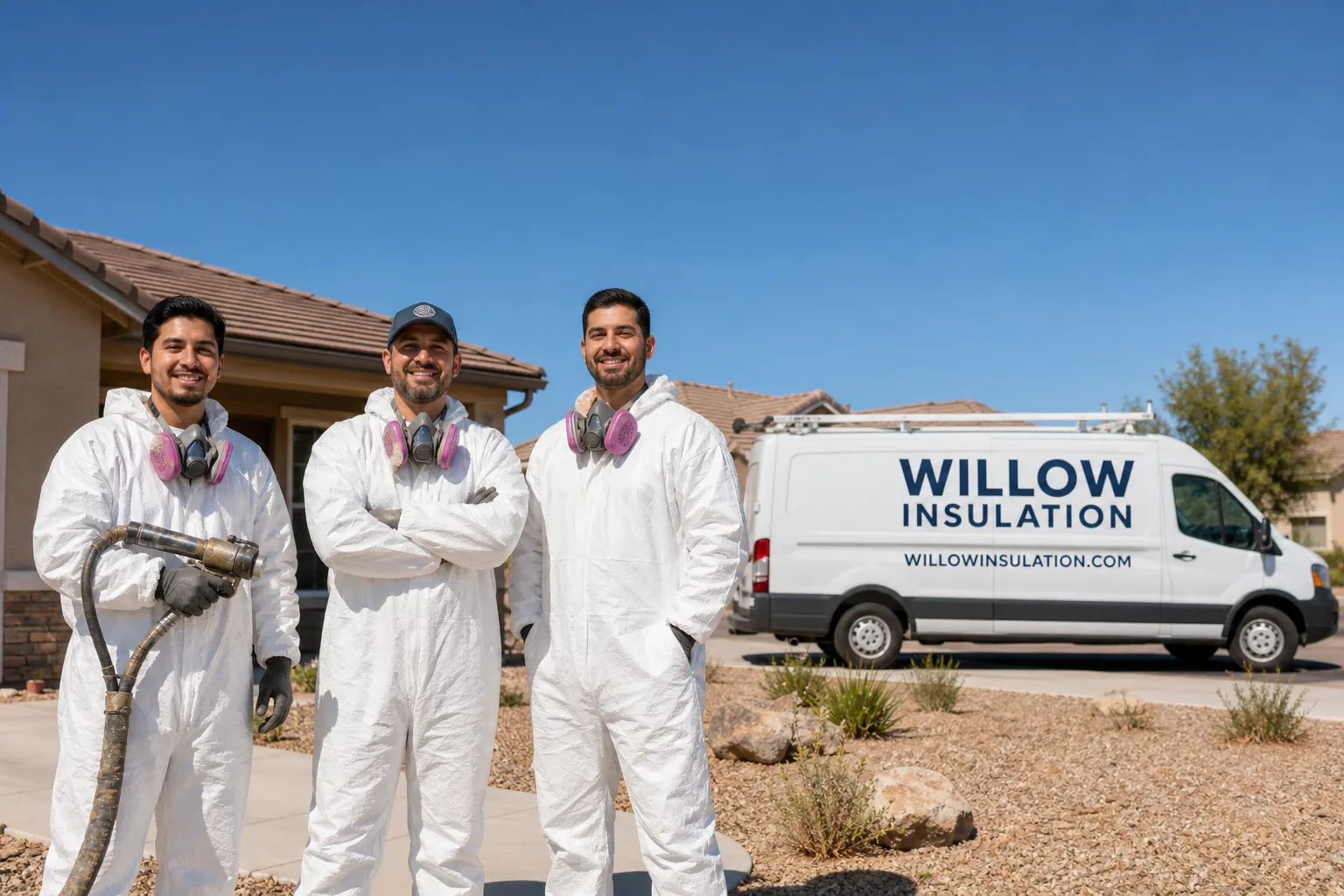
Fast, Reliable Spray Foam Insulation Across San Antonio Heights
Spray foam insulation in San Antonio Heights typically runs $2.40 to $6.80 per board foot depending on whether you need open-cell or closed-cell, with most hillside homes landing between $3,800 and $11,500 for a full attic or garage retrofit. We’re in and out of 91784 regularly, which means our crews know the winding roads, the gated driveways, and the quirks of hillside construction that flatland contractors miss. If your energy bills have climbed while your rooms still feel uneven, call us at (855) 473-6541 and we’ll walk through what your home actually needs.
We’re Willow Insulation, and we’ve worked on enough custom homes off Euclid Avenue and Mountain Avenue to know that San Antonio Heights homes don’t respond to generic insulation fixes. The combination of foothill elevation, older custom framing, and Santa Ana wind exposure means your spray foam job has to be planned around conditions that simply don’t exist in Upland or Rancho Cucamonga.
Why Willow Insulation Is San Antonio Heights’s Preferred Spray Foam Insulation Company
Noel Castaneda founded Willow Insulation on a simple principle: carry the broadest material lineup in the trade so the recommendation always fits the house, not our inventory. That’s why we install both Icynene and Demilec spray foam systems, alongside Owens Corning, Rockwool, GreenFiber, and five other manufacturer lines. When a San Antonio Heights homeowner needs closed-cell foam for a vaulted ceiling and blown-in cellulose for the attic floor, we handle both without subbing anything out.
Homeowners across 91784 consistently mention three things in reviews: we show up when we say we will, we explain the material options without pushing a single product, and we respect the fact that many of these hillside properties require more than a standard batts-and-go job. Our response time to San Antonio Heights is typically same-day or next-morning for estimates, and our crews are familiar with the limited attic access and irregular framing common to mid-century custom builds in the foothills.
Working on homes where the original insulation was installed fifty or sixty years ago changes how we approach every step. We check soffit vents for wind intrusion, look for compacted fiberglass, and assess whether the existing air sealing is even worth keeping. That’s local knowledge you won’t get from a contractor who only sees tract homes.
Garage Spray Foam Insulation in San Antonio Heights
Garage Spray Foam Insulation in San Antonio Heights is one of the most requested services we handle, and it usually costs between $1,900 and $5,400 depending on whether the garage is attached, detached, or finished as living space. Many homes in 91784 have garages carved into the hillside or built under the main floor, which means the garage ceiling is often the floor of a bedroom above. Spraying closed-cell foam against that shared surface stops both heat transfer and the low-frequency noise from openers, tools, and vehicles.
For older hillside garages with exposed rafter bays, we prep the substrate carefully because the irregular framing means foam depth can vary dramatically across a single ceiling. A rushed application leaves thin spots that undermine the thermal barrier.
Garage Ceiling and Overhead Door Surrounds
Air leaks around garage doors and the surrounding framing are a major source of energy loss in San Antonio Heights garages. We seal the perimeter and any knee walls before spraying, which keeps Santa Ana wind from driving dust and hot air into the space.
Bonus Rooms and Attached Garages
When a garage becomes a workshop, gym, or guest suite, the insulation requirements change entirely. We’ll recommend the right foam density and thickness for your specific use, not just whatever’s easiest to spray.
Closed Cell Spray Foam Insulation in San Antonio Heights
Closed Cell Spray Foam Insulation in San Antonio Heights generally runs $3.20 to $6.80 per board foot, and it’s the material we recommend most often for hillside homes in 91784 with vaulted ceilings, irregular rafter bays, and existing wind-compacted fiberglass. Closed-cell foam adds structural rigidity, which matters on slope-adapted framing that has shifted over decades. It also acts as an air barrier and vapor retarder in one pass, a real advantage when you’re sealing an attic against wind-driven debris and ember intrusion.
We recently sprayed closed-cell foam in a custom hillside home off San Antonio Heights Drive, where the original fiberglass batts had been compacted by years of Santa Ana wind intrusion through soffit vents. Our crew used Icynene closed-cell foam to seal the irregular vaulted ceiling and air-seal the attic hatch, achieving a whisper-quiet, draft-free envelope that stabilized indoor temperatures during both summer spikes and cold winter nights.
Air Sealing and Wind Resistance
Closed-cell foam adheres directly to the sheathing, which means it stays put when Santa Ana winds hit 60 mph and try to push debris through soffit vents. That adhesion is the difference between a thermal barrier that lasts and one that fails after a single wind season.
Moisture Control in Foothill Conditions
Winter nights in San Antonio Heights run colder than the valley floor, and that temperature differential can create condensation on roof decking. Closed-cell foam’s low vapor permeability keeps moisture from accumulating inside the building envelope, protecting framing from rot.
Trusted Brands We Service in San Antonio Heights
We install Icynene and Demilec spray foam systems, and we also carry Owens Corning, Johns Manville, Knauf, Rockwool, and GreenFiber for when a project calls for a different material or a hybrid approach. Having eight manufacturer lines means we’re never forcing a single brand into a situation it’s not suited for. For San Antonio Heights customers, we keep the most common foam formulations and accessories stocked on our trucks, so a repair or touch-up doesn’t mean waiting on a distributor shipment from the valley.
Common Spray Foam Insulation Problems We See in San Antonio Heights Homes
- Wind-compacted fiberglass: After a Santa Ana event, attic insulation is often flattened or pushed aside by wind-driven debris and embers entering through soffit vents. This is rare in lower-elevation cities but common enough here that we check for it on every 91784 estimate.
- Irregular rafter bays and vaulted ceilings: Mid-century hillside homes were built slope-adapted, which means few surfaces are perfectly level or evenly spaced. Foam depth has to be adjusted in real time, not sprayed to a uniform thickness.
- Limited attic and crawlspace access: Custom homes off Euclid Avenue and Mountain Avenue frequently have tight access hatches and cramped crawlspaces. Missed air-sealing opportunities in those areas undermine the entire thermal envelope.
- Failed DIY or single-trade patches: Some homeowners tried fiberglass repairs or hired a generalist who didn’t address the air leaks. We often find foam that was applied over dusty or oily surfaces and has since delaminated, leaving cold spots and drafts.
Pricing for Spray Foam Insulation in San Antonio Heights, CA
Open-cell spray foam in San Antonio Heights typically runs $2.40 to $4.10 per board foot for attic and wall applications, while closed-cell runs $3.20 to $6.80 per board foot. A full garage retrofit usually lands between $1,900 and $5,400, and a complete attic air-seal plus closed-cell job on a custom hillside home often falls between $6,200 and $11,500. Irregular framing, limited access, and wind-damage remediation all push cost toward the higher end. We give a written, line-item estimate before any work begins, and the estimate is free. Call (855) 473-6541 and we’ll schedule a walkthrough.
We Also Serve Cities Near San Antonio Heights
Our crews cover San Antonio Heights along with Upland, Claremont, Rancho Cucamonga, and Montclair. If you’re in a neighboring community and want the same material-agnostic approach to Spray Foam Insulation, call us and we’ll schedule a time to assess your home. We don’t push one product. We fit the insulation to the house.
Serving San Antonio Heights, CA — Our Local Coverage Area
We’re based in the San Antonio Heights area and know this community well. Use the map below to see our service coverage — if you’re nearby, we can almost certainly help.
FAQs About Spray Foam Insulation in San Antonio Heights
Spray foam handles San Antonio Heights’ temperature swings better than fiberglass because it air-seals the building envelope, preventing the hot attic air from pushing into living spaces during summer and the cold foothill air from intruding on winter nights. Closed-cell foam, in particular, maintains its R-value almost regardless of the temperature differential across the roof deck. Call (855) 473-6541 for an exact assessment of your home’s thermal performance.
Yes, spray foam is actually the best material for irregular attics because it expands to fill whatever cavity shape exists, whether it’s a vaulted ceiling, a sloped rafter bay, or a tight knee wall. We’ve applied both Icynene and Demilec foam in hundreds of hillside homes across San Antonio Heights, and our crews adjust the foam depth in real time to match the framing.
The best approach is closed-cell foam on the garage ceiling and perimeter walls, paired with air-sealing around the overhead door surround and any shared wall with the living space. This combination reduces noise transmission and stops the garage from acting as a heat sink against your conditioned rooms. It’s the approach we recommend most often for 91784 homes with attached garages or hillside-under-laundry-room setups.
Closed-cell spray foam adheres directly to roof sheathing and wall framing, creating a continuous barrier that wind-driven debris cannot displace. Unlike loose-fill or batt insulation, which gets compacted and blown around, closed-cell foam stays put even during sustained 60 mph gusts. For San Antonio Heights homes near open ridgelines, we also recommend addressing soffit vent screens to reduce the debris that enters in the first place.
Yes, we’re authorized to install both Icynene and Demilec spray foam systems, which means we can offer open-cell and closed-cell options without being locked into a single manufacturer. Icynene closed-cell is our go-to for air-sealing and moisture control in hillside homes, while Demilec open-cell works well for interior wall cavities where sound control is a priority. Call (855) 473-6541 for a free estimate and we’ll match the right system to your home.
Written by Noel Castaneda, Owner of Willow Insulation, serving San Antonio Heights and the surrounding foothill communities with spray foam, attic, and blown-in insulation since 2012.