
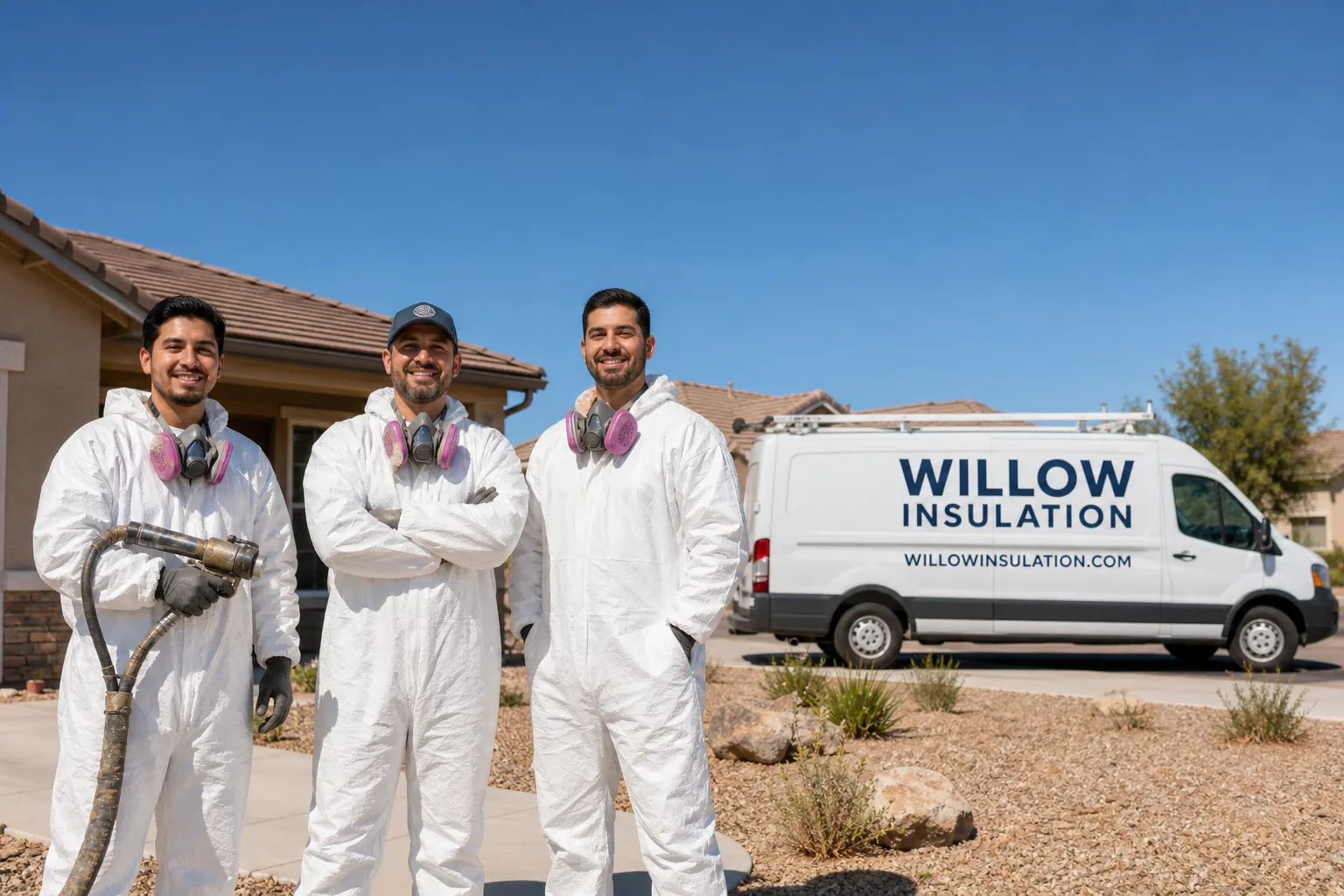
Fast, Reliable Spray Foam Insulation Across Riverside
Spray foam insulation in Riverside typically costs $2.50 to $6.00 per board foot installed, with most full attic or crawl space projects landing between $3,800 and $9,500 depending on square footage and foam type. We work throughout 92503, 92504, 92505, and 92506, from the postwar tracts off Magnolia Avenue to the acreage properties east of the 215. If you’re tired of rooms that never hold temperature or energy bills that spike every July, call us at (855) 473-6541 and we’ll walk you through what makes sense for your home, not just what’s in our warehouse.
Our Spray Foam Insulation team knows Riverside’s housing stock the way only a local crew can. We see the same ranch homes, the same detached workshops, and the same summer heat gain problems week after week. That repetition matters. It means we arrive with the right foam, the right prep plan, and a realistic timeline for your specific structure.
Why Willow Insulation Is Riverside’s Preferred Spray Foam Insulation Company
Homeowners across Riverside keep calling us back for one reason: we carry both Icynene and Demilec spray foam systems, so the recommendation you get is based on your home’s actual conditions, not what we happen to have on the truck. A 1960s ranch in 92504 with leaky ducts and a vented attic needs a different approach than a sealed workshop in 92506. We install both, so we tell you which one fits.
Noel Castaneda built Willow Insulation on the belief that an insulation contractor should do one trade and do it deeply. That means our crew shows up with eight manufacturer brands across spray foam, fiberglass, mineral wool, and cellulose. If spray foam isn’t the right answer for part of your home, we’ll say so and suggest Rockwool or GreenFiber instead. That material-agnostic honesty is rare in this trade, and it’s why Riverside homeowners who’ve been burned by one-product contractors end up staying with us for every subsequent project.
We also know Riverside’s schedule. The city runs on heat, and when a 100°F week hits, everyone wants insulation tomorrow. We prioritize Riverside calls and can usually get a crew to your property within a few business days, sometimes sooner. Free estimates at (855) 473-6541, and we quote in writing before any work starts.
Crawl Space Spray Foam Insulation in Riverside
Crawl Space Spray Foam Insulation in Riverside is one of the highest-impact fixes for older ranch homes where cold floors and musty smells never quite go away. In the 1950s – 1970s tracts around Arlington Avenue and the 92503 corridor, most crawl spaces were built with vented foundations and zero insulation on the floor assembly. That means every winter night in the low 40s transfers straight up through the floorboards. Closed-cell spray foam applied to the crawl space walls and rim joist turns that unconditioned space into a conditioned buffer, which stabilizes floor temperatures and cuts the stack effect that pulls hot attic air down through the house in summer.
A typical crawl space encapsulation with closed-cell foam in Riverside runs $4,200 to $7,800 for a 1,500 – 2,000 square foot home. Larger homes or those with significant moisture issues push toward the higher end. The price includes sealing the rim joist, which is where Santa Ana winds and winter drafts do their worst damage in Riverside’s older stock.
Rim Joist Sealing
The rim joist is the single leakiest part of most Riverside ranch homes. Closed-cell foam bonds to the wood and concrete, forming an air barrier that fiberglass batts simply cannot match. We see 15 – 20% energy loss through unsealed rim joists in homes off Magnolia and Arlington, and sealing them is often the first thing we recommend before any attic work.
Moisture Control for Riverside Crawl Spaces
Riverside’s semi-arid climate doesn’t mean dry crawl spaces. Winter rains and irrigation runoff can raise subfloor humidity significantly in low-lying pockets near the Santa Ana River. Closed-cell foam doubles as a vapor barrier, which is why we specify it for Riverside crawl spaces over open-cell alternatives.
Garage Spray Foam Insulation in Riverside
Garage Spray Foam Insulation in Riverside matters most for homeowners who actually use their garage, not just park in it. On Riverside’s acreage properties and in the larger lots east of the 215, garages double as workshops, gyms, and storage for temperature-sensitive equipment. An uninsulated garage in July hits 110°F by noon, and that heat radiates into adjacent living spaces for hours after sunset. Spray foam on the garage ceiling and shared walls drops that transfer dramatically, and for detached garages, it makes the space usable year-round.
We recently foamed the detached workshop of a ranch home near Magnolia Avenue, where the homeowner’s heavy steel doors and oversized openers had been fighting heat gain all summer. Our crew encapsulated the crawl space and garage ceiling with Icynene closed-cell foam, sealing the shop in one trip and stabilizing temperatures for the homeowner’s tools and workout equipment. That’s the one-trip outcome we aim for on every Riverside garage job. Expect to pay $2,800 to $5,400 for a typical two-car garage ceiling and shared wall application in Riverside.
Closed-Cell for Detached Workshops
Detached workshops in Riverside experience more extreme temperature swings than attached garages because they have no conditioned space buffering them. Closed-cell foam’s density and air-sealing properties make it the right call for these structures, especially when the owner is storing tools, paints, or electronics that don’t tolerate humidity swings.
Shared Wall Sealing
When a garage shares a wall with a bedroom or living room, that wall is a major comfort leak. Foaming it stops the afternoon heat soak that makes the adjacent room unusable until midnight. This is one of the most common complaints we hear from Riverside homeowners in 92504 and 92505.
Trusted Brands We Service in Riverside
Willow Insulation installs both Icynene and Demilec spray foam, which means Riverside customers get open-cell and closed-cell options from two of the most established names in the industry. We also work with Owens Corning, Johns Manville, and Knauf for batt and roll applications, and carry GreenFiber cellulose for homeowners who want a recycled-content blown-in option. Eight brands across every major insulation category. The right material for your home, not our warehouse. When you call for a Riverside estimate, we’ll tell you which brand and product fits your structure, your budget, and your comfort goals, without steering you toward whatever’s left on the shelf.
Common Spray Foam Insulation Problems We See in Riverside Homes
- Foam applied over failed fiberglass in Magnolia/Arlington tract attics. Original R-11 batts in 1950s and 1960s homes have often slumped, compressed, and gone brittle after decades of Riverside heat. Spraying foam directly over that failed material traps heat and prevents proper adhesion, leading to delamination within a few seasons. We remove and replace the old material first, which is the correct sequence and the only one that lasts.
- Delamination in detached workshops from daily temperature swings. Riverside’s 100°F afternoons and near-freezing winter nights cause substrate expansion and contraction that stresses poorly prepped foam. We see cracked, separated foam in detached shops where the installer skipped surface prep or used the wrong foam for the substrate. Proper cleaning, priming, and closed-cell selection prevent this.
- Santa Ana wind infiltration through unsealed penetrations. Spray foam’s air barrier only works if the perimeter is properly addressed. In Riverside, gaps around oversized shop doors, attic penetrations, and duct chases let wind-driven air bypass the foam entirely. We seal these openings before or during the foam application, not as an afterthought.
- Hot attic air leaking into living spaces through unsealed ductwork. Many Riverside ranch homes run HVAC ducts through unconditioned attics. In summer, those ducts sit in 130°F+ heat, and every joint leak blows conditioned air into the attic instead of the house. Foaming the attic plane or encapsulating the ducts in foam keeps that air where it belongs.
Pricing for Spray Foam Insulation in Riverside, CA
Open-cell spray foam in Riverside runs $2.50 to $4.00 per board foot installed. Closed-cell, which we recommend for crawl spaces, rim joists, and detached workshops, runs $4.00 to $6.00 per board foot. A typical attic air seal with open-cell foam in a 1,800 square foot Riverside ranch lands between $4,500 and $7,200. A full crawl space encapsulation with closed-cell runs $4,200 to $7,800. Garage ceiling and shared wall jobs typically run $2,800 to $5,400. Square footage, access difficulty, and the amount of prep work required to remove failed insulation all affect the final number. Every estimate we give in Riverside is free, in writing, and good for 30 days. Call (855) 473-6541 and we’ll come measure, inspect, and give you a real number.
We Also Serve Cities Near Riverside
Our crews work throughout the Inland Empire, and we regularly cross into Rubidoux, Glen Avon, Pedley, and Sunnyslope for spray foam projects. If you’re just outside Riverside city limits, we cover you too. The same material-agnostic approach, the same Icynene and Demilec capability, and the same one-trip reliability apply across the whole region. Call (855) 473-6541 and tell us where you are.
Serving Riverside, CA — Our Local Coverage Area
We’re based in the Riverside area and know this community well. Use the map below to see our service coverage — if you’re nearby, we can almost certainly help.
FAQs About Spray Foam Insulation in Riverside
Adding more fiberglass batts over the failed R-11 material in your attic won’t fix anything. The old batts have compressed and lost their loft, and they’re sitting on top of an unsealed attic floor that leaks air through every penetration. Spray foam air-seals the entire plane while adding insulation, which addresses the air leakage that fiberglass alone never stops. For most 1950s – 1970s Riverside ranch homes, removing the old batts and foaming the attic floor is the only fix that actually changes your energy bill. Call (855) 473-6541 and we’ll tell you honestly whether your attic qualifies or whether blown-in GreenFiber over sealed penetrations is the better fit.
Yes, and that’s the standard we aim for. A detached workshop or oversized garage in Riverside typically takes one full day for prep, foam application, and trim-out. We schedule the visit knowing you don’t want a crew coming back three times, and our truck carries everything needed for the job, including both Icynene and Demilec systems. For larger workshops with multiple rooms or complex rooflines, we’ll tell you upfront if a second visit is needed before we start, not after. Call us at (855) 473-6541 for a timeline on your specific structure.
For most Riverside applications, yes. Closed-cell foam acts as both insulation and vapor barrier, and its rigidity resists the expansion and contraction cycles that Riverside’s daily 60°F+ temperature swings put on building materials. We specify closed-cell for crawl spaces, rim joists, detached workshops, and any area with moisture exposure. Open-cell is appropriate for vented attics and certain interior applications where cost matters more than moisture resistance. The right answer depends on your specific structure, and we’ll explain why we recommend one over the other for your home.
In a 1960s Riverside home with ducts in the unconditioned attic, spray foam can be applied in one of two ways. We can foam the attic floor and air-seal the enclosure, which keeps the attic cooler and reduces heat transfer into the ducts. Or we can encapsulate the ducts themselves in closed-cell foam, which insulates them directly. The right approach depends on your duct condition, attic configuration, and whether you plan to condition the attic space. We inspect all of this during the free estimate. Call (855) 473-6541 to schedule yours.
The biggest mistake we see is crews applying foam over failed, compressed fiberglass without removing it first, especially in the older tract homes off Magnolia and Arlington. The foam traps heat against the old batts, fails to bond properly, and delaminates within a few seasons. On Riverside’s rural acreage properties, the second biggest mistake is skipping the air-sealing work around oversized shop doors and other penetrations before foaming, which undermines the entire air barrier. We never do either. Prep work is the difference between a foam job that lasts 20 years and one that fails in five, and our Riverside customers have seen enough failed jobs to know the difference.
Written by Noel Castaneda, Owner at Willow Insulation, serving Riverside since 2019.