
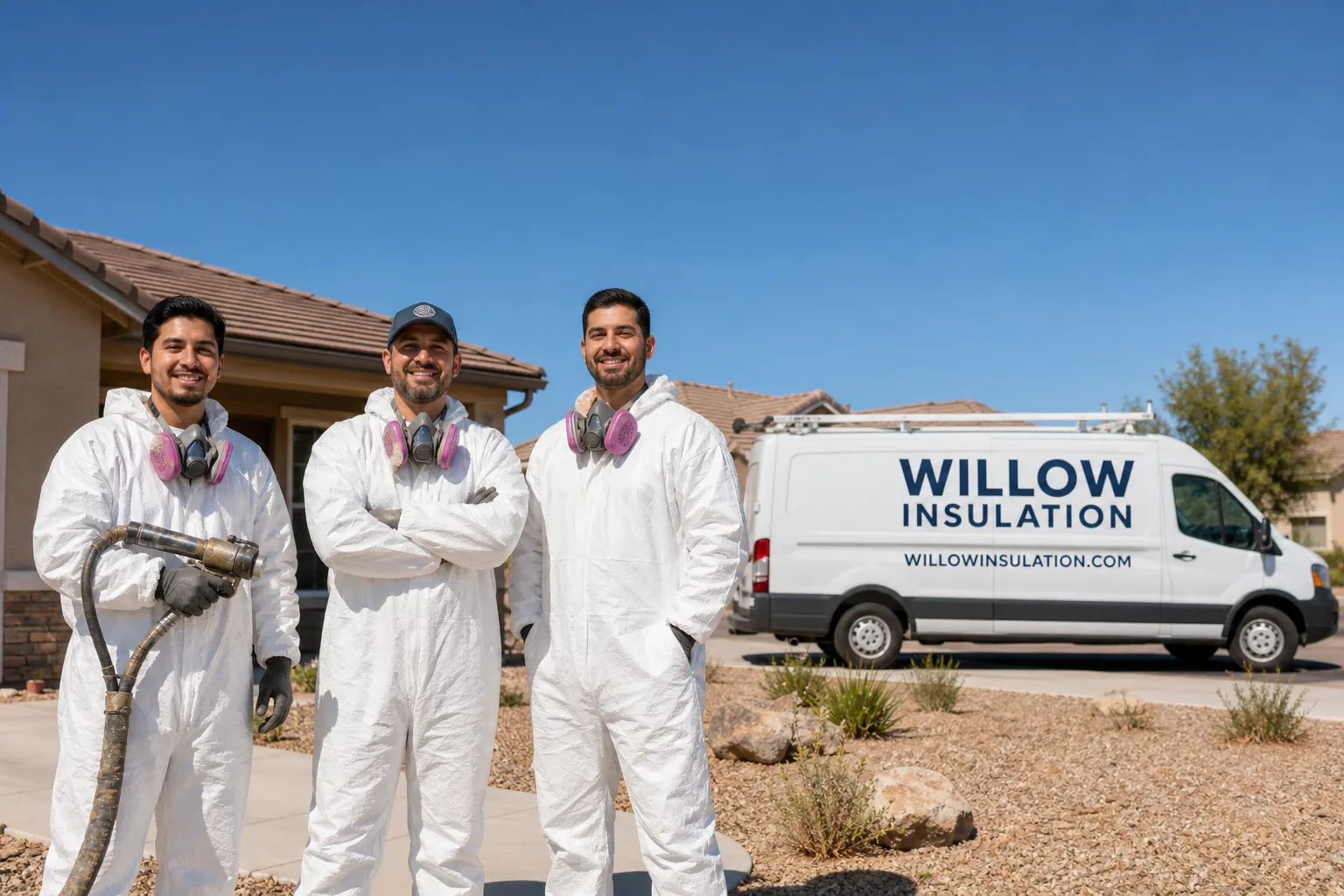
Fast, Reliable Spray Foam Insulation Across Moreno Valley
Spray foam insulation in Moreno Valley typically runs $2.50 to $6.50 per square foot installed, with most attic plane or rim joist projects completed in one to two days. We work throughout 92553, 92555, and the surrounding Moreno Valley tract-home belts, and our crews know exactly what they’ll find when they open a 1990s attic here: sagging R-11 batts, undammed recessed cans, and top plates that never got a proper air seal. Call (855) 473-6541 and we’ll send someone out to take a look, no charge for the estimate.
We’re the material-agnostic Spray Foam Insulation team at Willow Insulation, and we carry both Icynene open-cell and Demilec closed-cell systems so the foam we spray is the foam your house actually needs, not the foam on the truck. Moreno Valley sits at the eastern edge of the basin where summer temps push past 105°F and Santa Anas pull dust through every gap in the envelope. A foamed attic plane and sealed top plates change how a house holds temperature in August. That’s the whole point.
Why Willow Insulation Is Moreno Valley’s Preferred Spray Foam Insulation Company
We’ve worked enough Moreno Valley homes to know the pattern by heart. The city’s explosive 1980s-to-2000s builder era left thousands of stucco-on-wood-frame tract homes with attics insulated to bare minimums, and time hasn’t been kind to those installs. Batts sag. Can lights get punched through without dams. HVAC chases get cut open and never sealed. Our team comes in already knowing what to look for, which shortens the diagnostic time and gets the real work moving faster.
Noel Castaneda leads our crews, and he’s the one who set our standard: diagnose the house, not just the product. That’s how we’ve earned a strong referral base in neighborhoods like the 92553 belt, Sunnymead Ranch, and the newer pockets east of Moreno Beach Drive. When a homeowner calls us about a hot back bedroom or a dusty attic, we don’t quote foam first. We walk the attic, we find the failure points, and then we recommend the foam type and coverage that fixes them. Homeowners respond to that.
We’re authorized installers for both Icynene and Demilec spray foam systems, which matters more in Moreno Valley than in a coastal city. The right foam for a 100°F attic plane and the right foam for a crawl space rim joist are different products with different moisture and expansion profiles. Having both on the roster means the recommendation comes from the job, not from inventory. That’s the whole philosophy at Moreno Valley‘s local insulation specialist: the right material for the house.
Crawl Space Spray Foam Insulation in Moreno Valley
Crawl Space Spray Foam Insulation in Moreno Valley tends to focus on rim joist sealing and under-floor air sealing rather than full crawl space encapsulation. Most homes here were built on raised foundations with vented crawl spaces that let dry, dusty air move freely under the floor framing. Closed-cell foam from the Demilec line is the usual choice for rim joists because it locks out air movement and adds structural rigidity to the floor system. Typical rim joist work runs $4.00 to $6.00 per square foot of rim area.
Rim Joists and the Dust Problem
Santa Ana conditions push fine desert grit through vented crawl spaces, and the rim joist is the easiest entry point. When we foam-seal the rim on a Moreno Valley tract home, the improvement in floor comfort during winter nights is often immediate. We see the same issue in new infill construction as in 1990s originals: builders rarely air-seal the rim, and the gap is there.
When a Moreno Valley Homeowner Needs It
If your floors feel cold in January or you smell dry, dusty air coming from beneath the house, the crawl space is contributing. We check for open framing gaps, rodent entry points, and moisture before we spray. Closed-cell foam handles the air and the moisture question in one pass, which is why we lean toward it for subfloor applications.
Garage Spray Foam Insulation in Moreno Valley
Garage Spray Foam Insulation in Moreno Valley is usually a two-part job: the ceiling where the garage meets the house, and the wall shared with the living space. In a stucco tract home, the garage is typically unconditioned, and it becomes an oven by mid-afternoon in July. Spraying the garage ceiling and the common wall with open-cell Icynene brings the garage temperature down by fifteen degrees or more, and it stops the heat from bleeding into adjacent bedrooms. Budget between $1,800 and $3,400 for a typical two-car garage ceiling and common wall.
The Shared Wall
Most 1990s Moreno Valley homes have R-11 batts in the garage-adjacent wall, and those batts are often compressed by the time we open the drywall. Open-cell foam fills the cavity completely and air-seals as it expands, which handles both the thermal gap and the air movement that fiberglass can’t stop. Homeowners in 92555 consistently tell us the bedroom above or beside the garage holds temperature better after the job is done.
Dust and Grit in the Garage
Moreno Valley garages collect dust quickly because of the dry, wind-driven conditions. When a garage is unsealed, that dust moves through the wall cavity into the house. Foam-sealing the garage plane closes the path. It’s a simple fix with a measurable comfort payoff during the long summer stretch.
Trusted Brands We Service in Moreno Valley
We service and install product from Icynene and Demilec for spray foam, and for homes that need a mixed-material approach we also carry Owens Corning and Johns Manville batt products, GreenFiber blown-in cellulose, and Reflectix repair in Moreno Valley. That matters in Moreno Valley because this housing stock often calls for a layered solution: spray foam at the attic plane and rim joists, blown-in GreenFiber for the attic floor, and Rockwool where fire resistance or soundproofing is the priority. We keep local stock accessible for Moreno Valley jobs, so scheduling doesn’t get held up waiting on a supplier from Los Angeles or the High Desert.
Common Spray Foam Insulation Problems We See in Moreno Valley Homes
- Sagging builder-era batts in 92553 and 92555. Original 1980s and 1990s R-11 to R-19 batts have settled and separated from the ceiling line, leaving uninsulated stripes across the attic plane. Spray foam bridges those gaps in a way that re-fluffing or adding more batts never will.
- Recessed can lights punched through without insulation dams. Builder-era attics are full of non-IC-rated cans surrounded by open holes. Until those penetrations are sealed and the cans are protected, any attic insulation job underperforms.
- Santa Ana dust loading on exposed foam edges. Wind-driven desert grit gets through under-sealed top plates and garage gaps, and it accumulates on exposed spray foam surfaces. Proper air sealing before spray application is the only way to keep the dust out of the foam itself.
- Unsealed HVAC chases and duct boots. Tract builders regularly cut chases through top plates and left them open. Summers at 105°F turn those gaps into heat funnels. Foam-sealing them is often the single highest-return fix on a Moreno Valley attic.
Pricing for Spray Foam Insulation in Moreno Valley, CA
Open-cell Icynene at the attic plane runs roughly $2.50 to $3.75 per square foot in Moreno Valley. Closed-cell Demilec, which you would use at rim joists or in moisture-prone spots, runs $4.00 to $6.50 per square foot. A full attic plane job on a 1,500-square-foot tract home typically lands between $3,800 and $5,600. Rim joist sealing on a 2,000-square-foot home usually runs $1,200 to $2,400. Garage ceiling and common wall work falls in the $1,800 to $3,400 range. The variables are access, existing insulation removal, and how much air-sealing the attic needs before we spray. Call (855) 473-6541 for a free on-site estimate. We’ll give you a number before we leave the driveway.
We Also Serve Cities Near Moreno Valley
Our crews regularly work in March Air Force Base, Woodcrest, Colton, and Loma Linda, so if you’re just outside the Moreno Valley city line, we can still get to you quickly. We know the building patterns and climate conditions across this stretch of the Inland Empire. If you’re in Spray Foam Insulation in Moreno Valley or a neighboring community, call us and we’ll schedule a walkthrough.
Serving Moreno Valley, CA — Our Local Coverage Area
We’re based in the Moreno Valley area and know this community well. Use the map below to see our service coverage — if you’re nearby, we can almost certainly help.
FAQs About Spray Foam Insulation in Moreno Valley
Yes. Spray foam is often the best fix for a sagging-batt attic in a 92553 tract home because it fills the voids that compression and settling left behind, and it air-seals at the same time. We usually recommend open-cell Icynene at the attic plane in these homes, paired with mechanical sealing around any recessed can penetrations. Call (855) 473-6541 and we’ll send someone to measure your attic and confirm what’s up there.
Yes, with the right prep. Non-IC-rated cans need to be boxed or replaced with IC-rated fixtures before foam is applied, and we install insulation dams around each penetration so the foam can’t touch the fixture. We address this on nearly every pre-2000 Moreno Valley job. It’s not a reason to skip foaming the attic; it’s just a step that has to happen first.
It is, and it’s one of the fastest returns we see on this housing stock. A foamed garage ceiling and common wall cut heat transfer into the living space dramatically, and garages in 92555 and 92557 stop acting like heat sinks by late afternoon. Most homeowners report noticeable difference within the first full week after the job. A typical two-car garage ceiling and shared wall runs $1,800 to $3,400 in Moreno Valley.
Dust gets into attics through top plates, can-light gaps, and garage chases, and once it’s in, it settles on exposed foam edges and reduces the visual cleanliness of the install. The real problem is what the dust represents: an air leak. We air-seal before we spray so the foam and the attic stay cleaner, longer. That’s standard practice on every Moreno Valley job we do.
Yes. Crawl spaces here are dry and dusty rather than humid, so the priority is air sealing, not vapor control. We typically use closed-cell Demilec on rim joists and leave the bulk of the crawl space vented, unless there’s a moisture problem that calls for encapsulation. Different part of the house, different foam, different reasoning. Call (855) 473-6541 and we’ll explain what your crawl space actually needs.
Written by Noel Castaneda, Owner at Willow Insulation, serving Moreno Valley and the surrounding Inland Empire. Our team has spent years diagnosing and fixing the specific insulation failures of this housing stock, and we’d rather walk your attic than guess over the phone.