
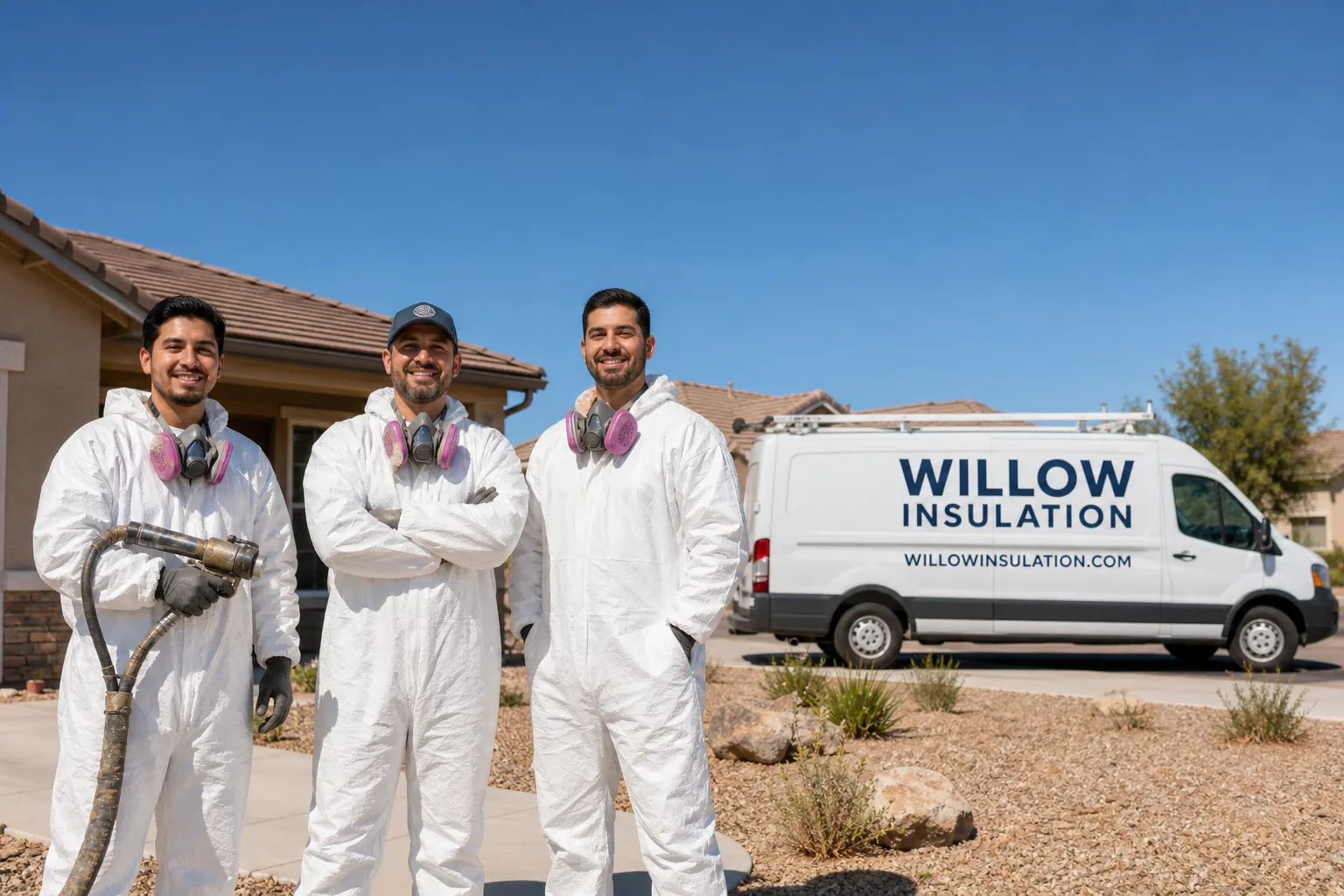
Fast, Reliable Spray Foam Insulation Across Lake Arrowhead
Spray foam insulation in Lake Arrowhead typically runs $2.50 to $6.00 per board foot installed, with most full attic jobs falling between $3,800 and $9,500 depending on depth, accessibility, and whether you need open-cell or closed-cell foam. We work throughout Lake Arrowhead regularly, and we know what these mountain homes throw at an insulation contractor. If your cabin fights you every winter with ice dams, cold vaulted ceilings, or a furnace that never stops running, call (855) 473-6541. We’ll come out, look at what’s actually going on inside your walls and roof assembly, and give you a straight answer.
Why Homeowners in Lake Arrowhead Call Willow Insulation
Noel Castaneda started Willow Insulation with a simple idea: carry more than one brand, more than one material, and recommend whatever actually fits the house in front of you. That matters up here. A 1960s A-frame off Grass Valley Road has completely different insulation needs than a 1990s chalet near Lake Arrowhead Village, and a contractor who only installs one product line can’t have an honest conversation about that. We install both Icynene and Demilec spray foam systems, plus Rockwool mineral wool and GreenFiber cellulose, so the recommendation is driven by the job, not our warehouse.
Lake Arrowhead homeowners consistently tell us the same thing: they called two or three other companies and got a sales pitch, not an assessment. Our approach is different. We’ll get into the attic or crawlspace, measure the existing R-value (the material’s resistance to heat flow – higher means more insulation working for you), check for moisture, and map out where air is actually leaking. Then we’ll show you your options with real numbers. Our Spray Foam Insulation team has worked on everything from small cabins to large custom builds across the San Bernardino Mountains.
Spray Foam Attic Insulation in Lake Arrowhead
Spray foam attic insulation is the single biggest comfort upgrade most mountain cabins can get. In Lake Arrowhead, where homes sit at 5,100 feet and winter nights routinely drop into the 20s, an under-insulated attic drags warm air out of the living space and pulls cold air in through every gap and crack. Spray foam attic insulation in Lake Arrowhead typically costs $4,200 to $8,800 for a standard 1,200 to 1,800 square foot attic, and the first sentence summary is this: if your roof has an attic space and you’re not sure what’s up there, the answer in this climate is almost never more fiberglass. It’s air sealing plus continuous insulation at the roofline or attic floor.
Open-Cell Foam for Attic Floors
Open-cell spray foam works well in Lake Arrowhead attics where the attic itself is properly ventilated and the goal is slowing heat movement through the ceiling below. It costs $0.90 to $2.10 per board foot. Open-cell is soft and spongy once cured, which makes it easy to trim and work around existing wiring or recessed fixtures. The material also absorbs sound well, a nice bonus in close-set mountain neighborhoods where homes sit near one another along roads like North Bay Road.
Closed-Cell Foam for Cathedral Ceilings
When the attic is a kneewall space or the roofline itself is the ceiling, closed-cell spray foam applied directly to the underside of the roof deck creates an airtight, moisture-resistant assembly. This runs $2.20 to $3.20 per board foot in Lake Arrowhead. We see this need constantly in cabins along State Highway 173 and the roads branching off it, where vaulted ceilings and post-and-beam construction leave no conventional attic to insulate.
Spray Foam Wall Insulation in Lake Arrowhead
Spray foam wall insulation stops the drafts that make mountain cabins feel cold even when the thermostat says 70. In Lake Arrowhead, where many houses are 1960s to 1980s builds with 2×4 walls and fiberglass that has slumped or settled over four decades, spray foam wall insulation in Lake Arrowhead typically runs $3,500 to $7,500 for full exterior wall coverage during a remodel or re-side. The foam fills every stud cavity completely, including around outlets, plumbing runs, and odd framing details common in owner-built additions across Blue Jay and Cedar Glen.
Closed-Cell for Exterior Walls
Closed-cell spray foam inside 2×4 wall cavities delivers roughly R-6.5 per inch, about double what fiberglass batts achieve in the same space. For a Lake Arrowhead cabin with no room to thicken the walls, that’s the highest practical R-value available without ripping the interior apart. Closed-cell also adds structural rigidity and acts as a vapor barrier, which matters in a freeze-thaw climate where warm interior air meeting cold sheathing causes condensation. Expect $2.60 to $4.00 per board foot installed.
Open-Cell for Interior Sound Control
Open-cell spray foam in interior walls is a strong pick for Lake Arrowhead homes that are now short-term rentals or split-level triplexes along the lake. It cuts sound transfer between rooms and floors meaningfully, and installs quickly in open framing. Pricing runs $1.20 to $2.40 per board foot. If you’re adding an ADU above the garage off Grass Valley Road, open-cell in the floor system makes the space quiet and comfortable year-round.
Trusted Brands We Service in Lake Arrowhead
Willow Insulation installs both Icynene and Demilec spray foam systems, which means we’re not locked into one manufacturer’s spec sheet or pricing model. Icynene’s open-cell products are excellent for attic floors and sound control, while Demilec closed-cell formulas hold up well against moisture and temperature swings in mountain wall assemblies. We also work with Rockwool mineral wool and Owens Corning fiberglass when a hybrid approach makes more sense. For Lake Arrowhead customers, carrying eight manufacturer brands across fiberglass, mineral wool, spray foam, and cellulose means we can match the material to the house, not the other way around. And because our team installs foam regularly across the 92352 ZIP, we arrive with the right rigs, hoses, and temperature-controlled material for high-altitude application.
Common Spray Foam Insulation Problems We See in Lake Arrowhead Homes
- Ice dams along the eaves. When spray foam is applied to the underside of a roof deck without addressing ventilation at the soffit and ridge, snow melts off the warm roof, refreezes at the cold eave, and backs up under the shingles. This is the number one moisture failure we see in Lake Arrowhead roofs.
- Closed-cell foam sealing in damp sheathing. If a cabin has a small roof leak or condensation problem that was never addressed, closed-cell foam applied directly over wet wood traps that moisture permanently. In intermittently-occupied vacation homes, a leak can run for weeks before anyone notices, so surface prep and moisture checks matter more here than anywhere else we work.
- Irregular cavities in owner-built additions. Lake Arrowhead’s housing stock is full of additions and dormers framed with whatever lumber was handy in the 1970s and 1980s. Those odd stud sizes and missed cavities need hand-cutting and careful thickness control, otherwise the foam pulls away as it cures and leaves gaps that undercut the whole job.
- Skipped air sealing on wall tops. In older cabins, the top plates of exterior walls often have a visible daylight gap to the outside. If spray foam goes into the cavities but nobody addresses the plate line, the house still leaks air around every wall. That’s a frequent source of “I insulated and it’s still cold” calls we get from Lake Arrowhead homeowners.
Pricing for Spray Foam Insulation in Lake Arrowhead, CA
Here’s what you can expect to pay for spray foam work in Lake Arrowhead. Open-cell foam runs $0.90 to $2.10 per board foot; closed-cell runs $2.20 to $4.00 per board foot. A typical open-beam vaulted ceiling of 600 to 900 square feet runs $3,600 to $6,800 for closed-cell applied directly to the roof deck. A garage ceiling with rim joist sealing usually lands between $1,800 and $3,400. What changes the number most? Access, surface prep, and how much of the framing is irregular. Lake Arrowhead pricing runs slightly above Victorville or Highland because most jobs involve steep rooflines, cold material handling, and homes with additions that require more hand detailing. Call (855) 473-6541 for a free, no-commitment estimate. We’ll give you exact numbers, not a range.
We Also Serve Cities Near Lake Arrowhead
Willow Insulation’s regular route includes Lake Arrowhead and the surrounding mountain and foothill communities. We’re in Crestline, Running Springs, Highland, and Muscoy every week, and our crews know the difference between a 5,000-foot ridge cabin and a valley rancher. If you’re anywhere in the San Bernardino Mountains between Crestline and Running Springs, the same crew and the same material-agnostic approach applies.
Serving Lake Arrowhead, CA — Our Local Coverage Area
We’re based in the Lake Arrowhead area and know this community well. Use the map below to see our service coverage — if you’re nearby, we can almost certainly help.
FAQs About Spray Foam Insulation in Lake Arrowhead
Spray foam handles Lake Arrowhead’s snow and freeze-thaw cycles better than conventional insulation when it’s paired with correct vapor management and ventilation, because closed-cell foam air-seals while it insulates, stopping the warm-air leaks that drive most ice dam formation and condensation problems. (855) 473-6541 for a free inspection.
Yes, closed-cell spray foam is the best retrofit option for the vaulted, open-beam ceilings found throughout Lake Arrowhead, because it can be applied directly to the underside of the roof deck at a thickness that delivers meaningful R-value without eating headroom or changing the look of the beams. Typically this runs $3,600 to $6,800 depending on square footage and rafter depth.
For a 1960s cabin with an uninsulated addition, the best approach starts with mapping where air moves through the original section and the addition, then applying closed-cell foam to the roof deck or exterior walls where space is tightest, and open-cell or blown-in GreenFiber where there’s room to fill. We’ve fixed enough of these to know that treating the addition and the original cabin as one envelope, not two, is what finally stops the drafts.
Closed-cell spray foam applied to the roof deck dramatically reduces ice dams in Lake Arrowhead because it stops interior heat from reaching the roof sheathing, which keeps snow from melting and refreezing at the eaves in the first place. But only when the soffit and ridge remain properly vented; sealing the roofline without that ventilation traps what the foam was meant to stop. Call (855) 473-6541 and we’ll explain exactly how this applies to your roof pitch.
Yes, spray foam is safe for part-time Lake Arrowhead homes that sit empty for weeks, provided that any existing leaks or moisture problems are addressed before installation so the foam isn’t sealing in dampness that grows a problem while nobody’s there. Closed-cell foam actually helps in seasonal homes because it keeps humid air out of wall and roof cavities during the long stretches between visits.
Why Lake Arrowhead Cabins Need a Different Insulation Approach
Most insulation advice written for Southern California assumes a house fights heat, not snow. Lake Arrowhead breaks that pattern entirely. At 5,100 feet in the San Bernardino Mountains, the cabins along State Highway 173 and around North Bay see real alpine winters: snow that sits on roofs for weeks, nights in the teens, and a freeze-thaw cycle that repeatedly wets and dries roof and wall assemblies. Insulation here isn’t just an R-value conversation. It’s a moisture conversation and an air-sealing conversation.
We recently worked on a 1970s open-beam cabin near Cedar Ridge Drive where the vaulted ceiling left only 2 inches between the roof deck and the interior drywall. The homeowner had been told by another contractor that the only fix was a full tear-off and rebuild. We applied closed-cell spray foam directly to the roof deck at that 2-inch depth, creating an airtight, insulated assembly without sacrificing a single inch of headroom, then detailed the eave with rigid board to manage the ice dam risk. The homeowner, a part-time resident, reported that the cabin felt noticeably warmer during winter visits and that no new ice built up at the eave line that season. That cabin’s problem is everywhere in Lake Arrowhead, and the solution is knowing which material fits the framing, not which material is on the truck.
This is the information gap most generic spray foam pages miss. Lake Arrowhead’s housing stock is dominated by cabins and chalets built from the 1960s through the 1990s, many with vaulted open-beam ceilings, wood siding, owner-built additions, and insulation levels that would have been considered thin even for summer camps in Victorville. A large share of these homes are second homes and short-term rentals that sit empty for weeks at a time. That changes the insulation calculus: moisture gets introduced and then goes unchecked, and closed-cell foam applied over wet wood or a hidden leak does more harm than good. We inspect before we spray, every time.
We’re also thinking about wildfire exposure here. Lake Arrowhead sits inside the San Bernardino National Forest, and the ignition-resistant detailing around any exterior upgrade matters in a way it simply doesn’t in Muscoy or the flatlands below. When we’re sealing rim joists, insulating a crawlspace, or detailing an eave, we’re doing it with one eye on the fire risk that defines mountain living.
Get a Straight Answer on Your Lake Arrowhead Insulation Project
If you own a cabin, chalet, or full-time home in Lake Arrowhead and you’re tired of cold rooms, high propane bills, or ice buildup at the eaves, call us. We’ll come out, look at the roof assembly, and tell you honestly whether spray foam is the right call or whether Rockwool, GreenFiber, or a hybrid approach will serve you better. We carry all of it, so the recommendation is always about your house. Free estimates. Straight answers. Call (855) 473-6541.
Written by Noel Castaneda, Owner at Willow Insulation, serving Lake Arrowhead and the San Bernardino Mountains since 2019.