
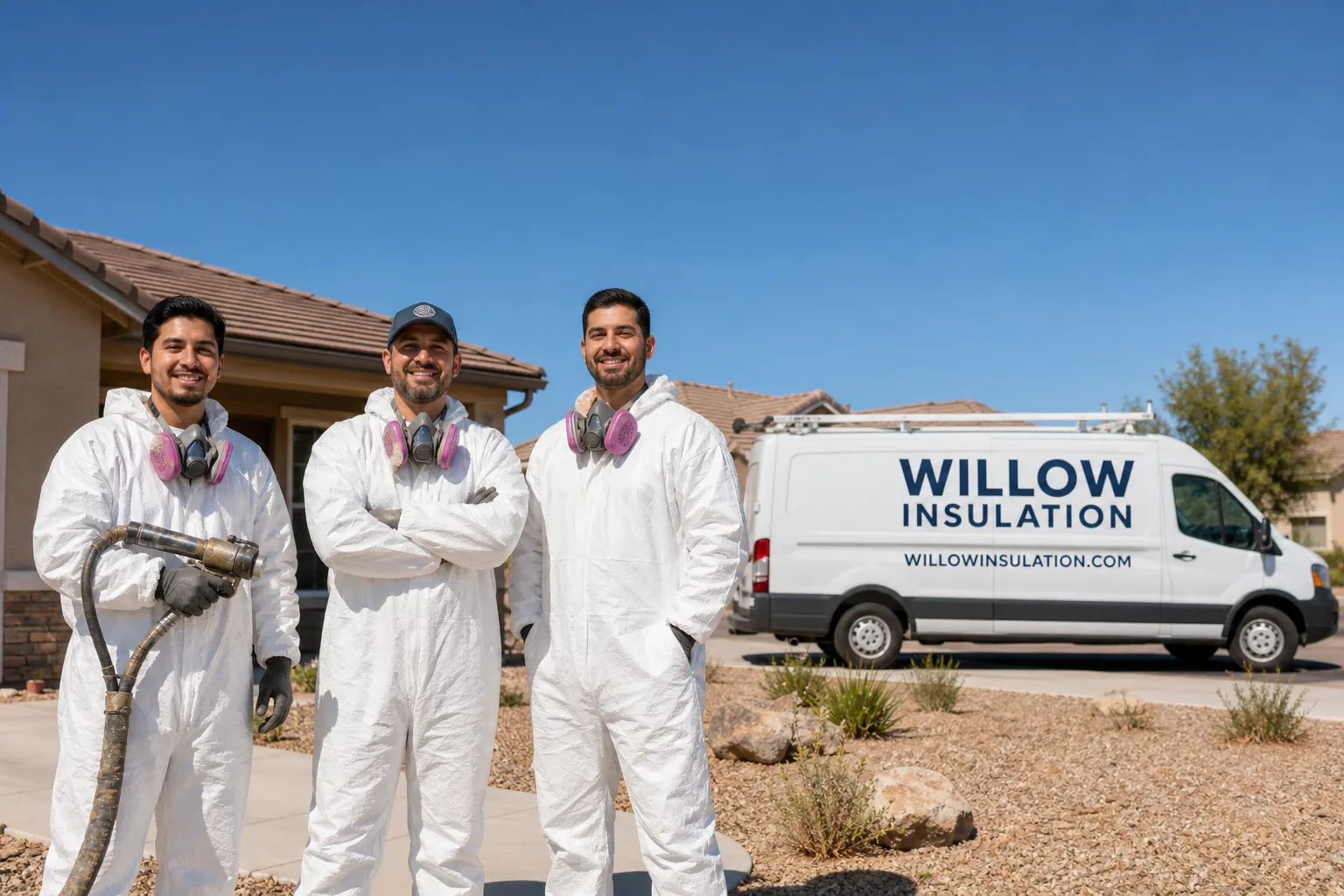
Fast, Reliable Spray Foam Insulation Across Highland
Spray foam insulation in Highland typically costs $2,800 – $6,400 for a full attic application, with closed-cell running $1.80 – $3.20 per board foot and open-cell at $0.90 – $1.60 per board foot. Most Highland homes need it because their attics sit at 140°F or hotter from June through September, cooking the living space below and forcing AC systems to run nonstop. We serve every zip code in Highland (92346) from our Victorville base and can usually reach your door within 24 to 48 hours for an assessment. Call (855) 473-6541 and we’ll walk through what your attic actually needs.
Why Willow Insulation Is Highland’s Preferred Spray Foam Insulation Company
Highland homeowners call us because we carry eight manufacturer brands and install both open-cell and closed-cell foam. That means when we show up at a 1962 ranch off Base Line, we’re not pushing a single product line because it’s what’s on the truck. We look at your attic, your floor plan, and your cooling bills, then recommend the material that fits. Noel Castaneda built Willow Insulation around that principle: the right insulation for your home, not our warehouse.
We’ve worked in tracts throughout Highland, from the neighborhoods around the Historic District to newer construction east of the 210. Homeowners tell us the same thing every summer: upstairs bedrooms won’t cool below 80°F, the AC runs from noon to midnight, and no one warned them the attic was the problem. We inspect, we explain, and we show you exactly where the heat is getting through. Reviews from Highland customers consistently mention that honesty and the thoroughness of our attic assessments.
Closed Cell Spray Foam Insulation in Highland
Closed Cell Spray Foam Insulation is the strongest thermal barrier we install for Highland’s summer heat. At roughly 2 inches thick, closed-cell foam creates an air seal and a vapor barrier in one pass, while adding structural rigidity to roof decks and rim joists. For a typical 1,200 – 1,600 sq ft Highland ranch, a closed-cell attic deck application runs $3,400 – $6,400. It’s the right call when you want maximum R-value per inch and you’re tired of heat bleeding through the ceiling every afternoon.
Attic Deck Application
In Highland, closed-cell foam on the underside of the roof deck converts a vented attic into a semi-conditioned space. Attic temperatures that used to hit 140°F settle closer to 115°F or 120°F, and the rooms below stop gaining heat through the ceiling drywall. We spray directly to the deck after removing degraded fiberglass and sealing any gaps around vents or electrical penetrations.
Rim Joist Sealing
Older Highland ranch homes often have band-board gaps that leak hot attic air into the crawlspace or basement. Closed-cell foam at the rim joist stops that bypass. We typically quote $900 – $1,800 for rim joist work depending on linear footage and access.
Open Cell Spray Foam in Highland
Open Cell Spray Foam offers a more budget-friendly route to a sealed attic, running $0.90 – $1.60 per board foot or roughly $2,800 – $4,200 for a full attic in most Highland homes. It expands aggressively into corners and odd framing, which matters in 1950s and 60s tract houses where nothing is square. Open-cell doesn’t act as a vapor barrier, so it suits vented attics that still breathe, and it does a strong job of blocking air movement and deadening sound from nearby traffic off Base Line or the 210 corridor.
Vented Attic Ceilings
If your Highland attic has ridge vents and soffit vents, open-cell foam on the ceiling floor or attic sidewalls still cuts air infiltration substantially. We often pair open-cell with blown-in cellulose or fiberglass for a layered approach that fits a mid-range budget without sacrificing much performance.
Garage Ceilings
Attached garages in Highland trap heat all day and radiate it into adjacent living areas through the shared wall and ceiling. Open-cell foam sprayed on the garage ceiling runs $1,100 – $1,900 for a standard two-car garage and makes a noticeable dent in how hot the rooms above or beside the garage feel by evening.
Trusted Brands We Service in Highland
Willow Insulation installs both Icynene and Demilec spray foam systems, covering the full open-cell and closed-cell spectrum. That dual capability means we’re not steering you toward a single manufacturer’s product line. For Highland homeowners who want a recycled-content blown-in option alongside foam, we also carry GreenFiber cellulose and fiberglass from Owens Corning and Johns Manville. Because we stock materials across all of these lines, we can usually schedule your Highland project within a week of the assessment, even during the July – September rush when demand spikes across the Inland Empire.
Common Spray Foam Insulation Problems We See in Highland Homes
- Foam delamination on unshaded roof decks. Highland summers push attic surface temps past 140°F before 11 a.m. When closed-cell foam is applied to a deck that’s already heat-saturated, it can lose adhesion and peel within months. We schedule attic foam work before 10 a.m. or after 6 p.m. from June through September for this exact reason.
- Bubbling and off-gassing over settled fiberglass. Many 1950s – 70s Highland homes still have original R-7 to R-11 batts that are crusted with dust and rodent debris. Spraying foam directly over that layer traps contaminants and creates bubbling. We scrape and prep the substrate first, every time.
- Rim joist gaps that bypass the foam entirely. Older ranch-style homes in Highland often have visible gaps where the foundation meets the band board. If we foam the attic but leave those gaps open, hot air still pours into the building envelope and undermines the R-value. The fix is integrated, not piecemeal.
- Uneven cooling that persists after foam is installed. Sometimes a previous contractor sprayed the attic deck but skipped the garage ceiling or rim joists. The foam does its job, but the rest of the envelope leaks, so the homeowner sees no change on their bill. We audit the whole envelope before we quote.
Pricing for Spray Foam Insulation in Highland, CA
Here’s what we see in the Highland market right now:
- Closed-cell attic deck: $3,400 – $6,400 for a 1,200 – 1,600 sq ft home
- Open-cell attic full application: $2,800 – $4,200
- Rim joist sealing: $900 – $1,800 depending on linear footage
- Garage ceiling (two-car): $1,100 – $1,900
- Removal of degraded existing insulation: $600 – $1,200
Your final number depends on attic square footage, access difficulty, how much old insulation needs to come out, and whether you’re doing closed-cell or open-cell. We provide a written line-item estimate before any work starts, and estimates are free. Call (855) 473-6541 to schedule yours.
We Also Serve Cities Near Highland
Our crews regularly run jobs in San Bernardino, Muscoy, Redlands, and Loma Linda, so scheduling and material runs to Highland are routine, not a special trip. If you’re in one of those cities and need Spray Foam Insulation, the same team and the same brand range apply.
Serving Highland, CA — Our Local Coverage Area
We’re based in the Highland area and know this community well. Use the map below to see our service coverage — if you’re nearby, we can almost certainly help.
FAQs About Spray Foam Insulation in Highland
Yes, but only during the right window. Closed-cell foam can lose adhesion and delaminate if applied to a deck that’s already over 140°F. We schedule Highland attic work before 10 a.m. or after 6 p.m. from June through September, when deck temps have dropped enough for a clean, lasting bond. Call (855) 473-6541 and we’ll book your application in the right slot.
For most Highland ranches, closed-cell foam delivers more comfort per inch than stacking fiberglass over degraded R-7 batts, especially if you’re already dealing with uneven cooling and 140°F attic temps. The air-sealing effect of foam is what fiberglass alone cannot match. We’ll pull back the existing batts, show you what’s underneath, and give you the numbers for both options.
Closed-cell gives you higher R-value per inch, an air seal, and a vapor barrier, at roughly double the cost of open-cell. Open-cell is cheaper, expands more aggressively into irregular framing, and works fine in a vented Highland attic because moisture can still move through it. If your attic is unvented or you want maximum heat blocking, closed-cell is the stronger play.
We remove the old fiberglass first. Highlands’s mid-century tract homes often have original batts that are packed with dust and debris, and spraying foam directly over that layer is a common cause of bubbling and off-gassing. We vacuum the substrate, inspect the deck for delamination risks, and only then spray. The prep work is non-negotiable.
In most cases, no, but some shingle manufacturers specify that closed-cell foam on the underside of the deck changes attic ventilation dynamics, which can affect warranty claims. We check your roof type and manufacturer before recommending a full deck application, and we’ll document everything in writing so you know exactly what you’re getting. Call (855) 473-6541 and we’ll walk through it with you.
Last August, a homeowner near the Highland Historic District called us about uneven cooling in a 1962 ranch with original R-7 batts. Our crew sprayed 2 inches of closed-cell foam (Icynene) to the attic deck and rim joists after scraping away settled fiberglass, then verified attic temps dropped from 142°F to 118°F by late afternoon. The following week their AC runtime dropped by about 30%. That’s the outcome we build toward on every Highland job.
Highland’s unshaded attics run hotter than nearby San Bernardino or Redlands because of how the city sits in the Inland Empire’s interior heat zone, with less marine influence and long afternoon sun exposure on east-west oriented tracts. That heat window, from about 10 a.m. to 6 p.m. from June through September, decides when foam can be safely applied and when it cannot. This is why application timing is the single biggest factor in whether a Highland foam job holds up for 20 years or fails in two.
If your attic is roasting, your rooms won’t cool, and your energy bill looks wrong for the square footage you’re actually cooling, let’s take a look. Call Willow Insulation at (855) 473-6541 for a free estimate, and we’ll give you a straight answer on what your Highland home needs.
Written by Noel Castaneda, Owner at Willow Insulation, serving Highland and the Inland Empire with material-agnostic insulation solutions.