
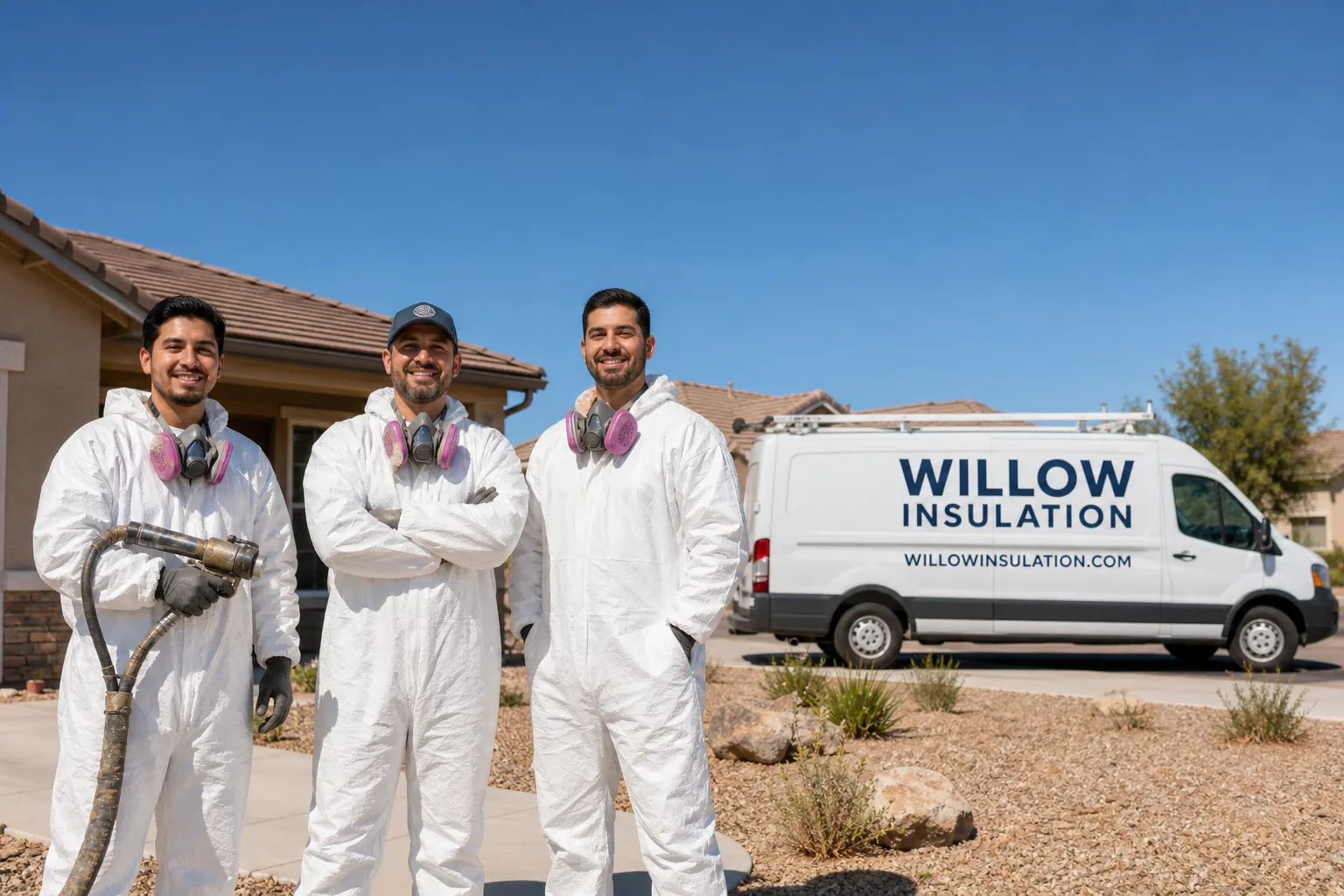
Fast, Reliable Spray Foam Insulation Across Eastvale
Spray foam insulation in Eastvale typically costs $2.50 to $5.50 per square foot installed for open-cell and $3.25 to $7.00 per square foot for closed-cell, with most garage ceiling or rim joist projects landing between $1,100 and $3,800. We’re Willow Insulation, and we work in Eastvale’s 92860 zip code almost weekly, so we know exactly what your 2000s-era tract home is dealing with when the Inland Empire summer hits. Call (855) 473-6541 for a free estimate from a team that understands Eastvale’s specific insulation challenges.
If you own a two-story stucco home in Eastvale built between 2005 and 2018, your builder-grade insulation is now hitting its first replacement window. That’s not a guess. It’s what we see every time we pull back the attic hatch in the neighborhoods off Archibald Avenue, Hamner Avenue, and Schleisman Road.
Why Willow Insulation Is Eastvale’s Preferred Spray Foam Insulation Company
Noel Castaneda built Willow Insulation around a simple idea: carry the material that fits the home, not the home that fits the material. In Eastvale, that matters more than most cities. These homes were built fast during the 2000s construction boom, and the insulation decisions made back then were driven by builder cost sheets, not the comfort of the family living there now. We carry eight manufacturer brands across every insulation category, so when we recommend spray foam for your Eastvale garage ceiling or rim joists, it’s because spray foam is genuinely right for that spot, not because it’s the only thing on our truck.
We’re not the cheapest bid and we won’t pretend to be. What we offer is a specialist who has worked on hundreds of Inland Empire tract homes with the same rooflines, the same attic depths, and the same second-floor overheating complaints. Homeowners in Eastvale call us because we explain the difference between open-cell Icynene and closed-cell Demilec in plain language, then install whichever one actually solves the problem. With both foam systems authorized on our roster, you’re not being steered. You’re being advised.
Our crews drive in from Victorville and reach most of Eastvale within 45 to 70 minutes, including the newer sections north of Limonite Avenue and the developments east of the 15. When you call for an attic or garage assessment, we show up on time, take real measurements, and tell you if spray foam is worth the cost or if blown-in GreenFiber cellulose is the smarter play. That’s the difference between a specialist and a sales pitch. Call (855) 473-6541 and we’ll walk you through what we find.
Crawl Space Spray Foam Insulation in Eastvale
Crawl Space Spray Foam Insulation in Eastvale is a less common job than in older Inland Empire cities, simply because most homes here sit on slab-on-grade foundations rather than raised floors. When we do see crawl spaces in Eastvale, they show up in a handful of custom builds and a few older Rancho-era properties near the Santa Ana River corridor. In those cases, the floor system above the crawl space is typically fiberglass batt that has sagged, gotten dusty, or been chewed through, and closed-cell spray foam applied to the subfloor underside stops the stack effect from pulling hot, dry air into the living space.
For the Eastvale homes that do have a crawl space, the job usually runs $2,200 to $5,500 depending on square footage and access height. Closed-cell Demilec foam is our go-to here because it creates its own vapor barrier and won’t soak up the minimal ground moisture we get in Riverside County. The result is a warmer floor in winter and less dust infiltration during Santa Ana wind events.
Closed-cell subfloor application
We spray a full-contact layer across the floor joist bottoms and rim band, sealing every gap where exterior air sneaks in. In Eastvale’s dry heat, this matters less for moisture than for temperature stability. The concrete slab homes most residents have don’t need this treatment, but if you own one of the few raised-floor properties near the 15/60 interchange, it transforms the feel of the house.
Rim joist and air bypass sealing
The rim joist is where the floor framing meets the foundation wall, and in Eastvale’s few crawl space homes it’s almost always left unsealed at the original build. Spray foam is the standard fix because it expands into the irregular cavity and locks the air barrier tight. A typical rim joist-only job in Eastvale runs $900 to $2,200 and can usually be done in a single visit.
Garage Spray Foam Insulation in Eastvale
Garage Spray Foam Insulation in Eastvale is the single most effective upgrade we install in these tract homes. Nearly every Eastvale house has an attached garage, and the builder left the garage ceiling and shared wall with the house essentially uninsulated. In a city where summer highs routinely top 100°F, that garage becomes a bake oven by 2 PM, and all that heat pushes against the conditioned living space on the other side of the drywall. Spraying closed-cell foam on the garage ceiling and the band joist where it meets the house cuts that heat transfer dramatically.
A standard two-car garage ceiling in Eastvale runs $1,300 to $2,900 for closed-cell foam at 2 inches of depth. The shared wall between garage and house adds $800 to $1,500 if it’s not already insulated. Most Eastvale homeowners notice the second floor above the garage stops cooking by the same afternoon the foam cures. And because Eastvale’s garages are almost always used for storage, a cooler garage means your boxes and tools aren’t being roasted all summer.
Closed-cell garage ceiling barrier
We spray directly against the garage ceiling drywall, creating a continuous thermal break that stops radiant heat from the tile roof above from pressing down into the garage space. In the two-story Eastvale tracts, this is often the difference between a master bedroom above the garage that cools at night and one that never quite drops below 78°F in July.
Shared wall and top plate sealing
The top plate where garage ceiling meets house wall is a notorious leak point in Eastvale construction. We’ve pulled back insulation in homes off Sumner Avenue and found gaps you could slide a hand through, letting garage air pour into the wall cavity. Foam seals those bypasses permanently. It’s not glamorous work, but it’s where the energy loss actually happens.
Eastvale homeowners who want to explore whether spray foam is the right fit, or whether Spray Foam Insulation should be layered with something like blown-in cellulose at the attic floor, get a straight answer from us. That’s the whole point of carrying eight brands. The recommendation follows the house, not the warehouse.
Trusted Brands We Service in Eastvale
We install Icynene open-cell and Demilec closed-cell spray foam systems, and we’re authorized installers for both. That dual capability matters for Eastvale because open-cell is the right call for attic roof decks in dry Riverside County, while closed-cell is the better fit for garage ceilings and rim joists where you need maximum R-value per inch. We also stock Owens Corning and Johns Manville products for the parts of your Eastvale home where fiberglass still makes sense, like certain wall cavity retrofits where foam isn’t practical. When we recommend a material, it’s because we’ve thought through how it performs in an Eastvale summer, not because it’s the only brand we’re allowed to sell. For GreenFiber cellulose blown over settled builder fiberglass, that’s another tool in the box we’ll pull out when it fits the job better than foam.
Common Spray Foam Insulation Problems We See in Eastvale Homes
- Builder radiant barrier foil masking thin fiberglass. The shiny foil stapled to your rafters reflects radiant heat, but it does nothing for the settled R-19 or less sitting on your attic floor. We find this in nearly every Eastvale tract home built between 2000 and 2015. The foil looks impressive from the attic hatch, so nobody checks what’s underneath.
- Undersprayed garage ceilings at the band joist. Builders often skip the garage ceiling entirely or leave the perimeter gaps open. Heat pours into the attached garage and pushes through the shared wall into your living room and upstairs bedrooms. Closed-cell foam at the band joist and top plates seals this bypass for good.
- Low-pitch attic decks limiting access. Eastvale’s concrete tile roofs sit on shallow trusses, and crews that can’t physically reach the perimeter skip the air sealing step. Spraying foam over unsealed top plates and can lights is like patching a tire without finding the nail. We seal first, then spray.
- West-facing rooms that never cool down. Homes along the western edges of Eastvale near the 71 get hammered by afternoon sun, and the builder-grade insulation in those walls and ceilings wasn’t sized for that solar load. Closed-cell foam in the attic knee walls and garage ceiling brings those rooms closer to the temperature of the rest of the house.
Pricing for Spray Foam Insulation in Eastvale, CA
Open-cell spray foam in Eastvale runs $2.50 to $5.50 per square foot installed. Closed-cell runs $3.25 to $7.00. A typical garage ceiling project lands between $1,300 and $2,900. Rim joists and band joists run $900 to $2,200 for most two-story tract homes. Attic roof deck spray jobs, depending on whether you have a low-pitch concrete tile assembly, usually fall between $4,500 and $9,800 for a 2,000-square-foot home. What moves the number: access height, how much air sealing is needed before foam goes in, and whether you’re doing open-cell or closed-cell. We give free estimates and tell you upfront if spray foam is overkill for what you actually need. Call (855) 473-6541 and we’ll price your Eastvale job precisely.
In Eastvale specifically, the biggest cost factor is often whether the builder foil radiant barrier can stay in place or needs to be removed or worked around. We don’t charge you for that assessment. It’s part of showing up and actually looking at the attic.
We Also Serve Cities Near Eastvale
Willow Insulation works throughout the Inland Empire, and Eastvale sits at the center of our core service area. We handle the same spray foam, attic, and blown-in work for homeowners in Norco, Home Gardens, Corona, and Jurupa Valley. Same specialist approach, same honest material recommendations, same crews. If you’re a few minutes outside the 92860 boundary, you’re still very much in our coverage area.
Serving Eastvale, CA — Our Local Coverage Area
We’re based in the Eastvale area and know this community well. Use the map below to see our service coverage — if you’re nearby, we can almost certainly help.
FAQs About Spray Foam Insulation in Eastvale
Yes, that’s the most common call we get in Eastvale. The radiant barrier foil on your rafters only reflects radiant heat. It does not stop conductive or convective heat transfer, and it does not add R-value. In most Eastvale homes, the blown-in fiberglass beneath that foil has settled to R-19 or less, so the upstairs ceiling is doing a fraction of the job it should. The fix is adding depth or sealing with spray foam at the right locations. Call (855) 473-6541 and we’ll measure what’s actually under the foil before recommending anything.
Yes, it’s the single highest-return spray foam job we do in Eastvale. The attached garage ceiling is almost always left uninsulated at original build, and it sits directly below living space in two-story models. Closed-cell foam at 2 inches creates a thermal break that stops heat from entering the garage and pressing into the house. Most jobs are done in one visit. For pricing specific to your garage size, call (855) 473-6541.
Yes. In fact, open-cell spray foam applied to the underside of the roof deck works very well with Eastvale’s concrete tile assemblies because it creates an unvented attic that stops heat from even entering the attic space. The low-pitch trusses make access tighter, which is why we take extra time on perimeter air sealing before any foam goes down. If your attic is too shallow for foam, we’ll tell you that and recommend a blown-in upgrade instead. That’s the material-agnostic approach.
For west-facing attic roof decks, open-cell spray foam at 5.5 inches is usually the stronger performer because it stops heat at the roof sheathing rather than trying to slow it at the attic floor. Blown-in fiberglass or GreenFiber cellulose still works at the attic floor, but on those brutal August afternoons when the sun is hammering your west roofline, foam at the deck is the difference-maker. We’ll lay out both options with real numbers for your specific roof orientation. Call (855) 473-6541 to get that assessment.
Look for three signs: second-floor rooms that never cool to the thermostat setpoint in summer, an attached garage that’s noticeably hot by early afternoon, and attic fiberglass that’s settled below the top of the joists. We find settled R-19 under shiny foil in nearly every Eastvale home we inspect. If you’re seeing any of those signs, call (855) 473-6541 and we’ll inspect it properly. The assessment is free.
Contact Willow Insulation in Eastvale
If your Eastvale home is fighting the Inland Empire heat with builder-grade insulation from the mid-2000s, it’s time to fix the actual problem, not pat around it. We’ll inspect your attic, garage ceiling, and any spray foam candidates, then give you straight advice on whether open-cell, closed-cell, or a blown-in upgrade makes the most sense for your house. Call Noel Castaneda’s team at (855) 473-6541 today for a free estimate. We serve all of Eastvale’s 92860 zip code, including the tracts off Archibald, Hamner, Limonite, and Schleisman.
Written by Noel Castaneda, Owner at Willow Insulation, serving Eastvale and the Inland Empire with honest, material-agnostic insulation advice.