
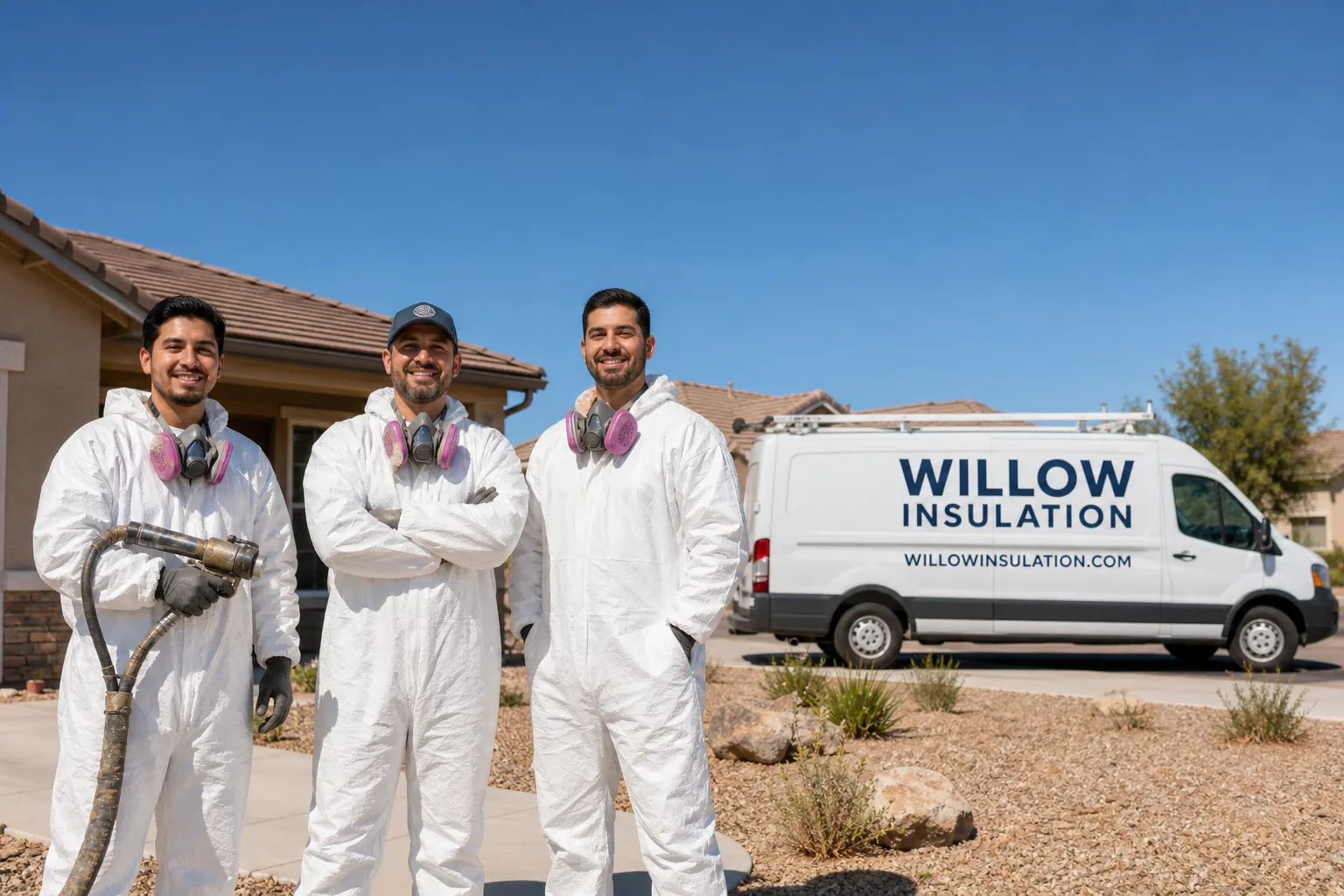
Fast, Reliable Spray Foam Insulation Across Corona
Spray foam insulation in Corona works harder here than almost anywhere in Southern California. Our attics routinely hit 160°F from May through October, and when Santa Ana winds kick up, fine dust from the nearby hills finds every gap in a home’s envelope. We’re Willow Insulation, and we’ve spent years correcting insulation failures in Corona’s 1980s and 1990s tract neighborhoods off the 91 freeway. Whether you’re in 92879, 92881, 92882, or anywhere across the city, our Spray Foam Insulation team can assess your home, tell you honestly what it needs, and install the right material for the job. Call (855) 473-6541 for a free estimate.
Why Willow Insulation Is Corona’s Preferred Spray Foam Insulation Company
Homeowners in Corona call us because we show up knowing their house. The tract neighborhoods off the 91 in 92879 and 92881 have a specific construction history: soffit-vented attics, original R-11 or R-13 fiberglass, and years of heat cycling that compress batts to half their rated depth. A contractor who doesn’t know this will happily spray foam over a problem and leave the homeowner paying for it.
We carry eight manufacturer brands across fiberglass, mineral wool, spray foam, and cellulose, so the recommendation is always driven by your project, not our warehouse. Noel Castaneda built Willow Insulation on that principle: diagnose the house, then choose the material. We install both Icynene and Demilec spray foam systems, covering open-cell and closed-cell applications, and we’re equally comfortable telling you when foam is not the answer and blown-in GreenFiber cellulose makes more sense for an attic top-up.
Response time to Corona from our Victorville base is typically same-week for estimates and scheduling, with many jobs completed within a few days of approval. Corona customers regularly mention that we actually explained their options instead of pushing one product line. That’s the whole point of working with a specialist.
Spray Foam Attic Insulation in Corona
Spray Foam Attic Insulation in Corona means treating attics that bake under the inland sun, often reaching 160°F or more during a typical summer afternoon. A proper attic spray foam job here starts with fixing what’s already broken: restoring soffit ventilation, removing heat-damaged fiberglass, and air-sealing top plates and can lights before any foam leaves the rig. Skipping those steps is how Corona attics end up trapping moisture instead of heat.
For most Corona attics, we scope baffle and ridge-vent corrections before spraying. The 1980s and 1990s homes off the 91 framed with soffit-vented assemblies lose a lot of their effective ventilation after decades of dust accumulation and thermal expansion. If we seal an under-vented attic, we create a condensation problem. So the job order matters.
Open-Cell Attic Floor and Knee Walls
When homeowners in 92879 or 92883 want to bring an upstairs from unbearable to comfortable, open-cell Icynene sprayed along the attic floor and knee walls is usually the move. It air-seals while it insulates, which matters in Corona because Santa Ana wind-driven dust pushes through every gap and accelerates settling. A typical open-cell attic spray in Corona runs $2.50 to $4.50 per square foot, depending on depth and access. Where existing fiberglass is present, expect a removal and disposal line item first.
Closed-Cell Roof Deck Application
For Corona homes where the attic is being converted into living space, or where the HVAC equipment lives up top, closed-cell Demilec foam applied to the roof deck is how we bring the attic inside the conditioned envelope. It’s a bigger investment, usually $4.50 to $7.00 per square foot in Corona, but it also handles moisture better than open-cell and adds structural strength to older roof assemblies. We recommend it when the attic has to stop being an oven for good.
Spray Foam Wall Insulation in Corona
Spray Foam Wall Insulation in Corona is the best answer for homeowners living in older single-story ranches near the 91 freeway corridor, where Santa Ana winds drive fine dust through wall cavities and original insulation is long past useful. Many homes in Corona’s older sections have nothing but empty 2×4 bays or compressed R-11 batts behind the drywall, which is why second-story rooms and west-facing walls feel like ovens by 4pm.
Wall spray foam works differently in Corona than in coastal cities. Here we’re solving for heat that radiates through stucco and dust that infiltrates every seam. Closed-cell foam at R-7 per inch in a 2×4 wall gives you more thermal resistance than an R-13 batt in the same cavity, while also acting as an air barrier. It’s not just adding insulation; it’s sealing the wall.
Closed-Cell Wall Cavity Injection
For retrofit work in occupied Corona homes, we can inject closed-cell foam into existing closed wall cavities through a drill-and-fill process. This is how you fix a 1970s or 1980s wall that was never insulated properly in the first place. Closed-cell wall injection in Corona typically runs $3.50 to $5.00 per square foot of wall area. The homeowner in a ranch near the 91 sees the biggest change: rooms hold temperature, and the dust that used to settle on every surface stops coming through.
Rim Joist and Band Board Sealing
In Corona’s two-story tract homes, the rim joist where the first and second floors meet is one of the worst air leakage points in the whole house. Hot attic air and dust get pulled down through the rim joist and into the living space. We seal rim joists with closed-cell foam as a standalone job or as part of a bigger wall insulation scope. Rim joist sealing alone in a typical Corona two-story runs $1.50 to $2.50 per linear foot. It’s a small job that fixes a disproportionate amount of comfort loss.
Trusted Brands We Service in Corona
We install both Icynene and Demilec spray foam systems, which means we’re the contractor who can offer a genuine choice between open-cell and closed-cell without pretending one product solves every problem. We also carry Owens Corning and Johns Manville fiberglass for projects where batt work is the right call, and GreenFiber cellulose for attic top-ups over existing surfaces. Carrying that kind of product range means Corona homeowners get a recommendation based on their house and their bills, not on what’s sitting in the back of a truck. We stock the right materials for the job because we know what Corona attics and walls actually look like.
Common Spray Foam Insulation Problems We See in Corona Homes
- Foam sprayed over compressed 1980s R-11 batts. In tract homes off the 91 in 92879, original fiberglass is often at half its rated depth. Applying foam on top of that traps dust and moisture between old and new material, and the thermal performance never meets expectations.
- Closed-cell foam against dust-packed soffit vents. Santa Ana winds push fine dust into soffit vents on older Corona ranches. Spraying foam directly against those vents chokes the attic’s only intake air, which bakes the shingles from above and causes premature roof failure.
- Skipped air-sealing at top plates and can lights. In Corona, hot attic air doesn’t just rise; wind-driven dust actively pushes through the gaps around top plates and recessed lights. Foam without air-sealing leaves those paths open, and the homeowners in 92882 feel it every summer.
- Wrong foam for the application. Closed-cell foam on an attic floor is overkill for some Corona homes and can trap moisture if the roof assembly isn’t breathing correctly. Open-cell on a wall cavity that gets damp from irrigation overspray is also a misapplication. This is why the assessment matters more than the product.
Pricing for Spray Foam Insulation in Corona, CA
Spray foam insulation in Corona costs more than traditional batt installation because the material itself is more expensive and the prep work matters more. Open-cell attic floor application runs $2.50 to $4.50 per square foot. Closed-cell roof deck work runs $4.50 to $7.00 per square foot. Closed-cell wall cavity injection runs $3.50 to $5.00 per square foot of wall area. Rim joist sealing runs $1.50 to $2.50 per linear foot. The single biggest variable in Corona isn’t the foam itself; it’s the condition of what’s already in the attic. Original batts from the 1980s and 1990s almost always need removal and disposal, and dust-clogged soffit vents need baffle restoration before any foam goes in. That prep work protects the investment and keeps the roof healthy. Call (855) 473-6541 and we’ll assess your home and give you a line-item price.
We Also Serve Cities Near Corona
If you’re in Home Gardens, El Cerrito Corona, Eastvale, or Norco, the same Corona team handles those areas with the same local knowledge. The housing stock and climate challenges in those nearby communities are nearly identical to what we see daily in Corona, so the assessment process doesn’t change. Call (855) 473-6541 and we’ll come out and look.
Serving Corona, CA — Our Local Coverage Area
We’re based in the Corona area and know this community well. Use the map below to see our service coverage — if you’re nearby, we can almost certainly help.
FAQs About Spray Foam Insulation in Corona
No, and we won’t. In the 92879 corridor, original R-11 batts from the 1980s and 1990s are almost always heat-cycled and compressed, sometimes to half their original depth, with years of Santa Ana dust packed into the fibers. Spraying foam over that traps dust and moisture between the old fiberglass and the new foam layer. The correct sequence is removal and disposal first, then any soffit baffle or ridge-vent correction, then foam. Call (855) 473-6541 and we’ll tell you what your attic actually needs.
Yes, it makes the most sense in exactly that kind of attic, but only if the ventilation is sorted first. Corona attics in the 91-corridor tract neighborhoods of 92879 and 92881 were built with soffit-vented assemblies that have lost a lot of airflow capacity after decades of dust buildup and thermal cycling. If we seal a 160°F attic without restoring ventilation, we trap heat and moisture. Once the airflow is correct, open-cell foam along the attic floor brings the attic temperature down significantly and stops the heat from radiating into the rooms below.
Yes, closed-cell foam is the strongest answer we have for that specific Corona problem. Older single-story ranches near the 91 freeway corridor deal with wind-driven dust infiltrating through wall cavities and around framing gaps. Closed-cell foam acts as an air barrier as well as insulation, so it stops the dust path at the source. It also gives you R-7 per inch in a 2×4 cavity, which beats any batt you could put in the same space. For homes in 92882 and 92877, this is often the fix that finally stops dust settling on furniture right after you clean.
We install both Icynene and Demilec spray foam systems. That covers the full range of open-cell and closed-cell applications, so the recommendation comes from the project, not from what’s on the truck. For Corona homes where spray foam isn’t the right call, we also install Owens Corning and Johns Manville fiberglass and GreenFiber blown-in cellulose. The point is that we’re not married to one product; we’re married to the house performing correctly.
In most older Corona attics, we correct soffit baffle installation and ridge-vent capacity before any spray foam is applied. The 1980s and 1990s tract homes off the 91 in 92879 and 92881 were framed with soffit-vented assemblies that dust has clogged over the years, and if we spray foam an under-vented attic, we create a moisture problem that rots the roof deck. The sequence is: assess the existing ventilation, restore what’s blocked, air-seal top plates and can lights, then spray. On a 1987 tract home in the 92879 corridor, our crew found original R-11 batts compressed to roughly half depth, dust-clogged soffit vents, and 160°F-plus summer attic temps driving the homeowner’s second-story rooms unbearable. We raked out the settled fiberglass, installed Owens Corning baffles to restore soffit airflow, then sprayed Icynene open-cell foam along the attic floor and knee walls and air-sealed the top plates. The following August the upstairs stayed noticeably cooler and the HVAC short-cycling stopped.
Written by Noel Castaneda, Owner at Willow Insulation, serving Corona since day one with material-agnostic insulation solutions.